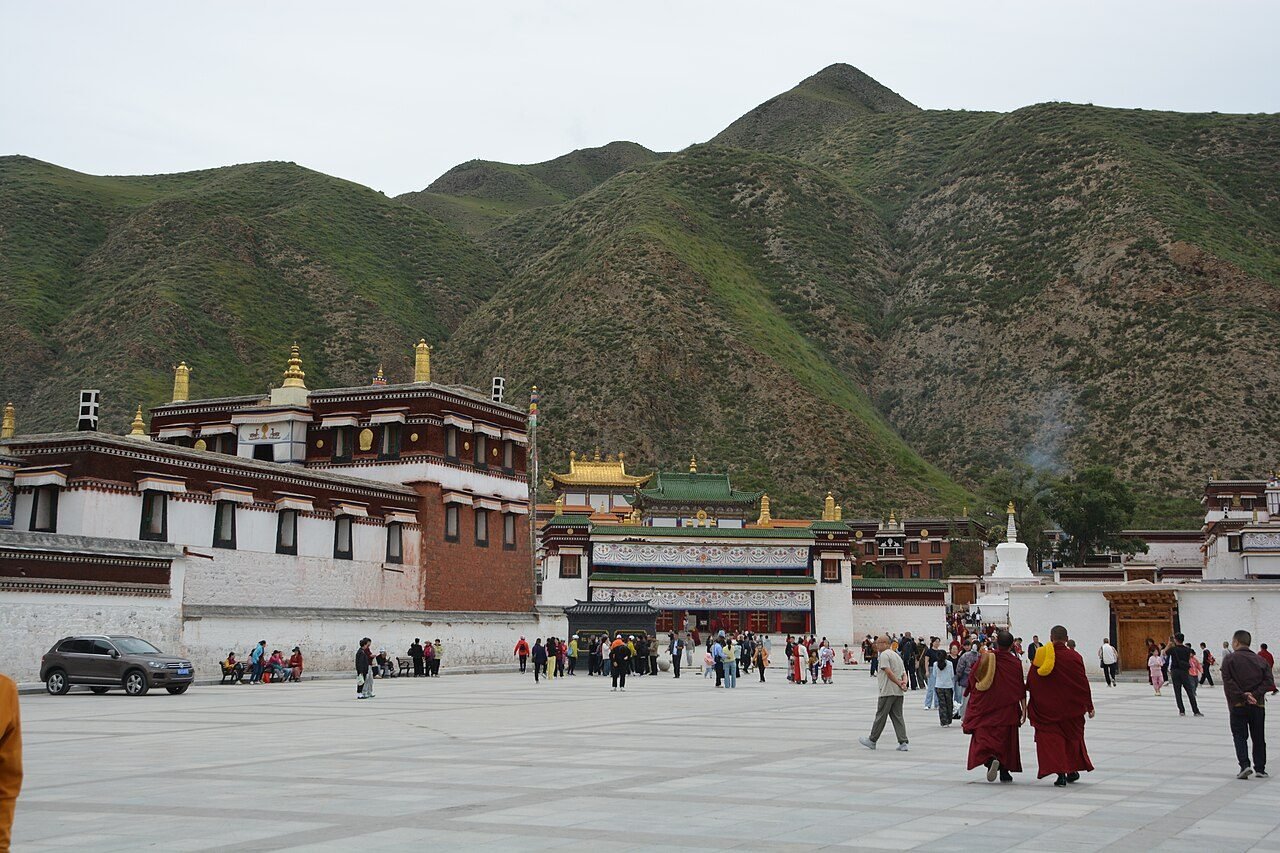
Most Chinese monastic sights are places you visit and leave. Labrang (拉卜楞寺) is not like that: the monastery is the town. Xiahe, in southern Gansu’s Gannan prefecture, grew up against the monastery walls, and the line between the religious complex and the streets of guesthouses, noodle shops, and pilgrim outfitters is barely there. I arrived on an early bus with cold air coming off the river, walked out into the square, and found myself already inside it.
Labrang is one of the six great monasteries of the Gelug school and the most important one outside the Tibetan areas proper. It is also, for a traveller, the most legible: everything happens outdoors, on a loop you can walk, at an altitude most people tolerate fine.
Founded late, built to last
Compared with the great Tibetan houses, Labrang is young. It was founded in 1709 by the first Jamyang Zhépa, Ngawang Tsondru, a monk from the Amdo region who had studied at Drepung near Lhasa and returned home with enough standing to open his own institution. That late date explains a lot about the place. It was built after the Gelug school had already consolidated power, with Mongol and local patronage behind it, and it grew quickly into a centre with six colleges rather than a single prayer hall.
The Amdo region, meaning roughly the northeastern edge of the Tibetan cultural world across parts of modern Gansu, Qinghai, and Sichuan, produced a disproportionate share of influential teachers. Labrang became the intellectual capital of that region and held the position for two centuries.
The colleges, and why they matter
Labrang runs six colleges covering philosophy, tantra, medicine, astronomical calculation, and ritual. This is not decoration. A monk entering here enrolls in one, studies a defined curriculum that may run fifteen years, and sits examinations in front of his peers, sometimes in the form of the public debating described below.
The practical effect for visitors is that the place feels like a campus rather than a church. Groups of young monks move between buildings at set hours, someone is always carrying a text or a kettle, and the courtyards between the colleges are full of ordinary errands. I like arriving mid-morning for exactly that reason.
Walking the kora
The prayer circuit is the reason many travellers come, and it deserves the reputation. A roughly 3.5 kilometre corridor runs around the whole complex, lined with well over a thousand prayer cylinders set into a continuous wooden shelter. Pilgrims spin each one as they pass, clockwise, at a pace that varies from a slow walk to a run.
Go at dawn. Between about six and eight in the morning the stream of pilgrims is dense, the light comes across the valley low and gold, and the sound of hands on wood and muttered mantras is continuous. By ten, the number of cameras rises steeply.
Joining in is straightforward: walk clockwise, spin the wheels with your right hand, keep your voice low. Nobody expects you to complete the loop, and plenty of visitors do a section and step off. It takes about fifty minutes at a normal pace and considerably longer if you stop for scenery.
The view from above
Halfway around, the circuit climbs and you get the view most photographs of Labrang are taken from: the whole white-and-gold sprawl laid out in the valley under the hills, the stream running through it, smoke from kitchens going straight up in the cold. There is a small rise rather than a formal viewing platform, and it is worth the extra ten minutes.
Inside the halls
The Great Sutra Hall is the core: a long dim building with pillars wrapped in coloured cloth, rows of low cushions, hundreds of butter lamps, and a smell I associate specifically with this place, something between beeswax, juniper, and old wool. The scale is the point. This hall was built to hold thousands of monks at assembly.
Photography inside the buildings is generally not allowed, and the restriction is not arbitrary; flash damages pigment on murals and thangkas. There are small additional tickets for some halls, sold at the door, and no consistency about which are open on a given day.
Like its sister monastery at Kumbum, Labrang is associated with butter sculpture work, and there is usually something to see in the cold months. The bigger draw in the calendar is the annual Great Prayer Festival in the first lunar months, when an enormous appliqué thangka is unfurled on a hillside above the river. Check the lunar dates carefully each year, since the whole Tibetan festival calendar is lunar and the Gregorian equivalent jumps around by weeks.
The debating sessions
On many afternoons you will find debate practice in the walled yards. If you have never seen it: one monk sits, one stands, the standing one asks a question and accompanies it with a loud clap and a stamp, then waits for the answer before pressing further. It looks aggressive on television and reads as rigorous in person. The point is to test a student’s grasp of logic under pressure in front of his peers.
Stand at the edge, keep your distance, and do not photograph without asking. Sessions are not held daily, and asking your guesthouse what time they start buys more certainty than any schedule published online.
Xiahe town: eating, sleeping, and the Hui half
Xiahe is small and easy. Guesthouses cluster near the main street and along the river, many run by Tibetan families, most with blankets thick enough for the night even in August. Prices are modest, and booking ahead matters mainly during the summer holidays.
The food splits two ways. On the Tibetan side there is the standard repertoire described in our Tibetan food notes on tsampa, yak, and butter tea: salty yak butter tea, tsampa roasted barley flour kneaded with tea, dried beef, momo dumplings, and yogurt with thick yellow cream. On the Hui side, hand-pulled noodles with clear beef broth, lamb skewers, and flatbreads, which is essentially the Lanzhou food tradition brought south.
My honest recommendation: eat Tibetan food once for the experience, then eat Hui noodles for the rest of the trip. Butter tea at altitude and in cold air is better than it sounds, but three cups a day is a commitment. The yak yogurt in town is genuinely excellent and usually served with sugar.
Getting there
There is no train to Xiahe, which is the single fact to plan around. Options are road or air.
- From Lanzhou: a few hundred kilometres by road, roughly four to five hours depending on roadworks and season. Buses leave from the south station, and a private car is faster and not much more expensive for a small group.
- From Xining: also by road through Tongren, and this is the route to take if you are coming from Qinghai Lake.
- By air: Gannan Xiahe airport serves a handful of routes, subject to change, and sits a long way from town.
Two combinations make the trip work. To the north east, Lanzhou is both the transport hub and the gateway to Bingling Temple’s reservoir grottoes. To the west and north, the Qinghai side leads to Kumbum Monastery near Xining and onward to Qinghai Lake. A ten-day Lanzhou, Xiahe, Xining, Qinghai loop is one of the better routes in western China.
| Base | Monastery | Altitude | Ease of access | Best for |
|---|---|---|---|---|
| Xiahe, Gansu | Labrang | Approx. 2,900 m | Road only, 4-5 hrs from Lanzhou | The kora, everyday monastic life |
| Xining, Qinghai | Kumbum | Approx. 2,600 m | Half hour from a major city | Art, butter sculpture, easy day trip |
| Shangri-La, Yunnan | Songzanlin | Approx. 3,300 m | Near an airport | Architecture, high plateau scenery |
Altitude, weather, and health
Xiahe sits near 2,900 metres. Most people manage it, and the usual advice applies: take the first day slowly, drink more water than seems necessary, and go light on alcohol and exertion for the first evening. If you are arriving directly from sea level rather than from Lanzhou, which itself is well under 2,000 metres, assume you will feel it on the stairs. Our page on altitude sickness above 3,000 metres explains what to watch for.
Weather swings hard. Even in July, evenings require a jacket. Winters drop well below freezing, though the light is often perfect and the monastery is quiet. Rain comes mostly in July and August. For the national seasonal picture, including Chinese holidays to avoid, see our month-by-month travel guide.
Beyond town: grassland and ruins
Sangke grassland, a short drive southwest, is where the horse-trekking and summer nomad camps sit. It is pleasant rather than dramatic, best in July when the grass is up and families have moved out to their tents. Closer still, the Ganjia area to the west has ruins and rock formations that see very few visitors.
Neither requires planning more than a day ahead, and both are easy to arrange through any guesthouse, which is how most things in Xiahe work.
Quick facts
- Location: Xiahe county, Gannan Tibetan prefecture, southern Gansu province.
- Founded: 1709 by the first Jamyang Zhépa, Ngawang Tsondru.
- Status: one of the six great monasteries of the Gelug school.
- Colleges: six, covering philosophy, medicine, tantra, and ritual disciplines.
- Kora: about 3.5 km of prayer wheels encircling the complex; walk clockwise.
- Elevation: roughly 2,900 m; expect breathlessness on stairs.
- Access: road only from Lanzhou (4-5 hrs) or Xining; small regional airport exists.
- Booking: some halls charge small extra tickets; entry prices change, check locally.
- Best months: May to October, avoiding the biggest domestic holidays.
Frequently asked questions
How long should I stay in Xiahe?
Two nights gives you a dawn kora, an afternoon inside the halls, and a half-day trip to the grassland. Three if you want to attempt tracking down a debate session, which is not scheduled daily.
Do I need a permit to visit Gannan?
No special permit is needed for Gannan or Xiahe, unlike Tibet. Carry your passport for hotel registration, which is mandatory for foreign visitors.
Can I photograph the monks?
Ask first. Outside and at a distance is usually fine, inside halls almost never, and during prayer never without permission.
Will altitude sickness be an issue?
Usually not severe at this height. Sleeping badly the first night is common and passes. Headache plus nausea plus confusion is the combination that means descend.
Is there an ATM?
Yes, several in town, and mobile payment works widely. Carry some cash for small stalls and donations.
What should I wear?
Layers. Even summer evenings are cold. Covered shoulders and long trousers are appropriate at a religious site, and shoes you can slip off help at hall entrances.
How do I get from Xiahe onward to Xining or Qinghai Lake?
By road through Tongren, either on a scheduled bus or with a hired car. Build in a full travel day rather than trying to squeeze it around other plans.
Want a Gansu and Qinghai loop that links Xiahe, Kumbum, and Qinghai Lake with realistic drive times and food worth stopping for? Send us your dates on the contact page.
Written by the ChinaTravelFood editorial team.