Mount Qingcheng (青城山) sits about 70 kilometres west of Chengdu, next to the Dujiangyan irrigation system, and it is one of the birthplaces of Taoism. People sell it as a “peaceful Taoist mountain,” and for once the marketing is not lying. I went after three days of Chengdu’s noise and spice and found the cypress forests and the quiet temples exactly the reset I needed. It is green, it is shaded, and the path up is lined with small Taoist halls where someone is always burning incense and nobody is hurrying.
Front mountain versus back mountain
Qingcheng splits into two managed areas, and the choice matters. The Front Mountain (Qianshan) is the famous one: temples, the main cable car, the historical Taoist sites, and the bulk of the crowds. The Back Mountain (Houshan) is quieter, wilder, more about forest walks and streams, with less religion and more nature. I did the Front Mountain first and liked the temples; on a second trip I did the Back and liked the silence more.
If your interest is Taoism and the famous grottoes, go Front. If you want a green hike away from people, go Back. Doing both in one day is possible but rushed, and the two areas have separate entrances and tickets.
The Taoist sites on the front
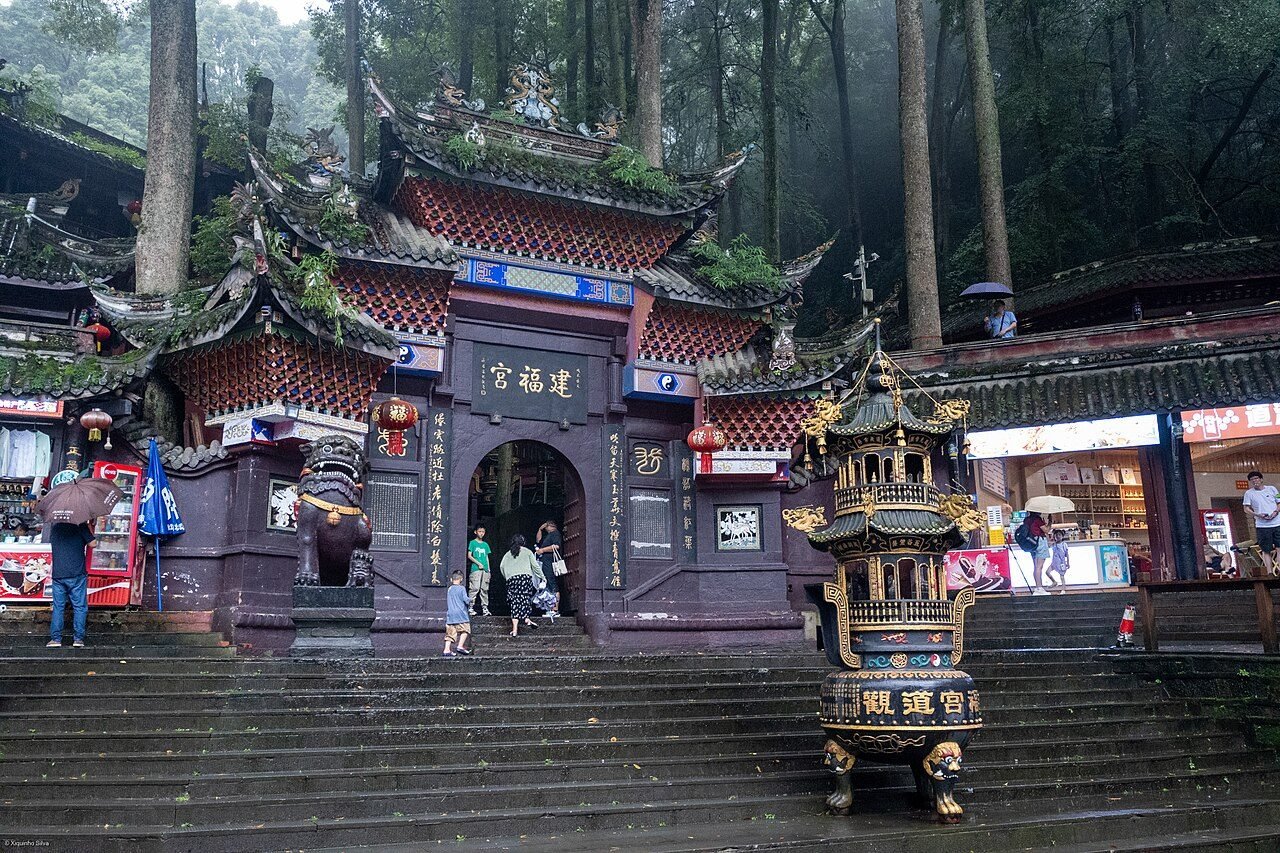
The climb starts at Jianfu Palace (建福宫) at the foot, a Ming-era temple complex in old trees. From there the path winds up through the Shangqing (Upper Clarity) Palace and the Tianshi Cave (天师洞), where Zhang Daoling, the founder of the Taoist Way of the Celestial Masters, is said to have practised. Tianshi Cave is the spiritual heart of the mountain and the most atmospheric stop, a cluster of halls built into the rock with a thousand-year-old ginkgo outside. The top, Laojun Pavilion, gives a view over the plain toward Chengdu on a clear day.
You can walk the whole front mountain or take the cable car for the upper section and walk the temples. I walked down and rode up; the descent through the cypresses is the best part.
The feel of the place
What stays with me is the shade. Qingcheng is densely planted with cypress and bamboo, so even in summer the path is cool, and the sound is water and wind rather than traffic. Taoist quietism suits the setting: the temples are not grand like the Buddhist monasteries up in Tibet, they are small, dark, and fragrant with smoke. It reads as a place people use rather than perform in.
Pairing it with Dujiangyan
The two are neighbours and the standard plan is to do both in a day: Dujiangyan in the morning, Qingcheng in the afternoon, or vice versa. A high-speed train reaches Dujiangyan from Chengdu in under an hour, and a short bus or taxi covers the last few kilometres to the mountain gate. The high-speed rail guide covers the booking, and the ticket notes matter on busy weekends.
Getting there and around
From Chengdu, train to Dujiangyan or Qingchengshan station (the latter is closer to the mountain), then a short taxi or the local shuttle to the gate. Inside, the front mountain has paved paths, steps, and a cable car; the back has longer, rougher trails. Wear proper shoes either way. The site is busy on weekends and holidays, when the cable car queue can be long, so a weekday morning is the move.
When to go
Spring and autumn are best: green and mild in spring, clear and golden in autumn. Summer is hot but the forest shade helps, and it is the rainy season, which makes the streams loud. Winter is cold and the upper paths can be icy. The mountain is close enough to Chengdu that you can pick a good-weather day rather than committing far ahead.
| Option | Effort | Crowds | Best for |
|---|---|---|---|
| Front, cable car both ways | Easy | High | Temples, less walking |
| Front, walk down | Moderate | Medium | The full atmosphere |
| Back mountain hike | Harder | Low | Forest and solitude |
| Both mountains | Long day | Mixed | Completers |
Eating near Qingcheng
The base town has Sichuan eateries and a lot of tourist restaurants selling “Taoist vegetarian” set meals, which are fine and a nice change from the meat-heavy regional default. The nearby area also does the same river fish you get at Dujiangyan. For the full regional picture, the Chengdu food guide is the reference, and if you are continuing west the panda base and the city’s museums fill another day.
What the walk actually gives you
Beyond the named temples, the path itself is the draw, and I want to be specific about why. The mountain is dense with old cypress and bamboo, and the trail is mostly flagged stone and shade, so even at busy times the soundscape is water and wind rather than engines. In the cooler months the mist sits in the lower trees and the red temple walls appear out of it like a painted scroll, which is the image most people actually keep. Bird life is rich: I watched flocks of small tits and a pair of laughing thrushes that the monks feed, and the absence of traffic lets you hear them clearly.
The back mountain is where this pays off most. With fewer temples and more forest, the trail follows a stream for long stretches, crossing it on simple plank bridges, and the only other people are walkers and the occasional farmer with a loaded shoulder pole. I spent a wet morning there with no music and no announcements, only the stream and the rain on leaves, and it was the calmest half day of a long trip. If you have energy for one side and do not care about the Taoist history, take the back.
For photographers, the early light on the front mountain is the prize, but the back in rain is the sleeper: wet stone and green read better under flat light than a blue sky does, and you get the compositions to yourself. The cable car queues by mid-morning, so ride up before nine or walk the whole way and let the coaches pass you. A word on the religion helps too: Taoism here is about harmony with the natural world and quiet self-cultivation, practised in plain robes rather than gold and drama, and the small dark halls make more sense once you read them as a retreat than as a shrine.
Quick facts
- Mount Qingcheng is a birthplace of Taoism, about 70 km west of Chengdu
- It splits into Front Mountain (temples, crowds) and Back Mountain (forest, quiet)
- Jianfu Palace, Tianshi Cave, and Shangqing Palace are the key Taoist sites
- Tianshi Cave honours Zhang Daoling, founder of the Celestial Masters school
- A cable car serves the upper Front Mountain
- Qingchengshan station is the closest high-speed stop
- Best paired with the Dujiangyan irrigation system next door
- Best months: spring and autumn
- Allow half a day for the Front Mountain, a full day for both
- Wear proper shoes; the back trails are rougher
Frequently asked questions
Front or back mountain?
Front for temples and Taoist history, back for a quiet forest hike. First-timers usually do the front. I preferred the back for the silence but missed the cave shrine.
How long do I need?
Half a day for the Front Mountain at a relaxed pace, including the cable car. A full day if you add the back or pair it with Dujiangyan.
Can I do Qingcheng and Dujiangyan in one day?
Yes, comfortably. Train from Chengdu, do one in the morning and the other after, train back. The Dujiangyan guide explains the pairing.
Is it a hard climb?
The front is moderate with steps and a cable car option; the back is a real hike. People with limited mobility should take the cable car and stick to the lower temples.
When is it least crowded?
Weekday mornings, outside the May and October holidays. The cable car queue is the bottleneck, so ride up early or walk.
What is the food like at the base?
Tourist Sichuan plus “Taoist vegetarian” set meals that are actually decent. For the real regional cooking, the Chengdu guide is the place to look.
Do I need a guide for the Taoist sites?
Not for the walk, but the history helps. Signage is limited in English, so a guide or app adds context at Tianshi Cave and the palaces.
Is it worth staying overnight?
Most people day-trip, but an overnight in the base town lets you catch the mountain at first light before the buses. The Mount Emei guide covers a bigger Sichuan sacred peak if you want to compare.
Planning a Chengdu day out
Qingcheng plus Dujiangyan is the cleanest nature-and-culture day you can pull out of Chengdu, and the train timing is the only real logistics. If you want a custom food-and-travel route that adds the panda base and the right Sichuan dinners, reach out through the contact page. We plan China routes including the Chengdu hinterland.
Written by the ChinaTravelFood editorial team.