Why Lanzhou belongs on a food trip
Lanzhou is not a pretty city and it does not pretend to be. It runs for thirty kilometres along a narrow bench of land between the Yellow River and the dry hills of Gansu, it gets cold, it gets dusty, and in winter the air can taste of coal. I keep going back anyway. Very few cities in China have organised their entire daily rhythm around a single dish the way Lanzhou has organised itself around beef noodles.
People here eat Lanzhou lamian the way Americans eat coffee: early, fast, daily, and with strong opinions about who does it properly. A shop that opens at six in the morning can be finished with its soup by one in the afternoon. Miss the window and you discover that the city has closed for lunch. This guide covers what to eat, how to order it without hesitating, which neighbourhoods are worth the taxi money, and how much you should expect to pay. Prices are what I paid in 2024; assume they have drifted and check at the counter.
Beef noodles: how to order like you have done it before
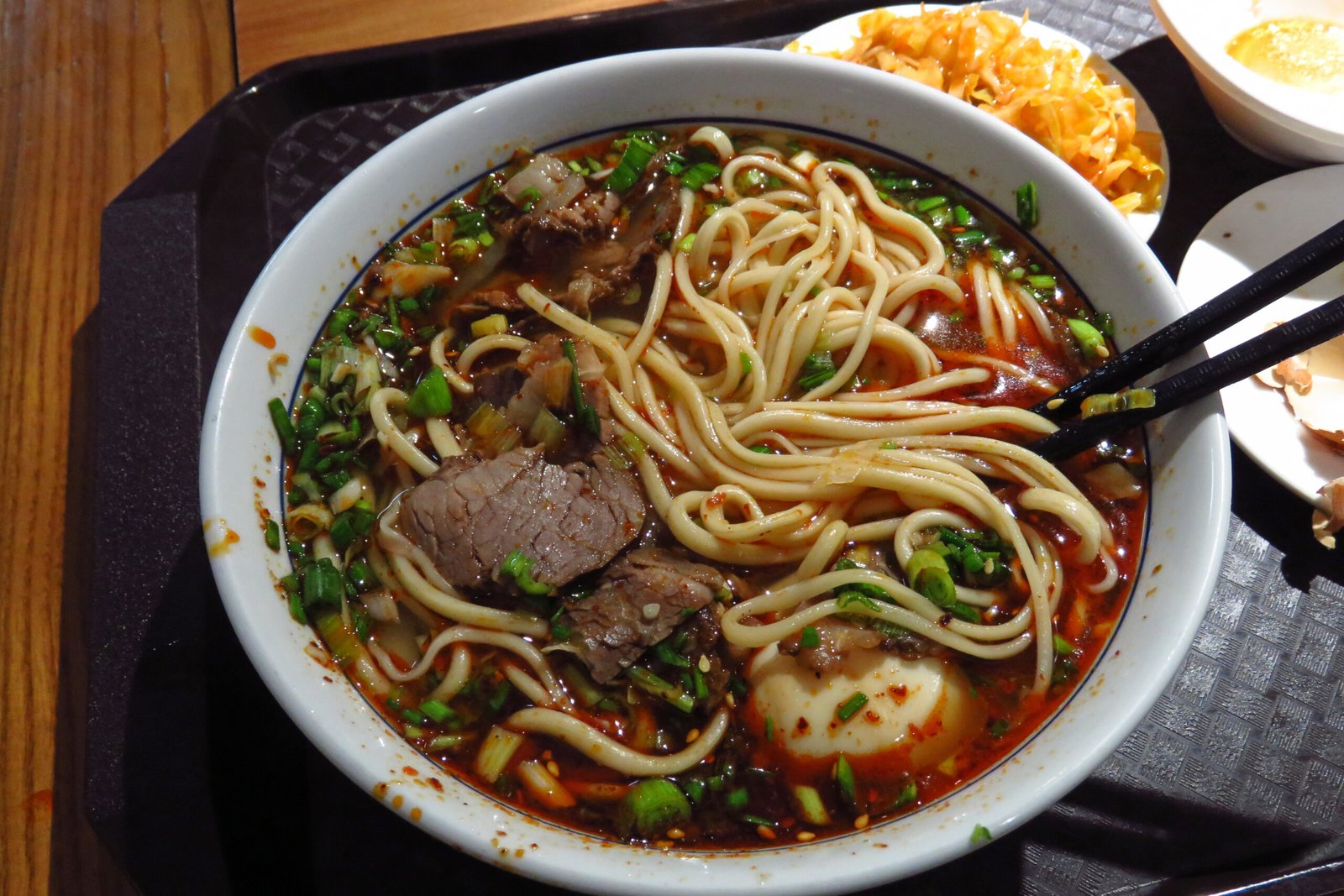
The dish is called Lanzhou lamian (兰州拉面), or niurou mian, beef noodles. Every shop repeats the same five-part formula, which locals recite as yi qing, er bai, san hong, si lü, wu huang: one clear, two white, three red, four green, five yellow. The soup is clear, the radish slices are white, the chili oil is red, the coriander and garlic sprouts are green, and the noodles are yellow. If a bowl arrives that breaks two of those rules, you are in the wrong shop.
You order at the counter or the window, pay first, get a paper chit, then hand it to the man pulling dough at the cauldron. This is the part travellers freeze on. He will ask how thick you want the noodles, and the answer should come out immediately.
The noodle thickness options
There are more options than any first-time visitor can absorb, and the shop will not wait while you think. Here is the useful subset:
| Chinese term | What you get | Notes for visitors |
|---|---|---|
| 毛细 (maoxi) | Capillary thin, almost vermicelli | Drinks up soup, goes soft fast. Order it if you like that; do not order it if you photograph your food |
| 细 (xi) | Thin round | The safe default. Standard and forgiving |
| 二细 (erxi) | Slightly thicker round | What a lot of locals actually ask for. More chew |
| 韭叶 (jiuye) | Flat, “chive leaf” | My own preference. Catches chili oil better than round strands |
| 宽 / 大宽 (kuan, dakuan) | Wide and extra wide ribbons | Filling, heavy, good in cold weather |
| 荞麦棱 (qiaomaileng) | Buckwheat ridge, triangular | Worth trying once for the texture |
If all else fails, say “erxi” and move along. Nobody is grading you.
The five details that decide whether a bowl is good
You can judge a shop in about four seconds once you know what to look at. The broth should be genuinely clear, meaning you can see the bottom edge of the bowl, because the kitchen has spent hours skimming beef bones and aromatics rather than reaching for stock powder. The chili oil should sit on top in its own red layer, not be stirred in, and should smell roasted rather than raw-hot. The radish should be translucent, almost pickled. The coriander and minced garlic sprouts should be piled generously, not rationed. And the beef itself, sliced thin and simmered separately, is what you pay extra for.
A standard bowl with only a few token cubes of beef cost me between 8 and 12 yuan in 2024. Adding a proper portion of sliced beef (“jia niurou”) roughly doubled it. I always pay for the meat. Without it you are eating excellent noodles and missing most of the point.
Which shops to try, and the arguments about them
Asking two Lanzhou residents which shop is best will get you two confident, incompatible answers, usually along family rather than quality lines. I have eaten my way through the well-known names and the small unmarked places, and the honestly useful distinction is not famous versus unknown. It is whether a shop still closes when the soup runs out.
Mazi Lu (马子禄) is the name that gets printed in guidebooks, and it is decent, busy, and reliable. But if I am staying near the river I will usually walk to somewhere like Mogouyan (磨沟沿) or a smaller street shop instead, because the queue at the famous one can eat your morning. Wumule’s penghui style noodles have a following for a reason: the dough has a distinctive spring.
My actual advice is to pick whichever shop near your hotel has a line of locals at 7am and nobody holding a menu with photographs. In Lanzhou that heuristic has never failed me once, and it has saved me from every tourist-priced bowl.
Timing matters more than the shop
This surprises visitors. Lanzhou beef noodle shops are largely a breakfast and early lunch business. Many open between 5:30 and 6:30 in the morning, hit their peak before 9, and shut somewhere between noon and 2pm. A handful stay open all day, but they are the exception, and the soup is usually freshest on the early side. If you want to eat noodles at 8pm you are looking for a different kind of restaurant entirely.
Beyond the noodles: the rest of a Lanzhou table
Fixing exclusively on beef noodles is like visiting New Orleans for the coffee. The city has a whole second tier of food, much of it shaped by its large Hui Muslim community, and most of it costs less than a bowl of noodles.
Niangpi and cold plates
Niangpi (酿皮) is the dish I order second in Lanzhou, especially in summer. It is made by washing wheat starch out of dough, steaming the starch into sheets, then cutting those sheets into chewy ribbons and dressing them with sesame paste, chili oil, black vinegar, garlic water and a little mustard. The result eats cold, tastes sour-spicy-nutty, and costs pocket change. Look for vendors advertising gaodan niangpi, a thicker, more sesame-forward local style.
Alongside it you will see cold noodles (liangmian), various soy and wheat gluten preparations, and plates of braised offal. Order two or three and share.
Sweet things: huidouzi, tianpeizi, and milk egg laozao
Lanzhou’s sweet course is strange and excellent. Huidouzi (灰豆子) is grey peas, usually described as麻豌豆, simmered for hours with alkali until they collapse into a soft porridge sweetened with sugar and sometimes jujube. It is served warm and it tastes like Chinese red bean soup’s earthier cousin.
Tianpeizi (甜醅子) is fermented highland barley, served as grains in a lightly alcoholic sweet liquid, cold. On a hot afternoon this is the most refreshing thing in the city.
And there is milk egg laozao (牛奶鸡蛋醪糟): milk heated with fermented rice wine, an egg beaten into it, then topped with sesame, raisins, peanuts and goji berries. It is rich, slightly sour, slightly boozy, and it is absolutely the thing to drink while walking a cold night market. I have also had it mixed with tianpeizi, which I recommend.
Night markets and skewers
Zhengning Road (正宁路) is the night market that everybody names, largely because television got there first. It still works. Vendors work the length of the lane with skewers, offal, grilled bread, and enormous pots of the milk egg laozao described above, and the crowd is a real mix of locals and out-of-towners. Go around 8pm, expect to shoulder through, and carry small cash or have Alipay set up before you arrive.
Dazhong Lane (大众巷), closer to Zhongshan Bridge and the riverfront, has been turned into a food street in its own right and is easier to navigate if you want somewhere to sit. Street markets in Chinese cities get reorganised by the authorities fairly often, so treat specific stall names as provisional and ask your hotel where people are eating this month.
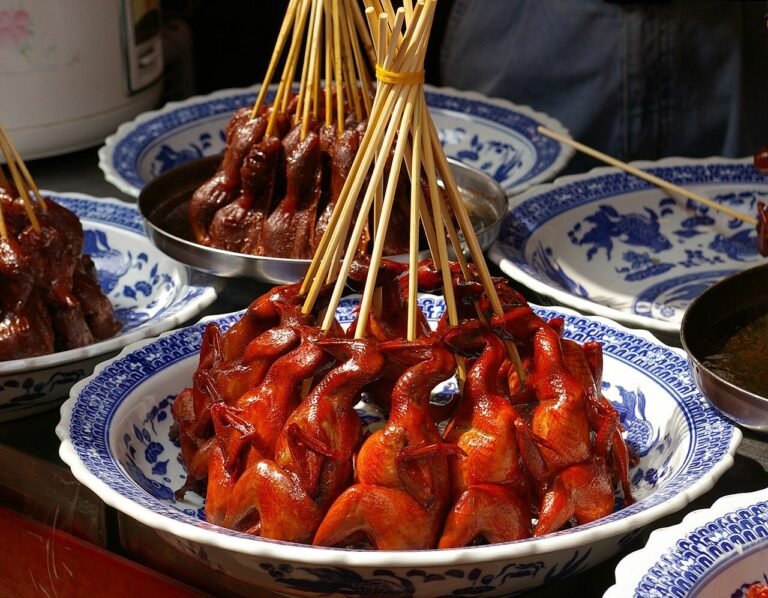
Then there is the grilled meat. Northwest Chinese BBQ is cumin-forward in a way skewers in the south are not: lamb fat, coarse cumin, chili flake, salt, and smoke from a charcoal trough. Handfuls of skewers and a bottle of a local beer is a completely reasonable dinner. If you want something more substantial, order hand-grabbed mutton (shouzhua yangrou) or a bowl of yangzasui, an offal soup that is far better than it sounds.
A practical day of eating
Here is the day I would hand a friend visiting for 24 hours. It is built around the fact that the best things here are eaten early and cheaply.
| Time | What to do | Rough cost (2024) |
|---|---|---|
| 6:30-8:00 | Beef noodles at any crowded neighbourhood shop. Add beef. Add a plate of pickled radish or cold vegetables | 15-25 yuan per person |
| 9:30-11:30 | Gansu Provincial Museum for the Silk Road galleries and the bronze galloping horse. Free, but reserve the day before | 0 yuan |
| 12:30 | Niangpi plus a cold noodle or wheat gluten plate at a small shop; keep it light | 10-20 yuan |
| Afternoon | Walk the riverside, cross Zhongshan Bridge, take the cable car up to Baita Shan for the view back over the city | 50-100 yuan including cable car |
| 18:30 | Dinner proper: hand-grabbed mutton, or a hot pot built around local ingredients | 70-150 yuan per person |
| 20:30 | Skewers and milk egg laozao at Zhengning Road or Dazhong Lane | 30-60 yuan |
What this table gets wrong is appetite. Lanzhou portions are not small. If you are travelling as a pair, consider ordering one bowl and one plate per stop rather than two full bowls, and you will make it to the night market.
Getting there and using Lanzhou as a Silk Road base
Practical details worth pinning down before you book, all of which should be confirmed against official timetables and your own consulate’s guidance in the year you travel:
- High-speed trains connect Lanzhou to Xi’an in roughly three hours and to Xining in about one, which makes the city a natural hinge between eastern China and the western corridor.
- Lanzhou Zhongchuan International Airport sits around 70km north of downtown. There is a rail link and plenty of coaches; allow real time for either.
- Beijing Jiao (railway-style) and intercity connections continue west towards Zhangye and Dunhuang. If you are heading to Mogao Caves, Lanzhou is a reasonable first stop rather than a throwaway transfer.
- Xiahe and its Labrang Monastery sit within day-trip-to-overnight range by road, though check current road and access rules before committing.
- Altitude is around 1,520 metres. Most people are fine. If you have just flown in from sea level and plan to climb anything, take the first day easy.
Getting around inside the city is straightforward. There is a metro, buses are cheap, and taxis are easy to flag, but note that the city’s long ribbon shape means a “short” trip across town is not short. Budget twenty minutes more than the map suggests, and have the metro and payment apps installed before you arrive rather than figuring them out at the turnstile.
Prices, seasons, and honest warnings
Lanzhou is one of the cheapest cities on any serious China food route. On around 100 to 150 yuan a day per person you eat extremely well, including the sit-down dinners and plenty of skewers. Halal food is everywhere and easy to find; travellers with dietary requirements who normally struggle in China often find the northwest straightforward, and it pairs naturally with the halal route across Xi’an and Xinjiang.
Two warnings. First, air quality: Lanzhou gets dust in spring and inversions in winter, so if you have respiratory issues check conditions before committing to long walking days. Second, temperature swings. The city sits high in dry continental country, so a September day can start at 8C and hit 25C. Layers, always.
As for season, I would take October, when the riverbanks are full of locals drinking tea and the produce is good, or early summer for niangpi and cold plates. Deep winter has a certain grim appeal if you like sitting in a hot noodle shop watching frost on the windows, which I do.
Quick facts
- Signature dish: Lanzhou beef noodles, Lanzhou lamian, built on the “five clear colours” formula
- Must-order move: specify noodle thickness; default to erxi or jiuye
- Typical bowl price in 2024: roughly 8 to 12 yuan plain, double that with extra beef
- Eating window: most noodle shops are breakfast and lunch only, closing early afternoon
- Second dishes: niangpi cold starch ribbons, hand-grabbed mutton, cumin skewers, sweet fermented barley
- Night markets: Zhengning Road for crowds and laozao; Dazhong Lane for something calmer near the river
- Free best thing: the Gansu Provincial Museum’s Silk Road collection
- Daily food budget: about 100 to 150 yuan per person, and that includes good dinners
- Altitude: roughly 1,520 metres
Frequently asked questions
Are Lanzhou noodles the same as the “hand-pulled noodles” I get at home?
Sometimes, but often not. Restaurants abroad frequently borrow the name without the technique, the beef broth, or the five-part formula. Real Lanzhou noodles are pulled to order by a visible cook, served in a clear beef broth rather than a soy-dark soup, and finished with chili oil and radish rather than stir-fried sauce.
Do I need to speak Chinese to order?
A little helps, and mostly it is two or three sounds. Learn the thickness word you want, learn “jia niurou” for extra beef, and point at things. Most shops operate on volume and speed, so staff will happily gesture you towards the options. Downloading an offline phrase list before you fly is worth twenty minutes of your prep.
Is the food halal?
Much of it is, given the city’s Hui population, and 清真 (qingzhen) signs make this easy to identify. But Lanzhou is not uniformly halal, so read the signs rather than assuming. Travellers looking for a coordinated plan can build Lanzhou into the broader Silk Road food route where halal eating is the norm.
Can vegetarians eat well here?
Better than you might expect, worse than in Sichuan. Niangpi contains no meat, there are bean curd and wheat gluten plates, plenty of breads, and the sweets above are all meat-free by default. The difficulty is broth, since almost every noodle bowl is built on beef. Ask directly and be prepared for some places to have nothing.
How many days should I spend in Lanzhou?
Two nights is honest: one full eating day plus the museum, and either a morning for the second round of noodles and Baita Shan, or a launch point west. If you are pushing straight to Dunhuang or Xiahe, one very early night still gets you two noodle breakfasts, which I think is the minimum acceptable version of the trip.
Where is the best place to eat breakfast noodles near the river?
Rather than name one address that may have moved by publication, use the crowd test. Walk out of your hotel around 7am and go to the nearest shop with people standing and locals queueing with their own containers for takeaway. In Lanzhou, the takeaway-bucket crowd is the strongest quality signal I know.
Should I visit the Yellow River sculpture and Zhongshan Bridge?
Yes, but as an appetite-builder rather than a headline attraction. Walking the riverbank at dusk, then heading up into the food streets, is exactly how the city wants to be used. Thirty minutes for the bridge and the Yellow River Mother statue is plenty.
What should I skip?
I would skip the restaurants with English menus printed in colour and photographs of every dish. They are not always bad, but they are consistently worse value than the place two doors down with one handwritten list. I would also skip trying to eat four bowls of noodles in a day. Spread it out and eat the other stuff.
Planning your own route through northwest China
Lanzhou works best as part of a chain rather than a destination flown in and out of in isolation. A sensible loop runs east from Xi’an’s Muslim Quarter, through Lanzhou, and then west along the Hexi Corridor, gaining altitude and aridity as you go. The food changes visibly across that line: wheat replaces rice, cumin replaces ginger, and mutton becomes the default centre of the plate.
If you are piecing together a personalised route and want help sequencing the train legs, restaurant stops and seasonal timing, get in touch through our contact page and tell us which cities and how many days. We build these itineraries around breakfast schedules and market days, not just hotel nights.
Written by the ChinaTravelFood editorial team.