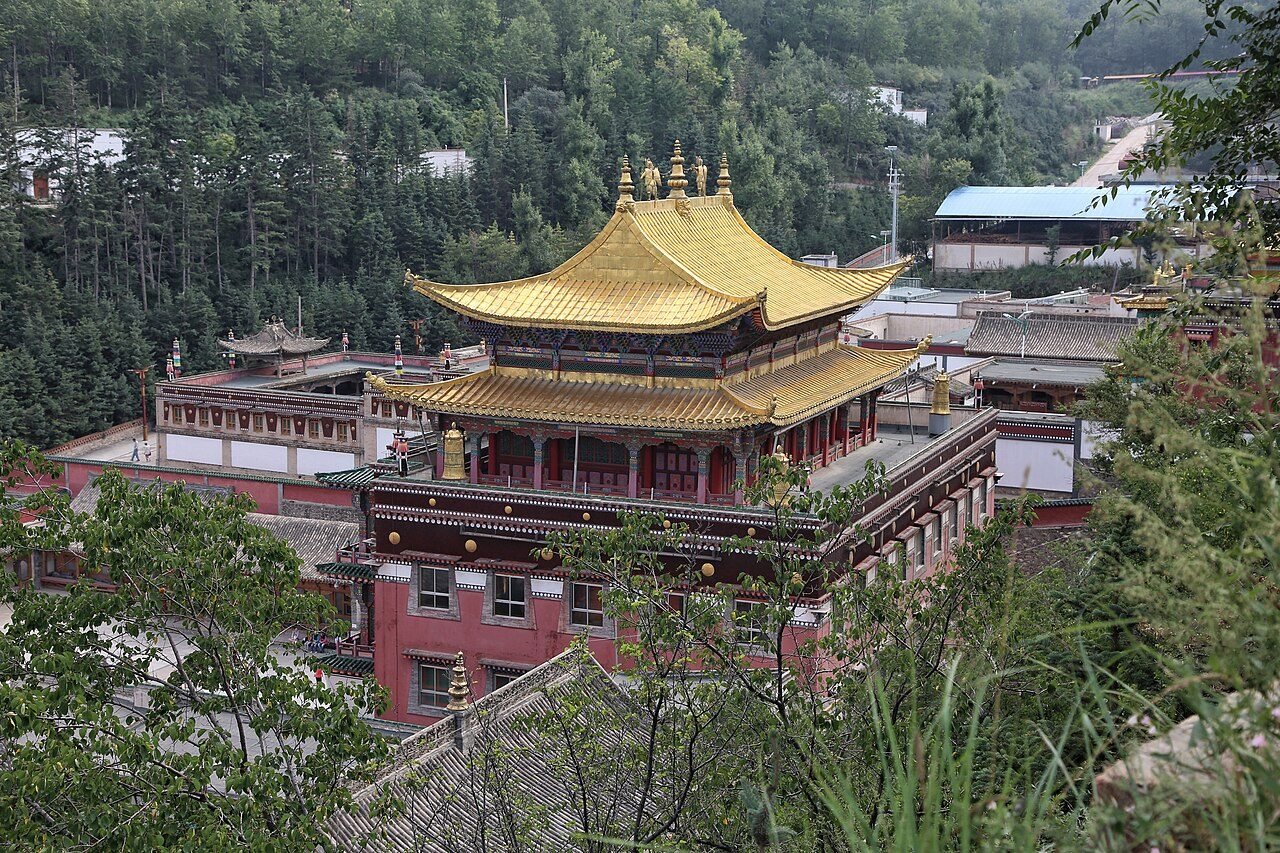
The approach to Kumbum Monastery tells you what kind of place it is before you buy a ticket. Twenty-five kilometres southwest of Xining, in the farming and herding country of Huangzhong county, the road fills with Tibetan pilgrims walking the last stretch in their good clothes, some of them having come from Qinghai’s pasture districts and further. It is not a museum dressed up as a monastery. Roughly four hundred monks live here, the prayer halls work every day, and visitors are the minority inside them.
Kumbum is also known by its Chinese name Ta’er Si (塔尔寺), and the two names describe the same thing from two traditions: a Gelug Buddhist monastery built up around the birthplace of Tsongkhapa, the fourteenth-century reformer whose school came to dominate Tibetan Buddhism and whose two most famous disciples became the Dalai Lama and the Panchen Lama.
The Tsongkhapa story, briefly
Tsongkhapa was born here in 1357. The legend, which the monks tell without embarrassment, says that when he was born the afterbirth fell to the ground and a sandalwood tree grew from that spot, each leaf bearing the image of a buddha. His mother later built a small stupa over the tree, in 1379, and that stupa became the seed of everything around it. The name Kumbum means something like “a hundred thousand images,” referring to those leaves.
The monastery itself was founded in 1560, so nearly two centuries separate the birth from the institution. That gap is normal in Tibetan religious geography: a holy spot collects a chapel, the chapel collects monks, and eventually it collects a monastic university with its own colleges, debating courtyards, and abbot.
What you need to know beyond that is simple. Kumbum is one of the six great Gelug monasteries, it came through the twentieth century better than many in this region, and it remains a working centre rather than a restoration project. Its role in the Tibetan world is closer to a university town than to an attraction.
What you see, and the order I’d take it in
You enter past a row of eight white stupas standing in a line along the front. They were built in 1776 and commemorate eight events in the Buddha’s life. They are also the most photographed object at Kumbum, which is slightly unfair to everything behind them.
From there the site climbs a low hillside in a spread of whitewashed walls, courtyards, and golden roofs. Nothing is linear, so here is how I do it: follow the main path up, keeping left as pilgrims do, then come back down through the lower courtyards. The stops worth your time are below.
The Great Hall of the Golden Tiles
This is the building with the genuinely expensive roof. Tibetan monasteries spend money on roofs and interiors rather than facades, and this one signals its importance from across the compound. Inside are images of Tsongkhapa, rows of butter lamps, and the dim, smoky, juniper-and-wax atmosphere that makes every lit face in the room look deliberate. The gilding is real, historically funded by local patrons and Mongolian donors.
The butter sculptures
This is what people come asking about, and the thing most often oversold. Kumbum is famous for figures modelled from yak butter mixed with pigment and kept cold so they hold their form. Monks work through the coldest months building enormous coloured reliefs of deities, flowers, and even whole temple facades, and these are displayed during the Great Prayer Festival around the lunar new year. That is the most spectacular time to see them and also the coldest.
On an ordinary day you may find smaller examples in a display hall rather than the festival pieces. I have been there in August, when the display was modest and hot afternoons were the problem, and in January when the courtyard smelled of cold butter and the panels were extraordinary. Plan for that difference if the sculptures are your reason for coming.
The debate courtyard
On afternoons when the schedule runs, younger monks gather in a walled yard to debate. One sits, another stands over him clapping a hand down to punctuate each point, firing questions about logic and doctrine in short bursts. It looks like an argument because it is one, formalised into a training method. Do not photograph it without asking, and do not walk through the middle. I once watched for forty minutes without understanding a word and still came away with a sense of how much these students care about precision.
The Three Marvels
Signs refer to Kumbum’s three marvels: butter sculpture, mural painting, and appliqué embroidery known as duixiu. All three are made on site. All three are fragile. The last two hang in halls where photography is barred, and both deserve longer than you expect to give them. The appliqué, built up in layered silk until it stands off the wall in low relief, is a technique I have not seen executed at this scale anywhere else on the plateau.
How to behave without feeling awkward
Go clockwise. Prayer wheels, circumambulation corridors, and the general flow of people all follow the sun’s direction, so going with it is simply easier than arguing with traffic.
Remove hats and sunglasses in the halls, keep your voice down, and do not point a finger at a statue or a person. Photography indoors is restricted; treat a no as a no. Small cash offerings in a donation box are welcome, and stalls near the entrance sell butter oil and scarves if you would rather offer something with a bit of tradition attached.
The one thing I ask every visitor to remember: the pilgrims are not scenery. They are doing something difficult and personal. I have watched people lean into a prostrating pilgrim’s frame to get a photograph, and it remains the rudest thing I see regularly at Tibetan sites.
Getting there from Xining
Xining is the provincial capital at around 2,260 metres, with an airport, high-speed rail links, and a large Hui Muslim population. The monastery sits in Huangzhong, roughly a half hour southwest on decent road. You can reach it by public bus from the city, by shared taxi, or by private car. A private round trip with waiting time costs a few hundred yuan, which for two or three people is the sensible option.
Entry covers most courtyards, with a few halls ticketed separately, and prices move with the season, so read the official board at the gate rather than trusting whatever a driver quotes in the car park. An hour and a half covers the site at a steady pace. Three hours if you sit in the debate yard.
Altitude and what it actually does to you
Xining is a reasonable first stop on the plateau and the monastery is only slightly higher. Most visitors notice nothing worse than mild breathlessness on stairs. If you have flown in from sea level and plan to push on to Qinghai Lake or toward Tibet, two nights in Xining first is sensible. Our notes on altitude sickness at plateau levels set out which symptoms deserve a descent and which deserve a cup of tea and a slow day.
Combining Kumbum with the rest of Qinghai
Xining is the hinge of every Qinghai trip, and the pairings are obvious once the map is open. To the west lies Qinghai Lake, the country’s largest lake, ringed in July by rapeseed fields that put a yellow border on the shoreline. Beyond it, Chaka Salt Lake does its sky-mirror trick in calm conditions, which is dramatic and completely at the mercy of wind nobody can schedule.
To the southwest, over the Gansu border at Xiahe, sits Labrang Monastery, the other great Tibetan house of study and the one with the longest prayer corridor. Seeing both makes for a fair comparison, and they differ enough that neither makes the other redundant: Kumbum is compact, artistic, and close to a city. Labrang is larger, colder, and feels more like a university.
| Monastery | Nearest base | Known for | Feel |
|---|---|---|---|
| Kumbum (Ta’er Si) | Xining, Qinghai | Tsongkhapa’s birthplace, butter sculpture | Busy, artistic, many pilgrims |
| Labrang | Xiahe, Gansu | Long kora, six colleges | Remote, cold, scholarly |
| Songzanlin | Shangri-La, Yunnan | Hilltop complex, high plateau | Rebuilt, very photogenic |
Eating around Xining
Xining is one of the easiest cities in China to eat well in if you like meat and dairy. It is substantially Hui Muslim, so halal lamb is everywhere: hand-pulled noodles, mutton soup, skewers, flatbreads, and the kind of fresh noodle work you find across the northwest. Tibetan cooking brings a different table again: butter tea, tsampa, dried beef, and yogurt under a layer of yellow cream that I think about more than I expected to before trying it.
Near the monastery, small shops sell yogurt in clay pots under a sugar crust, and it is worth the stop. My routine after a visit is noodles at a Xining night market, and it has never let me down.
When to go
May through September is comfortable, with July and August the busy months for both pilgrims and domestic holidays. Winter has two arguments for it: the butter sculpture work happens in the cold months, and the crowds evaporate. January is punishing outdoors and the monastery is at its most itself. Our month-by-month travel guide gives the national picture, though the plateau always runs cooler than the calendar suggests.
Quick facts
- Location: Huangzhong District, roughly 25 km southwest of Xining, Qinghai.
- Chinese name: Ta’er Si. Kumbum means roughly “a hundred thousand images.”
- History: a stupa over Tsongkhapa’s 1357 birthplace in 1379; monastery founded 1560.
- Community: several hundred monks in residence; an active Gelug institution.
- Signature arts: yak butter sculpture, murals, layered silk appliqué.
- The row of eight white stupas at the entrance dates to 1776.
- Elevation: Xining near 2,260 m; the monastery a little higher.
- Time: one and a half hours at pace, three if you linger.
- Best butter sculpture displays fall around the lunar new year.
Frequently asked questions
Is Kumbum a working monastery or a tourist site?
Both, honestly. Several hundred monks live and study here, and it is also the busiest single attraction in Qinghai. Walk past the front courtyards and the working life takes over quickly.
How do I get there from downtown Xining?
Bus, shared taxi, or private car, about half an hour each way. A private car with waiting time costs a few hundred yuan and is the least stressful choice for a small group.
Can I take photographs?
Generally yes outdoors, generally no inside the halls, where the rule protects pigment and textile. Always ask before photographing people, especially pilgrims.
Do I need a guide?
Optional. A guide helps with doctrine and history, and English guiding is available but uneven. With decent signage and this page, most people manage fine on their own.
Will the altitude affect me?
Usually not badly at this elevation. Expect mild breathlessness on stairs. If you are heading higher afterward, spend two nights in Xining first.
When are the butter sculptures displayed?
Around the fifteenth day of the first lunar month, typically February or early March. Check dates each year, because the lunar calendar moves.
Is it suitable for children?
Yes, with the caveat that it involves a lot of steps and uneven stone. The butter sculptures and the debating sessions hold their attention better than the halls do.
Want a Qinghai route that links Kumbum, Qinghai Lake, and Xiahe with realistic drive times and good eating at each stop? Send us your dates on the contact page.
Written by the ChinaTravelFood editorial team.