Shanghai eats in layers
Shanghai food is not one cuisine, it is a stack of them. At the bottom is benbang (本帮), the local cooking of the Jiangnan river mouth, known for dark, sweet-savory red-braised dishes and a heavy hand with oil and soy. On top of that sits the food of migrants from every province who came to the boomtown, and above that the international layer of cafes and brasseries left by the foreign concessions and revived in the last twenty years. When I eat in Shanghai I move between all three in a single day, and that range is the city’s real draw.
This guide covers what to seek out, where the locals actually line up, and how to balance the famous soup dumplings against the quieter local dishes. For the dim sum side of the wider region, our dim sum guide explains the Cantonese tradition that also thrives here.
The icon: xiaolongbao
No Shanghai food talk starts anywhere but the xiaolongbao (小笼包), the steamed soup dumpling with a pocket of hot broth inside. The proper way is to lift it with a spoon, nibble the top, sip the soup, then eat the rest dipped in black vinegar with ginger. The classic version is pork; the crab-and-pork one appears in autumn when the hairy crab is in season. I have eaten them in the tourist halls of the old town and in a Nanxiang branch that was packed with locals, and the local-packed room was the better bowl.
The folding technique and the broth cube are specific enough that our xiaolongbao guide is worth a read before you order, so you do not burn your chin on the first bite like I did.
The street bun with a crust: shengjian
If xiaolongbao is the famous one, shengjian (生煎) is the one locals actually eat for breakfast. These are pork buns pan-fried bottom-down in a flat pan, so you get a crisp base, a soft top, and the same juicy filling. A row of four costs about 10 yuan and they are sold from specialist shops with a constant queue. I treated a shengjian stall near my hotel as a daily ritual; the trick is to eat them slightly cooled so the soup does not scald.
Benbang: the dark and the sweet
The local restaurant cooking is built on hong shao (red-braising): pork belly, fish, and tofu simmered in soy, sugar, and rice wine until glossy and dark. The signature is hong shao rou (red-braised pork), fatty and sweet in a way that shocks first-timers from leaner cuisines. I came to love it with a bowl of plain rice to cut the richness. Another benbang standout is “oil-blasted shrimp” (you bao xia), tiny river shrimp quick-fried and sweet.
For the sweeter, broth-lighter southern style that influences Shanghai, the Cantonese cuisine guide explains the freshness-first logic that competes with benbang on the city’s tables.
Noodles and the humble bowl
Shanghai does a mean scallion-oil noodle (cong you mian), a cheap dry noodle tossed in fragrant oil rendered from scallion and a little soy. It is a worker’s lunch, about 12 yuan, and one of the most satisfying things in the city. The wider soup-noodle culture is covered in our Chinese soup recipes piece, because the broths here run lighter than the red-braised mains.
Hairy crab and the autumn crush
From roughly September to November, the city turns to da zha xie (hairy crab), the mitten crab from the Yangtze lakes, eaten steamed with a side of aged vinegar and ginger. It is a ritual more than a meal: small, fiddly, and prized for the roe. I tried it once at a friend’s table and understood the fuss even if the yield is low for the effort. If you are in town in autumn, do it once at a proper crab restaurant rather than the tourist sets.
Where to eat: a neighborhood table
| Area | Best for | Vibe | Price |
|---|---|---|---|
| Old Town (Yu Garden) | Xiaolongbao, tourist halls | Crowded, classic | Mid |
| Jing’an / former French Concession | Cafes, fusion, mid restaurants | Stylish, walkable | Mid to high |
| Huanghe Road | Red-braised local classics | Old-school, lively | Mid |
| Street corners anywhere | Shengjian, noodle bowls | Fast, local | Low |
| Yuyuan snack alley | Grab-and-go bites | Touristy graze | Low to mid |
The cafe layer
Shanghai’s coffee scene is the best in mainland China, a holdover from the concession era that boomed again in the 2010s. The former French Concession has independent roasters where a flat white costs what it would in Brooklyn, and the people-watching is part of the product. Our China coffee culture piece tracks the neighborhoods worth a detour, but the short version is: skip the chain, find the corner roaster, sit by the plane trees.
Street food and late nights
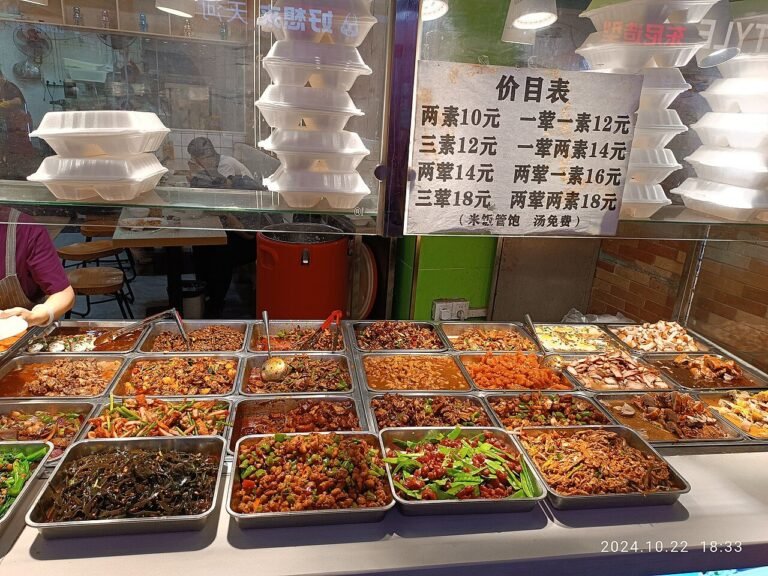
For the all-city snack map, our Chinese street food guide covers the skewers, the stinky tofu, and the sweet potato vendors that come out after dark. Shanghai’s night food is tamer than Chengdu’s but the late noodle shops and the congee stalls are reliable. I liked the small “great cold dish” counters where you point at a tray of prepared salads and get a plate for a few yuan.
Red-braised pork, up close
Hong shao rou is the dish that defines benbang for better and worse. The good version is pork belly cut in squares, simmered in a mix of soy, Shaoxing wine, and sugar until the fat turns translucent and the sauce reduces to a glossy coat. The sugar is not there to sweeten so much as to balance the salt and build the lacquer, but the result reads sweet to an untrained palate, which is why first-timers either love it or push it away. I land in the love-it camp, eaten with plain rice to mute the fat. The same technique shows up on fish and tofu across the city, so once you understand the sauce, you recognize it everywhere.
Vegetarian and the temple table
Shanghai’s Buddhist temples run some of the best vegetarian kitchens in the country, turning soy, mushroom, and gluten into convincing mock meats that taste good on their own terms rather than as imitations. The Jing’an and Jade Buddha temples are the well-known ones; a temple lunch there is cheap, calm, and a useful counterpoint to the rich benbang food. I went expecting a compromise and left full and surprised. For travelers who avoid meat, this is the most reliable high-quality option in the city, and the dishes often echo the red-braised logic of the local style without the pork.
Sweets and the western edge
Shanghai has a sweeter tooth than most of China, from the sticky “pear syrup candy” stalls to the French-influenced pastries of the old concessions. The local “bai tang” hawthorn sticks and the sesame candies are the street end; the indie bakeries of the former French Concession are the borrowed end. I would not build a meal around the sweets, but a mid-afternoon pastry with the city’s good coffee is a fine way to break a day of heavy eating. The coffee culture guide points to the roasters worth the stop.
Quick facts
- Shanghai stacks three food layers: local benbang, migrant regional, and international cafes.
- Icon dish: xiaolongbao soup dumplings, eaten with vinegar and ginger.
- Local breakfast: shengjian pan-fried buns, about 10 yuan for four.
- Benbang style is dark, sweet-savory red-braised (hong shao).
- Autumn brings hairy crab season, roughly September to November.
- Best coffee in mainland China, concentrated in the former French Concession.
- Scallion-oil noodles are the cheap, perfect lunch at ~12 yuan.
Frequently asked questions
What is the one Shanghai dish I must try?
The xiaolongbao, at a local-packed house rather than the old-town tourist halls. After that, a bowl of scallion-oil noodles and a shengjian breakfast round out the real city. The red-braised pork is the sit-down splurge.
Is Shanghai food sweet?
The local benbang cooking is noticeably sweet next to northern or Sichuan food, because sugar balances the soy in the red-braising. Not dessert-sweet, but a Southern glaze. If you prefer savory, the migrant regional places and the Cantonese spots tone it down.
Where do locals actually eat?
Corner shengjian shops, the noodle counters, and the older dining streets like Huanghe Road for red-braised classics. Tourists cluster at Yu Garden; locals go a few blocks past it. Follow the queue, not the signage.
When is hairy crab in season?
About September through November, peaking in late autumn. It is a splurge and a fiddle, best done at a proper crab restaurant once. Outside that window, skip it; the frozen versions are not the same.
Is Shanghai good for vegetarians?
Better than the north. The Buddhist temple restaurants (the Jing’an and the Jade Buddha area) do excellent vegetarian banquets, and the scallion-oil noodle is meat-free if you confirm the oil. Many red-braised dishes use pork stock, so ask.
How much should I budget for food?
Street and noodle meals run 10 to 30 yuan; a benbang dinner for two at a mid place is 150 to 250 yuan; the fancy xiaolongbao halls and crab dinners climb higher. Coffee is the one Western-priced item, 30 to 45 yuan a cup at indie roasters.
When should I visit for food?
Autumn, for the crab and the comfortable weather. Our best time to visit China page flags September to November as the easy window before the winter damp and the summer heat close in.
Plan a Shanghai eating route
Shanghai is best eaten by neighborhood: a dumpling morning, a red-braised lunch, a coffee afternoon, a crab dinner if the season allows. Tell us your dates and how much you want to spend through our contact page and we will build the food-and-walk route.
Written by the ChinaTravelFood editorial team.