Yunnan food is China’s most underrated regional table
When people talk about Chinese food, they name Sichuan, Cantonese, and maybe Hunan. Yunnan rarely comes up, which is a shame because the province in China’s southwest corner eats like nowhere else. I spent two weeks there in 2022 hopping between Kunming, Dali, and the rice terraces, and the thing that stuck with me was the variety. One morning I had a bowl of crossing-the-bridge noodles so clean it reset my idea of what broth could be; that same night I ate grilled goat cheese rubbed with chili at a Bai minority stall.
The short version: Yunnan food is defined by its ethnic mix (25 official minorities live here), its wild mushrooms, and its position on the old trade routes that brought herbs and techniques from Tibet, Myanmar, and Vietnam. The provincial capital Kunming is the best place to sample all of it in one trip because every group sends cooks to the city.
Why Yunnan tastes different
Three things set the table apart. First, altitude and climate. Kunming sits at about 1,900 meters and is called the “spring city” for its mild weather, which lets farmers grow an absurd range of vegetables year round. Second, the minorities. The Bai, Yi, Naxi, Dai, and Hani each bring their own ferments, grilling styles, and rice dishes. Third, the mushrooms. Yunnan produces more wild edible fungi than any other Chinese province, and the summer mushroom season is treated like a festival.
The crossing-the-bridge noodle story
The signature dish of Kunming is crossing-the-bridge noodles (guo qiao mi xian). The legend is that a scholar studied on an island and his wife carried hot broth across a bridge to him, keeping it warm under a layer of oil. The real version you eat today is a bowl of near-boiling chicken broth brought separately from a plate of raw slivers: thin meat, quail egg, tofu, and rice noodles. You slide everything in and it cooks at the table. The broth stays hot long enough to do the job, which is the whole trick.
What to eat in Kunming
The city is walkable and full of small restaurants. Here is a short list I came back to:
| Dish | What it is | Where to look | Price (2024 RMB) |
|---|---|---|---|
| Crossing-the-bridge noodles | Broth + raw toppings + rice noodles | Specialist shops near Green Lake | 18-35 |
| Guo qiao with wild mushrooms | Seasonal fungus upgrade | Summer only | 35-60 |
| Jian shui roast tofu | Grilled fermented tofu cubes | Night markets | 10-20 per bowl |
| Over-the-bridge rice rolls | Steamed rice sheets | Breakfast stalls | 8-15 |
| Dai-style sour fish | Fish in tamarind-like broth | Ethnic restaurants | 40-70 |
Prices are local and cheap by Western standards. A filling noodle breakfast runs under 20 RMB, and even a mushroom feast for two rarely tops 200 RMB outside hotels.
The mushroom season
If you come between June and September, you walk into Yunnan mushrooms mania. Markets fill with pine mushrooms (song rong), termite mushrooms (ji cong), and the prized “see you tomorrow” (jin guo) fungus. Restaurants run hot pot broths built entirely around them. The flavor is earthy and meaty in a way cultivated button mushrooms never reach.
One serious warning: some wild mushrooms are toxic, and poisonings spike every rainy season. Only eat them at established restaurants that know their stock. The food safety rule here is non-negotiable. Never forage on your own, no matter how confident a local seems.
Beyond Kunming: the minority plates
Kunming is the gateway, but the surrounding regions sharpen the picture. Up at Dali food you eat Bai-style grilled cheese (rushan) and sour preserved vegetables with Erhai fish. Further north, Lijiang food brings Naxi cured pork (baba) and a chewy barley bread. Toward the Tibetan edge, Shangri-La serves yak meat and butter tea. Each stop is a different cuisine wearing the same province’s name.
This is the best argument for treating Yunnan cuisine as a collection rather than a single style. If you only eat in Kunming you miss half of it, but Kunming is where the greatest hits converge and where you can build a plan.
Markets and street food in Kunming
The real education happens at the markets. The wet markets around Dongfeng Square and the Muslim quarter near the old city sell piles of unfamiliar produce: purple yams, fern tips, and baskets of small dried fish. I like going early, before 9am, when the mushroom stalls are fullest and the breakfast rice rolls are just off the steamer. Vendors are friendly and will let you photograph the weird stuff if you buy a little.
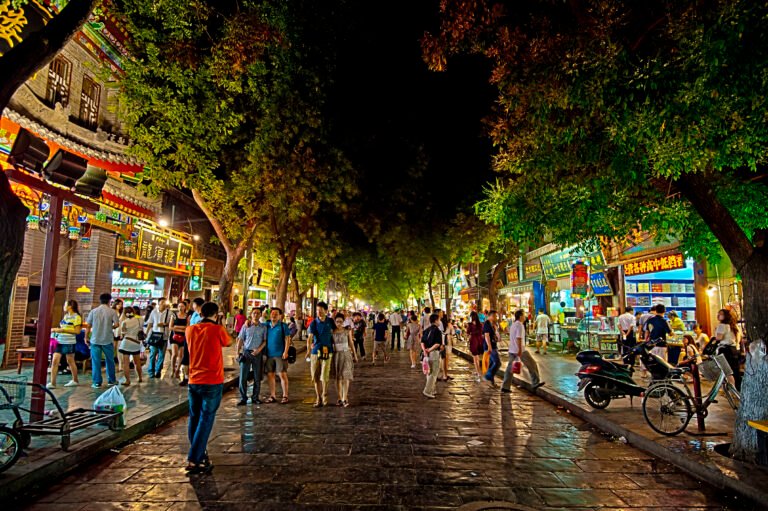
At night the city shifts to grills. Jian shui tofu is the star: small squares of fermented tofu puffed over charcoal and dipped in a dry chili-salt mix. A plate costs a few RMB and disappears fast. Around the universities you also find “shao kao” (skewers) of everything from mushroom to chicken cartilage, eaten standing up with a bottle of local beer.
The flower-eating habit
Yunnan is one of the few places in China where eating flowers is normal, not a novelty. In spring, rose petals go into sweets and sticky-rice balls, banana flowers are stir-fried with pork, and golden needle (daylily) buds show up in soups. The Bai are known for a dish of deep-fried rose petals dusted with sugar. It sounds like a gimmick; it is actually delicate and slightly perfumed, not soapy. Try it once and you will understand why locals defend it.
This habit ties back to the province’s herbal tradition. Many “vegetables” here are technically flowers or ferns, and the line between food and medicine is thin. That is part of what makes minority cuisines in China so interesting: the pantry is the hillside.
Drinks and sweets
Yunnan grows tea, including pu-erh, and a pot of aged pu-erh after a heavy mushroom meal is the local reset. The Dai and Bai make rice wines that range from sweet to throat-searing. For dessert, look for “er kuai” (a soft rice cake) grilled and rolled with sugar, or rose-flavored sweets made from the region’s famous edible roses. The flower-eating habit is real: stir-fried rose petals and banana flowers show up on menus in spring.
The Dai influence from the south
The Dai people in southern Yunnan share a border and a food culture with Thailand and Laos, which means you find lemongrass, lime, and coconut milk in dishes that would confuse a northern Chinese cook. Dai sour fish broth, wrapped grilled chicken (using banana leaves), and sticky rice eaten by hand are all common in Kunming’s southern-ethnic restaurants. It is the closest China gets to Southeast Asian flavor without leaving the country, and a relief if you have been eating chili for a week.
If you are building a broader eating plan, the best food cities list usually ranks Kunming lower than Chengdu or Guangzhou, which I think is a mistake. Kunming wins on range, not on any single dish, and range is exactly what a first-time visitor to China’s southwest should chase.
Quick facts
- Yunnan has 25 official ethnic minorities, each with its own food.
- Kunming is called the spring city for its year-round mild weather.
- Signature dish: crossing-the-bridge noodles, served deconstructed.
- Mushroom season runs roughly June to September.
- Typical noodle bowl: 18-35 RMB in 2024.
- Tea: pu-erh is the local specialty worth bringing home.
- Best plan: use Kunming as base, side-trip to Dali and Lijiang.
FAQ
Is Yunnan food spicy?
Less uniformly than Sichuan. The Dai and northern groups use chili, but many dishes are sour, herbal, or mild. You can eat here comfortably even if you avoid heat, and you can add dried chili flakes at the table when you want it.
When is the best time to visit for food?
Summer (June-September) for wild mushrooms, spring for edible flowers, and autumn for clear weather and harvest vegetables. Winter is mild in Kunming but colder up at Shangri-La. Pick by what you want to eat.
Are the minority dishes hard to find in Kunming?
No. Kunming has dedicated ethnic restaurants and a big mushroom-market district. Ask your hotel for a “minzu fandian” (minority restaurant) and you will be pointed somewhere good.
Can vegetarians eat well in Yunnan?
Better than in many Chinese regions because of the vegetable range and the mushroom culture. The vegetarian travel guide lists useful phrases, but note that some “vegetable” broths use chicken stock, so ask.
Is it safe to eat the wild mushrooms?
Only at established restaurants. Foraging is dangerous and poisonings are common in season. Stick to licensed places and you get the flavor without the risk.
How do I get from Kunming to Dali and Lijiang?
High-speed trains connect all three. Kunming to Dali is about two hours, Dali to Lijiang under two. The high-speed rail network makes this loop easy and cheap.
What should I bring home as a souvenir?
Aged pu-erh tea cakes, dried wild mushrooms (sealed, check customs), and flower-based sweets. Buy tea from a proper shop, not a tourist stall, and ask for a receipt.
Plan your Yunnan food loop
Yunnan rewards a slow route: Kunming for the greatest hits, Dali for the lake and Bai grills, Lijiang for Naxi cured meats, and Shangri-La if you want yak and altitude. If you want a route that lines up the trains, the markets, and the right season for mushrooms, reach out through our contact page and we will build a food-and-travel plan around your dates.
Written by the ChinaTravelFood editorial team.