Why China has more kinds of tofu than any menu lets on
Walk into a Chinese supermarket and the tofu section runs four or five shelves deep: silken tubs, vacuum-packed blocks, amber-coloured sheets, knotted bundles that look like pale rope, and a refrigerated corner of things that smell like a gym locker left too long. Most visitors arrive knowing one or two of these and order accordingly, which is why so many first trips end with the same quiet disappointment: the tofu was fine, but it was the wrong tofu for the dish.
My own education came the hard way. In my first month in Chengdu I ordered what the English menu called “tofu with garlic sauce” three times in a week and got three completely different textures — a wobbling custard, a chewy fried slab, and a bowl of what turned out to be dried tofu strips. Same word, same restaurant, entirely different food. Nobody had made a mistake. Chinese cooking treats tofu as a family of ingredients with distinct jobs, and once you learn which member of the family does what, a whole category of dishes opens up.
This guide covers the eight types you will actually meet, what each one is for, how to order it in a restaurant that has no English menu, and which ones to approach with caution. For a broader overview of how tofu fits into regional cooking, see our guide to tofu in Chinese cooking.
The texture ladder: soft, pressed, dried, fermented
The clearest way to understand Chinese tofu is as a moisture ladder. Every type is the same two ingredients — soybeans and a coagulant — taken to a different point on that ladder, and every one behaves differently in the wok.
Silken tofu (nèn dòufu, 嫩豆腐)
Unpressed, uncured, with the texture of set custard. It is sold in tubs or in fragile blocks sitting in water, and it breaks if you look at it sideways. Silken tofu is not a stir-fry ingredient. It goes into soups, steamed dishes, and cold preparations where its job is to be slippery and mild. The classic use is pídàn dòufu, cold silken tofu with century egg, soy, sesame oil and scallion — a dish that takes four minutes and tastes far better than that sounds.
Expect to pay ¥8–15 for a cold silken tofu dish in a mid-range Sichuan restaurant. Ordering note: if you want it cold, say liáng bàn (凉拌) before the tofu name.
Soft block tofu (ruǎn dòufu, 软豆腐)
One rung up — still tender but holding its shape when you lift it with chopsticks. This is the tofu in mapo tofu, the dish that makes the case for soft tofu better than any other: the cubes stay intact through a rolling, chilli-heavy sauce, and each one carries the heat differently from the sauce around it. Use soft tofu for braises and for any dish where the tofu sits in liquid.
Firm tofu (lǎo dòufu, 老豆腐)
Pressed until the moisture drops and the texture turns springy. Firm tofu takes a pan. It holds a sear, keeps its corners when you stir-fry, and absorbs sauce without falling apart. This is the everyday workhorse — the block you want for home cooking, for braised dishes, and for the dry-fried tofu with celery and dried chilli that appears on Hunan menus.
Extra-firm and smoked (dòufu gān, 豆腐干)
Pressed further and often lightly smoked or braised in soy and five-spice. Sold as dense amber blocks, sliced thin. The texture is closer to a firm cheese than to anything most visitors think of as tofu. Served cold with beer, torn into salads, or stir-fried with pork. In Nanjing and Shaoxing it turns up at breakfast with congee.
Dried tofu sheets (dòufu pí, 豆腐皮) and knotted tofu (dòu jié, 豆结)
The skin skimmed off heated soy milk, dried into sheets, sometimes tied into knots. Dried sheets rehydrate into something with real chew and take up braising liquid like a sponge. You will meet knotted tofu in hot pot and in Buddhist temple cooking, where its meaty bite does a lot of work in a meatless kitchen. Sichuan hot pot orders often include it as dòupí.
Fried tofu (zhá dòufu, 炸豆腐) and stuffed tofu (dòufu pào, 豆腐泡)
Fried cubes or hollow puffed pillows. The puffs are the ones that matter in the kitchen: their hollow interior fills with whatever sauce they are braised in, so a bite releases liquid. Stuffed versions — Hakka niàng dòufu, with pork or fish paste pressed into a slit — are a regional speciality worth hunting in Guangdong and Fujian.
Fermented tofu (fǔrǔ, 腐乳)
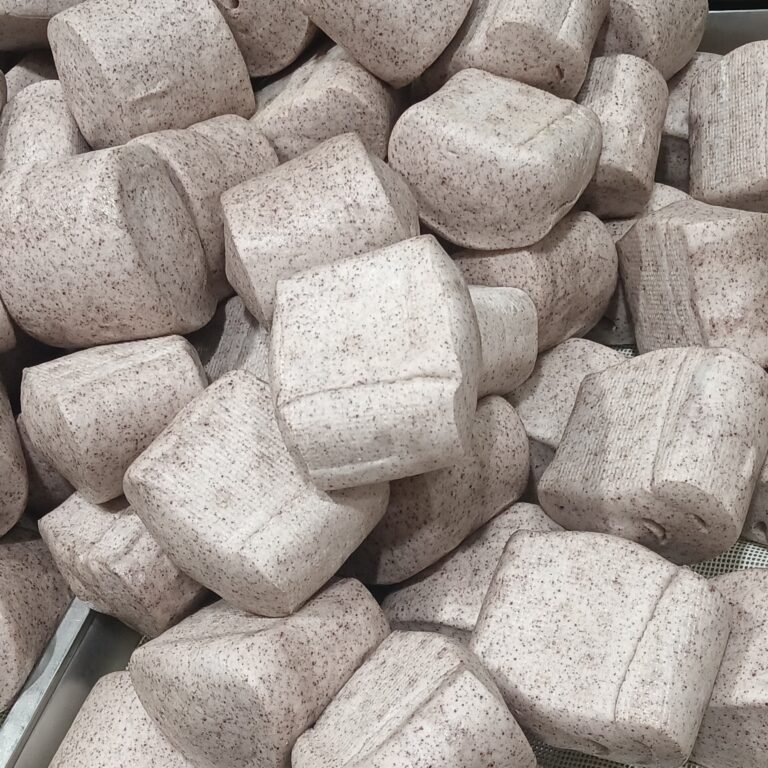
Cubes cured in rice wine, chilli, or rose until they turn creamy and sharply salty, sold in jars. Used as a condiment, a marinade, or the seasoning base for a stir-fry of plain greens. Red fǔrǔ is the one you will see on breakfast tables with congee; white is milder. It is intensely salty — a single cube seasons a whole dish.
Stinky tofu (chòu dòufu, 臭豆腐)
Fermented in a brine that can be months old, then deep-fried until the crust blisters. The smell is the point and it is genuinely powerful — you will locate a stinky tofu stall by nose from forty metres away. The texture is crisp outside, custardy inside, and the flavour is far milder than the aroma promises. The two versions worth seeking out are the Changsha style (black, crisp, served with chilli water and garlic) and the Shaoxing style (paler, eaten with sweet sauce). Our dedicated stinky tofu guide goes deeper on regional styles and how to order your first one.
| Type | Chinese | Texture | Best for | Typical price |
|---|---|---|---|---|
| Silken | 嫩豆腐 | Custard, breaks easily | Cold dishes, soup, steaming | ¥8–15 / dish |
| Soft block | 软豆腐 | Tender but shape-holding | Braises, mapo tofu | ¥18–32 / dish |
| Firm | 老豆腐 | Springy, holds a sear | Stir-fry, pan-fry | ¥16–30 / dish |
| Dried / smoked | 豆腐干 | Dense, cheese-like | Cold plates, salads | ¥10–20 / plate |
| Sheets / knots | 豆腐皮 / 豆结 | Chewy, sponge-like | Hot pot, braises, temple food | ¥8–18 / order |
| Fried puffs | 豆腐泡 | Hollow, sauce-holding | Braises, stuffed dishes | ¥15–28 / dish |
| Fermented | 腐乳 | Creamy, very salty | Condiment, congee | ¥6–15 / jar |
| Stinky | 臭豆腐 | Crisp outside, soft in | Street snack, fried | ¥8–20 / portion |
Ordering tofu without an English menu
Three words cover almost every situation. Dòufu (豆腐) gets you tofu; mápó dòufu (麻婆豆腐) gets you the Sichuan classic specifically; and pointing at what the next table is eating works everywhere. If you want to avoid the fermented and stinky end of the range entirely — and plenty of travellers do — the safe orders are mapo tofu, tiěbǎn dòufu (tofu on a sizzling iron plate), and any cold silken tofu with scallion.
One useful distinction: restaurants in Sichuan and Hunan treat tofu as a serious dish and cook it well; restaurants in coastal cities often treat it as a vegetarian afterthought. If tofu is what you want to eat, eat it inland.
What tofu means if you are avoiding meat
Tofu is the obvious anchor for vegetarian travel in China, but it is not a guarantee — a “vegetarian” tofu dish frequently arrives cooked in lard or with pork mince as seasoning. The phrase that helps is wǒ chī sù (我吃素, I eat vegetarian), followed by bú yào ròu (不要肉, no meat). Buddhist temple restaurants are the reliable option, and several cities have excellent ones; our guide to temple vegetarian food covers where to find them and what to expect on the table.
For city-by-city advice on eating meat-free, including which regional cuisines make it easiest, see the best Chinese cities for vegetarian travellers.
Buying tofu to cook with
Chinese supermarkets sell loose tofu by weight from a water tray, and this is better than anything vacuum-packed. It is also cheaper than visitors expect — ¥3–6 for a block that feeds two. Use it the day you buy it. Wet-market tofu has no preservative and turns sour fast in a warm apartment.
If you are cooking in a rental, firm tofu is the forgiving choice: it survives clumsy handling, sears without sticking if the pan is properly hot, and takes any sauce. Silken tofu rewards care and punishes impatience. For the dishes to build around it, our guide to Chinese rice dishes pairs well, since tofu rarely arrives alone.
Frequently asked questions
Is all Chinese tofu the same product at different moisture levels?
Basically yes, up to the dried and fermented end. Silken through firm differ mainly in how much whey has been pressed out. Dried sheets, fermented cubes and stinky tofu involve additional processing — skimming, curing, or brine fermentation — so they are genuinely different ingredients rather than just drier tofu.
Why does my stir-fried tofu fall apart?
You are using silken or soft tofu in a dish that needs firm. Either switch to firm tofu, or press soft tofu under a weight for thirty minutes first. The second common cause is stirring too early — let the cubes sear undisturbed for two minutes before you touch them.
Is stinky tofu safe to eat?
Yes. It is fermented under controlled conditions and then deep-fried at high heat. The brine is aged and the smell comes from the fermentation, not from spoilage. Buy it from a busy stall with high turnover, as you would for any Chinese street food.
What is the mildest tofu dish to start with?
Cold silken tofu with scallion and sesame oil, or tiěbǎn dòufu — tofu on a sizzling plate with a mild brown sauce. Both are savoury rather than funky, and neither requires any tolerance for fermentation or chilli heat.
Can I eat tofu in China with a soy allergy?
No — tofu is soy. If soy is your concern, the safe proteins are egg, dairy in the far north and west, mushroom dishes, and the wheat-based seitan that appears in temple cooking as miànjīn (面筋). Carry the Chinese characters for your allergy written down; English allergy cards are rarely understood outside international hotels.
Learn the ladder, then order accordingly
The single most useful thing a visitor can learn about Chinese tofu is that the menu is not being vague — it is being precise about a category with eight working members. Once you can tell a soft block from a dried sheet, dishes that previously arrived as a surprise start arriving as what you expected.
If you are planning a trip built around food rather than sightseeing, tell us your route and your tolerance for the fermented end of the range on our contact page, and we will help you plan a route that moves from a Chengdu mapo tofu to a Changsha stinky tofu stall in the right order.
Written by the ChinaTravelFood editorial team.