What a Chinese food court actually is
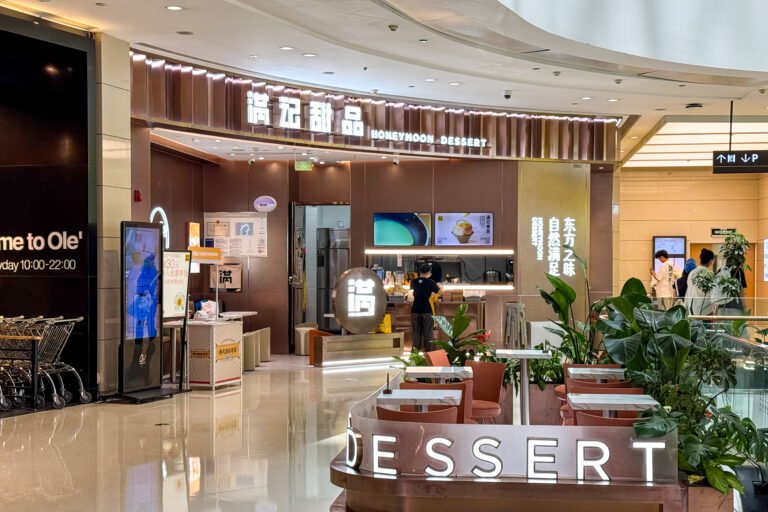
The first time a local friend led me into a Chinese shopping-mall food court, I expected the sad food hall of a Western suburb: one sandwich chain, one pizza slice counter, piped music. What I got was a ring of independent stalls, each with a number, a steamer or a wok, and a queue of regulars, all feeding off a shared sea of plastic tables. The sign said 美食城 (meishi cheng), literally “food city,” and the name is not marketing. A busy court in a big city can hold thirty or forty kitchens under one roof, and the prices are a fraction of a restaurant because you are paying for the food, not the room.
You will find them stacked above metro stations, buried in the basement of a department store, or filling the top floor of an office tower or a university plaza. The model is simple. A central cash desk or a table QR code handles payment, you walk the ring of stalls, point at what looks good, and carry your tray to any open seat. One court can span Lanzhou noodles, Cantonese clay-pot rice, Sichuan dan dan noodles, malatang, Korean fried chicken and bubble tea, and most of it is made by people whose families have cooked the same dish for generations. Tourists almost never go looking for a food court, which is exactly why the food is honest and so are the prices.
How payment works, and why it trips people up
Sort out payment before you hunger-shop, because the individual stall vendors often cannot take cash or a foreign card. Two systems run side by side. The older one is a stored-value card: you go to the central desk, pay a deposit, usually 10 to 20 yuan, on top of what you load, and tap the card at each stall. When you leave, you return the card and get the balance and the deposit back. The newer system is a QR code on your table; you scan it with Alipay or WeChat Pay, order from a menu on your phone, pay per item, and the food is either brought to your seat or called out by number.
If you have not set up mobile payment in China yet, our guide to paying with Alipay and WeChat Pay covers the setup, including the passport binding that catches out most newcomers. The QR system is what you will meet most often in the newer courts of the big cities, but the card system is alive and well in smaller cities and at train stations. Keep the card in your pocket rather than on the tray; trays get bussed, and cards do not come back.
The stall types worth your yuan
Courts repeat the same core lineup across the country, and it helps to know what each stall does well. Prices below are what I paid on recent visits in 2024 and 2025, so treat them as a baseline and expect a few yuan of drift.
| Stall type | What to order | Typical price | Notes |
|---|---|---|---|
| Lanzhou hand-pulled noodles | Beef noodle soup, noodle width of your choice | 12 to 25 yuan | Ask for 二细 (second-thin) if you have no opinion |
| Malatang (麻辣烫) | Self-picked ingredients, weighed at the till | 20 to 40 yuan | Skewers priced by weight; 微辣 is the mild option |
| Cantonese clay-pot rice (煲仔饭) | Sausage or pork rib over rice | 18 to 35 yuan | Takes 15 to 20 minutes; wait for the crisp rice base |
| Sichuan noodles | Dan dan noodles or sweet-water noodles | 10 to 20 yuan | Sesame paste heavy; ask for less chili oil |
| Cantonese roast meats | Char siu or roast duck over rice | 20 to 40 yuan | Look for the stall with meats hanging in the window |
| Congee and dim sum | Plain congee, shrimp dumplings | 8 to 25 yuan | Breakfast courts open earliest, around 7 a.m. |
| Korean fried chicken | Half chicken with a beer | 15 to 35 yuan | Common in tier-one city courts, rare in small towns |
| Bubble tea | Whatever has the queue | 8 to 20 yuan | Usually one tea stall per court; lines at lunch and dinner |
Lanzhou hand-pulled noodles are the one stall type I seek out in any city, because the noodle width is a real choice rather than a gimmick. 毛细 is capillary-thin, 二细 is second-thin, 韭叶 is chive-leaf width, 宽 is wide, and 大宽 is belt-wide, and the counter will ask you which. If you have no opinion, say 二细 and you will be happy. Our guide to Lanzhou hand-pulled noodles covers the dish in detail, including why the soup is clear and the chili oil is separate.
Malatang deserves a note because the pricing confuses everyone. You take a tray, pick your own ingredients from the fridge case and skewers from the racks, the stall weighs the lot, and you pay by weight, usually 20 to 40 yuan depending on how much seafood you grabbed. Then you choose a soup base; 微辣 (mildly spicy) is the safe starting point, and in Chengdu or Chongqing even that will have a kick.
How courts change from city to city
The format is national but the menu is local, and this is the part I find genuinely interesting. Northern courts lean heavy on noodles, dumplings and braised plates; a court in Xi’an or Tianjin will have more wheat than a court in Guangzhou, where clay-pot rice, congee and the hanging roast-meat windows dominate. The Chengdu and Chongqing courts I have eaten in add rows of dry-fried chili dishes that would never appear in a Hangzhou court, where the steamers and the sweet dishes take over. If you eat at courts in three cities, you essentially eat three regional menus under one roof type.
The newer courts in the big cities are cleaner and more app-driven, sometimes with numbered queuing screens and a rating for each stall, and they charge a couple of yuan more for the polish. The older courts in smaller cities still run on the deposit cards and shouted orders, the floors are stickier, and the regulars are more regular. Both work. I will take the old one for character and the new one on a day when my stomach feels delicate.
The small skills: timing, tables and trays
Peak times are roughly 11:45 to 13:00 and 17:45 to 19:00, and at those hours every seat is taken and every queue is three deep. The fix is simple: arrive at 11:15 or after 13:30 and the same court feels like a different place. Table tactics matter for groups. Everyone orders separately and meets at a shared table, which is flexible, but seats fill fast at noon, so send one person to hold a table while the others queue. Learn to spot a departing diner with a finished tray and hover politely; it is a small skill, but it makes the court far less stressful.
Two more court habits that locals follow without thinking. Bus your own tray at the collection point when you finish, because the staff are few and the turnover is fast. And decide what you want before you reach the counter, because the queue builds behind you while you study the photo board. Pointing is completely acceptable; most stalls have plastic food models, and the person behind the counter expects you to point. If you want to go further, our guide to reading a Chinese menu breaks down the characters you will see most, and our piece on ordering in a Chinese restaurant covers how to ask for less oil or no MSG without it turning into an event.
Food safety, and what I actually order
A licensed, inspected court with fast turnover is one of the safer places to eat on the road in China, and I would put a busy court above a midnight roadside cart without hesitating. The rules I follow: pick stalls with queues, skip anything sitting under a heat lamp, avoid the pre-cut fruit unless it is covered and moving, and order food cooked through rather than served cold. Bottled or boiled water is still the rule for drinking; the details are in our guide to food and water safety in China.
What I order, most visits: a noodle bowl plus a plate of stir-fried greens, 25 to 35 yuan total, and something from the tea stall to finish. I skip the fried chicken in a city where I could be eating hand-pulled noodles, and I skip the set-meal photo boards that promise more than the plate delivers. A full court dinner for two people, eating properly, rarely passes 80 yuan.
Vegetarian eating in a court
Vegetarian options exist in most courts: steamed vegetable buns, plain congee, stir-fried greens, tofu stalls and the occasional all-veg counter. The catch is that broths are almost always meat-based, and “vegetarian” in Chinese restaurant practice often means no visible meat rather than no animal products at all. Say 不要肉 (bu yao rou, no meat) and point at what you want, and the stall holder will usually steer you to something safe. The fuller vocabulary is in our guide to eating vegetarian in China, and if you are in a city with a Buddhist temple, the temple kitchens are worth a separate trip.
Courts, night markets and delivery apps
People ask me how a food court differs from a night market, and the answer is that they solve different problems. A court is indoor, seated and meal-focused, open through the day from morning congee to evening noodles. A night market is outdoor, evening, snack-focused, and as much about atmosphere as food; our guide to Chinese night markets covers the best ones city by city. On a tired travel day, delivery apps will bring court-adjacent food to your hotel room for a few yuan of delivery fee, and our guide to food delivery apps explains how to order when you cannot read the menu. None of that replaces the court itself, which is still the best-value meal in town when you are out and about.
Quick facts
- A normal court meal runs 15 to 40 yuan per person; 50-plus is possible with skewers and tea
- Payment is either a stored-value card with a 10 to 20 yuan refundable deposit, or a table QR code through Alipay or WeChat Pay
- Peak times are 11:45 to 13:00 and 17:45 to 19:00; arrive before 11:30 or after 13:30 for an easy seat
- Courts open from around 7 a.m. to 9 p.m.; breakfast courts start earliest
- Look for 美食城 or 美食广场 on mall signage, usually on B1 or the top floor
- The best signal of a good stall is a queue of locals, not the photo board
- Return your deposit card at the central desk before you leave
Frequently asked questions
How much does a meal in a Chinese food court cost?
Most people spend 15 to 40 yuan. A noodle bowl is 12 to 25, a clay-pot rice 18 to 35, and a full two-person dinner with skewers and tea usually stays under 100 yuan. Station and airport courts charge a bit more.
How does payment work if I cannot read Chinese?
Either buy a stored-value card at the central desk, where they will mime the deposit, or scan the table QR code and use the pictures on the ordering screen. Pointing at stall photo boards works for the rest. Set up Alipay or WeChat Pay before you rely on courts.
Are food courts hygienic?
More so than roadside carts, because the courts are licensed and inspected. Choose busy stalls with high turnover, watch for food sitting under heat lamps, and you will be fine.
Can I find vegetarian food in a court?
Yes, but read carefully. Steamed vegetable buns, plain congee, stir-fried greens and tofu stalls are common, but broths are usually meat-based. Point to the vegetable dishes and say 不要肉 (no meat).
Is a food court good for groups?
Good and bad. Everyone orders separately and meets at a shared table, which is flexible, but seats fill fast at noon. Send one person to hold a table while others queue.
How is a food court different from a night market?
A court is indoor, seated and meal-focused, open through the day. A night market is outdoor, evening, snack-focused, and about atmosphere as much as food.
Are there food courts at train stations and airports?
Often, yes, especially in the big hubs. They are a solid option when you have a long wait, though station courts cost a little more than neighborhood ones.
If you are building a China itinerary and want the food-court routes mapped onto your travel days, send your dates through the contact page and we will plan the meals around the stops.
Written by the ChinaTravelFood editorial team.