The cake that cost more than my flight
In a tea shop in Menghai, in southern Yunnan, the owner put a 1990s cake on the table and quoted a price that was roughly four times what I had paid to fly to Kunming. I did not buy it. I did buy, from the same shop, a 100 RMB cake of shou pu’er that I drank for the next two years, and I still think about that cake. The lesson I took from the exchange is the one this whole guide is built on: pu’er is a tea where the gap between the cheapest drinkable version and the collector version is wider than in any other tea category on earth. You do not need to spend a fortune to drink it properly, but you do need to know what you are looking at, because the market is full of invented vintages and fake mountain names.
I have been buying and drinking pu’er for a decade, badly at first and then better. Here is what I have learned about the styles, the brewing, and the buying.
What pu’er actually is
All tea comes from the same plant, camellia sinensis. What makes pu’er different is where it grows and what happens after it is picked. Pu’er is made from the large-leaf variety, camellia sinensis assamica, grown in the mountains of southern Yunnan, and it is the only major Chinese tea category built on microbial fermentation. Everything else about the tea follows from that.
There are two families. Sheng pu’er, raw pu’er, is processed like green tea: the leaf is pan-fixed, rolled, and sun-dried into loose tea called maocha, then pressed into cakes. Left alone, it ages slowly over decades, the way a good armagnac does, turning from bitter and aggressive into something smooth. Shou pu’er, ripe pu’er, was invented in 1973, when the Kunming and Menghai tea factories developed a pile-fermentation process that mimics decades of aging in about six weeks: the leaf is piled, dampened, and turned until microbes do their work, then dried and pressed. Almost all cheap pu’er you will encounter is shou, and most expensive pu’er is aged sheng.
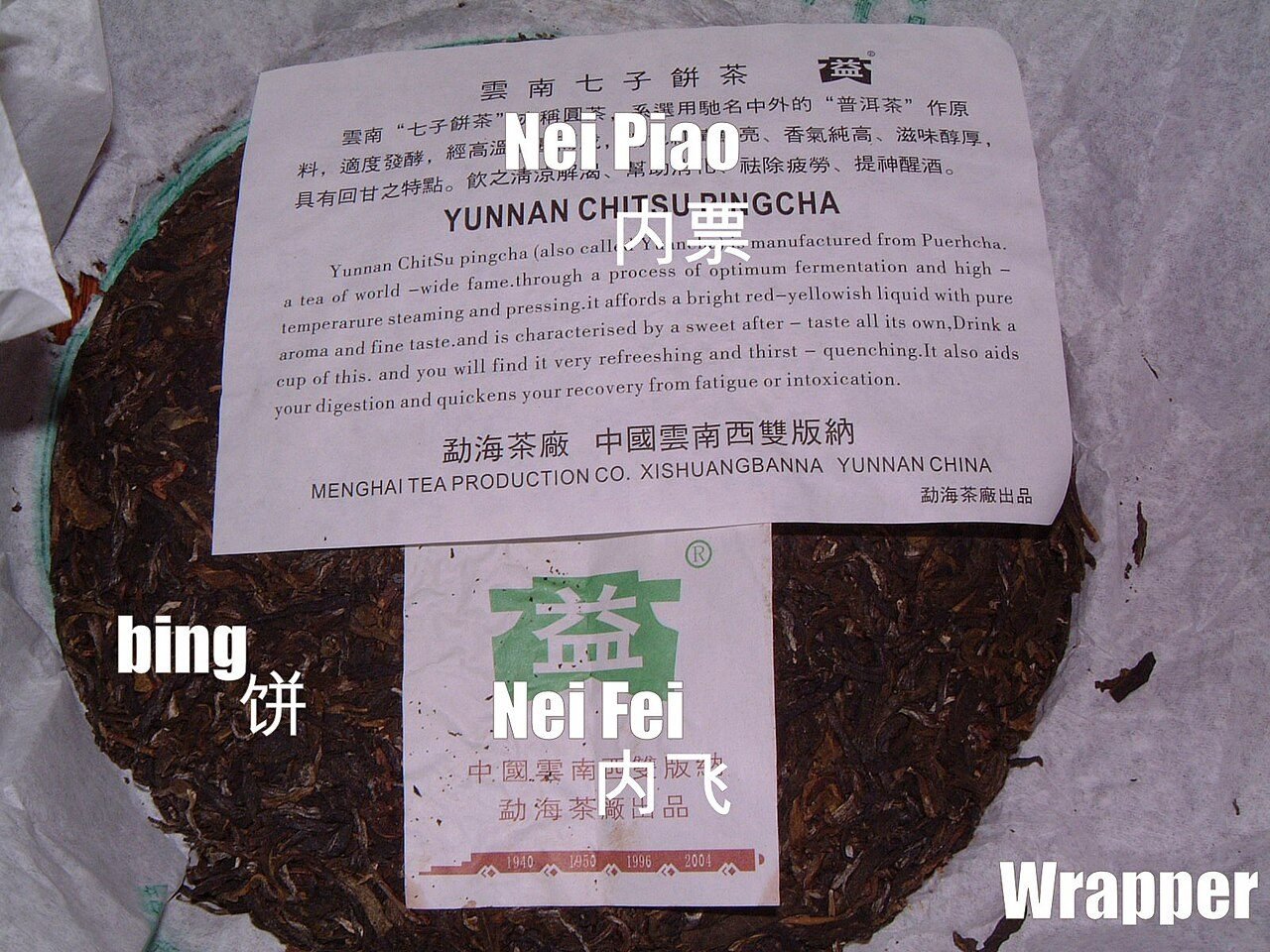
The shapes matter less than people pretend, but you will see cakes (bing), domes (tuo), and bricks (zhuan). A standard cake weighs 357 grams, a legacy of old trade weights, and tuo of 100 or 250 grams are the convenient format for one drinker.
The mountains and the names
Pu’er country covers Xishuangbanna and Pu’er city in southern Yunnan. The old tea mountains, the ones that built the tea’s reputation on the old tea-horse road, include Yiwu, Youle, and Manzhuan in the east. The newer famous villages, most of them in the Bulang and Mengku mountain ranges, include Laobanzhang, famous for heavy bitter tea that returns sweet, and Bingdao, famous for a delicate, almost honeyed style. Between the two sits Menghai, the county town that produces more pu’er than anywhere else on earth and holds the Menghai Tea Factory, maker of the Dayi brand, whose recipe numbers like 7542 and 7572 are the closest thing this market has to a universal language.
If a cake costs a few hundred RMB and names a famous village, treat the label as marketing until proven otherwise. The real village production is small, the old trees are protected, and the supply chain from a single famous mountain to your table is exactly as leaky as you would expect. For the wider Yunnan picture, our tea tour guide covers the region and its plantations.
How to drink it
Use a small pot. A 100 to 150 ml gaiwan or clay teapot, about 7 grams of tea, water just off the boil. Rinse the leaf once quickly and pour the water away; this wakes up compressed cake tea and rinses away dust. Then brew in short steeps: 10 to 15 seconds for the first three infusions, adding 5 to 10 seconds each time. Good pu’er gives you eight to twelve infusions this way, and the flavor moves as it goes.
What you are tasting: young sheng hits bitter first, then floods back sweet, a sensation Chinese drinkers call huigan. Aged sheng trades the bitterness for a rounder, woody sweetness, sometimes with a camphor note that drinkers pay absurd money for. Shou is thick, dark, and earthy, with almost no bitterness, closer to a broth than a tea; if your first pu’er experience is a harsh, fishy shou, you had a bad shou, not bad pu’er. Rinse shou twice before drinking it, which most shops skip and most drinkers thank them for later.
Pu’er also tolerates boiling. In the tea houses of Xishuangbanna the tea is often boiled in a clay pot over charcoal for minutes at a time, and the result is strong and thick. That is the peasant way and it is not wrong. Our guide to Chinese teahouses explains the house styles you will meet.
How to buy it without getting burned
Start with a known brand. Menghai Tea Factory’s Dayi line sells reliable shou and sheng recipes at sane prices: a 7572 shou cake runs 80 to 200 RMB depending on the year, and a 7542 sheng runs 100 to 300 RMB. These are benchmark teas. They are not the greatest pu’er in the world, but they are honest, and once you know what they taste like, you can judge everything else.
Then, if you want to go deeper, buy loose maocha from small producers rather than betting on vintage cake claims. Loose tea is harder to fake than a pressed cake with a printed wrapper, because you can see and smell the leaf. Smell for mustiness, which means bad storage, and look for stems, which are normal in pu’er, and foreign matter, which is not.
Where to shop: Kunming has two big tea markets, Xiongda and Kangle, with hundreds of shops where you can taste before buying and where the tea comes with a story, most of it partly true. Menghai and Jinghong in Xishuangbanna are closer to the source and cheaper. Pu’er city itself has the tea museum and a large trade market. Prices across the range, as of 2025:
| Type | Price range | What you are buying |
|---|---|---|
| Everyday shou cake (Dayi 7572 class) | 80 to 200 RMB | Reliable benchmark ripe pu’er, drinkable now |
| Entry sheng cake (Dayi 7542 class) | 100 to 300 RMB | Benchmark raw pu’er, needs a few years or tolerates youth |
| Small-producer loose maocha | 100 to 400 RMB per 500 g | Single-mountain leaf, hard to fake, best value |
| Aged sheng, 10 to 20 years | 500 to 3,000 RMB per cake | Real aged tea if the storage history checks out |
| Famous village cakes (Laobanzhang, Bingdao) | 1,000 to 10,000+ RMB | Marketing, or genuinely rare leaf; verify the seller |
| Pre-1990s cakes | Collector prices | A market for specialists, not visitors |
Storage advice for anything you buy: keep it dry, ventilated, away from kitchen smells, and do not refrigerate it. Pu’er is a living tea and wants to breathe. Wet storage, the humid cellar method used in Hong Kong and Malaysia, ages tea faster but risks a moldy profile, and I avoid wet-stored cakes unless I have tasted them. Our guide to buying tea in China covers grades and fakes across all the tea categories.
The ceremony, briefly
You do not need a ceremony to drink pu’er, but knowing one helps you read the teahouses. The gongfu style, small pot and many infusions, is the standard in Yunnan and Guangdong, and it suits pu’er because the flavor develops across infusions. Pour for guests before yourself, tap two fingers on the table to thank the pourer, and do not slurp loudly at a formal table. If you want the full practice, our guide to the Chinese tea ceremony walks through it, and our overview of Chinese tea types puts pu’er next to the greens and oolongs it is usually compared with.
Quick facts
- Two families: sheng (raw, ages over decades) and shou (ripe, pile-fermented since 1973)
- Standard cake weight is 357 grams, a legacy of old trade weights
- Brew at roughly 7 grams per 120 ml, water just off the boil, rinse first
- Shou is thick and earthy; young sheng is bitter then returns sweet (huigan)
- Benchmark brands: Dayi recipes 7542 (sheng) and 7572 (shou), 80 to 300 RMB
- Kunming’s Xiongda and Kangle tea markets are the main buying grounds
- Store dry and ventilated; pu’er is a living tea and should not be sealed away
- Prices above are 2025 shop prices in Yunnan; shop prices elsewhere run higher
Frequently asked questions
Does pu’er tea really get better with age?
Good sheng does, for twenty to forty years, in the right storage. Bad pu’er does not improve; it just gets older. Most cakes sold as “aged” are five years old with a story. If you want to test the concept cheaply, buy two identical young sheng cakes, drink one now, and store the other for five years in a dry cupboard. That experiment teaches more than any shopkeeper.
Is the health claim real, that pu’er helps with cholesterol and weight?
The research is suggestive, not conclusive. There are studies on pu’er and lipid metabolism, mostly on animals or small human samples, and the tea is genuinely low in calories. Drink it because you like it, not as medicine. If you are sensitive to caffeine, remember that pu’er holds a real dose of it, shou included.
Why does cheap shou sometimes taste fishy or muddy?
Usually bad pile fermentation, bad drying, or bad storage. Rinse the leaf twice with boiling water and most of the harshness lifts. If it still tastes off, it is off, and the fix is a better producer, not a longer steep.
Can I visit the tea mountains?
Yes, and it is the best way to understand the tea. Menghai, Jinghong, and the villages around them take visitors, and the harvest runs from March to October. Stay in Jinghong or Menghai town and hire a car for the mountain villages. Our guide to Kunming travel covers the gateway city.
Should I press my own tea?
Some shops let you wrap and press a cake of loose maocha yourself, and it is a good souvenir because you chose the leaf. The pressing molds are heated and the whole thing takes ten minutes. Make sure the shop writes the mountain and year on your wrapper, because you will not remember in three years.
How do I drink pu’er without a gongfu set?
A mug with a strainer works: 3 grams of leaf, hot water, two-minute steeps, and just keep adding water until the flavor stops. You lose the evolving infusions but keep the tea. Every method in this guide survives a hotel room.
If you want the tea markets and the mountains built into a Yunnan route, we can help you plan a custom food-and-travel itinerary through the contact page. Tell us what you usually drink at home, and we will point you at the first pu’er worth buying.
Written by the ChinaTravelFood editorial team.