The desert that is not empty
I came to the Gobi expecting sand and got a highway through gravel plains, salt flats, black volcanoes, and a wind that rearranged the campsite overnight. The Gobi is not the Sahara. It is a cold desert of rock and gravel and thorn scrub that happens to have some of the most photogenic dunes on earth wedged into it, and on the Chinese side it is wrapped around one of the great corridors of world history, the Silk Road route through Gansu and Xinjiang. The name itself, from the Mongolian for “waterless place,” is accurate and slightly misleading: it rains, occasionally hard, and there is life everywhere, from desert foxes to the poplar trees that turn whole valleys gold every October.
For a visitor, a Gobi Desert tour in China means one of a few concrete things: the dunes and caves at Dunhuang in Gansu, the wind-carved yardangs west of town, the tall stationary dunes of the Badain Jaran in Inner Mongolia, or the Tengger at Shapotou in Ningxia, where the desert meets the Yellow River. This guide covers how each works, what they cost, and when to go. Prices are from 2024 and 2025 trips; confirm current ticket policies with official sources before you travel.
Quick facts
- The Gobi spans Mongolia and northern China; the Chinese side is the more developed for travel
- Best season is May through October; July and August are hot but clear, and October brings the desert’s best light
- Dunhuang is the classic base: Mogao Caves, Mingsha dunes, Yadan yardangs, all within two hours of the city
- Spring, March to May, brings the sandstorm season; flights and road trips get cancelled without warning
- Desert nights are cold even in summer; a 35 C afternoon can drop to 12 C after dark
- Reach Dunhuang by high-speed rail from Lanzhou (about 7 h) or by air from Xi’an, Urumqi, or Beijing
Dunhuang: the dunes, the caves, and the base camp
Almost every Gobi trip starts in Dunhuang, and for good reason. The town is an oasis at the edge of the dunes with enough hotels and restaurants to make a base, and everything worth seeing sits within a two-hour drive.
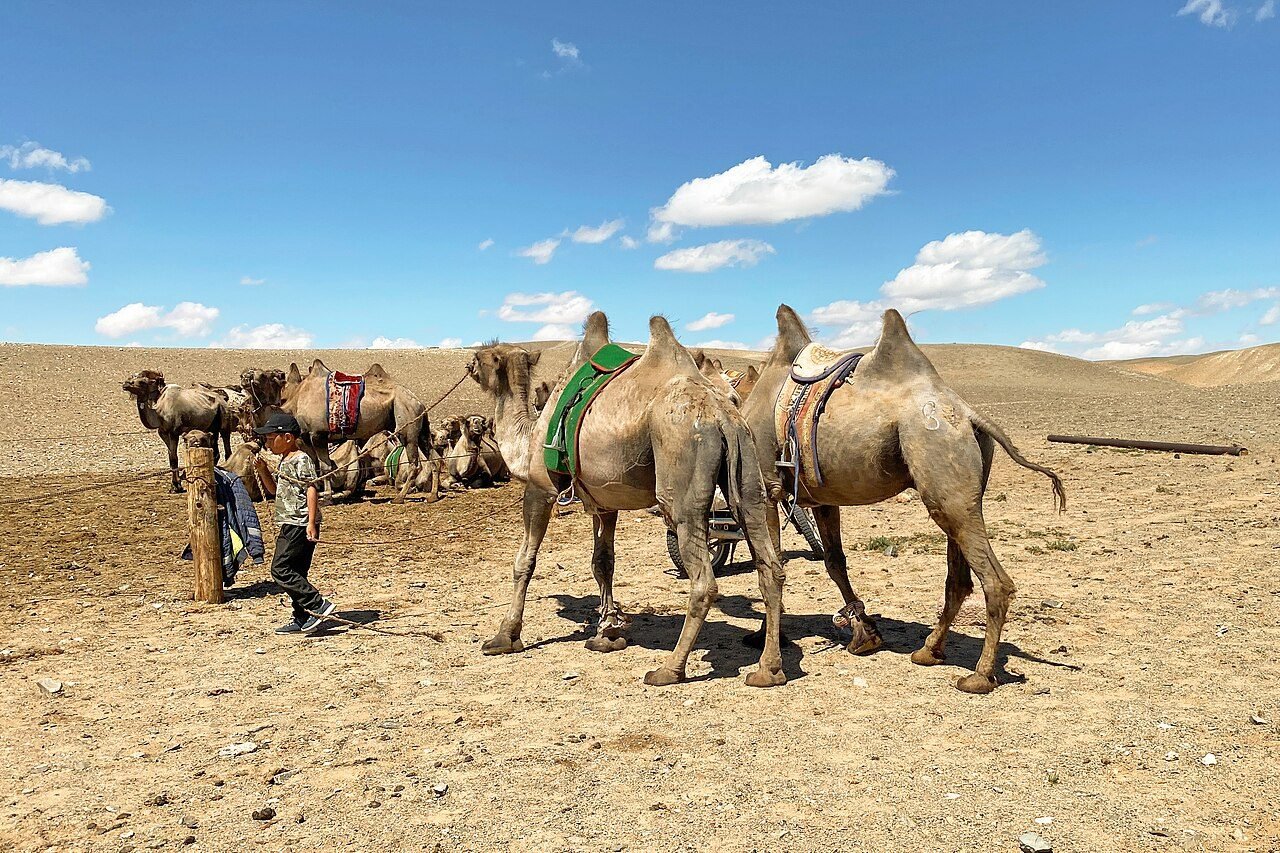
The Mingsha Crescent Lake (鸣沙山月牙泉), the “singing sand mountain,” is the dune experience: a ridge of sand several hundred feet high that hums when you slide down it, with a crescent-shaped spring at its foot that has not dried up in recorded history. Entry runs around 110 yuan as of 2025, which covers the shuttle and the dunes. Camel rides go for 100 to 150 yuan an hour and leave from a string of camels kneeling at the dune base; the handlers walk them in a line and the pace is set by the slowest animal, which is the point. Sand sledding costs 20 to 30 yuan for a plastic tray and a walk back up the dune. Come at 5 p.m. in summer, stay for sunset, and bring a light jacket; the wind turns cold the moment the sun drops behind the ridge.
The Mogao Caves (莫高窟), a 25-minute drive southeast, are the reason the Silk Road exists in the popular imagination: 492 decorated cave shrines carved into a cliff face between the 4th and 14th centuries, holding the finest Buddhist art in China. A standard A-class ticket runs about 238 yuan and includes two films plus a shuttle and a guided tour of a handful of caves; the number of caves open on any day is fixed and the guides pick the route, so repeat visits see different art. You cannot book these on the door in high season; reserve online days or weeks ahead. The caves close for part of the winter and in extreme weather. Our Mogao Caves guide explains the art in more detail.
West of town, the Yadan National Geological Park (雅丹魔鬼城, “Devil City”) is a field of wind-eroded yardangs, clay ridges carved into pillars and minarets that glow red at sunset, 180 kilometers along the road toward Lop Nor. The trip takes a half day by tour bus or private car: entry plus shuttle is about 120 yuan, and the last bus out leaves before sunset, which is the only time the rocks are worth photographing. Some tours combine Yadan with a night at a desert camp, which is how most visitors see it.
Sleeping in the desert: camps, yurts, and what you get
Desert camps around Dunhuang fall into three tiers, and the difference is mostly showers and heating.
| Type | Where | What you get | Price per person (2025) |
|---|---|---|---|
| Public dune camps | Behind the Mingsha dunes | Tents or yurts, shared toilets, campfire, breakfast; no hot shower | 150 to 300 yuan |
| Boutique desert camps | Around Dunhuang and Yadan | Private glamping tents with beds, private bathroom, dinner, star-gazing | 600 to 1,200 yuan |
| Ger stays (Mongolian yurts) | Badain Jaran and Inner Mongolia | Simple family-run yurts, home-cooked meals, lake access | 200 to 500 yuan including meals |
I have slept in the cheap tents and the glamping versions. The cheap ones are cold in shoulder season, loud when the wind hits the canvas, and unforgettable when the sky clears, because the Gobi has some of the darkest skies in China. The expensive ones are hotels with better ceilings. If you go cheap, bring a sleeping bag liner and earplugs; the wind does not stop at night.
Badain Jaran: the tall dunes and the singing sand
China’s tallest stationary dunes, some of them rising 200 meters and more, sit in the Badain Jaran Desert of western Inner Mongolia, a place reached by a long drive from the nearest town, Jinchang or Alxa Youqi. What makes it worth the effort is the water: more than a hundred small lakes sit in basins between the dunes, spring-fed and blue against the sand, and a few have temples beside them that have been pilgrimage sites for centuries.
Access is by 4×4 with a driver, usually arranged from Alxa Youqi (阿拉善右旗) as a two-day trip with a night in a yurt or a simple guesthouse. Expect 800 to 1,500 yuan per person for vehicle, driver, and basic lodging; the driving is rough, on soft sand between the dunes, and nobody sensible attempts it without a local driver. The season is short, June through September, because winter temperatures drop below minus 20 C and there is no shelter. Our Badain Jaran guide covers the logistics in more detail.
Shapotou: the desert with a river and a zip wire
If you want desert without a two-day commitment, Shapotou (沙坡头) is the answer. It sits where the Tengger Desert is stopped by the Yellow River near Zhongwei in Ningxia, and it has been developed since the 1950s as a demonstration project for desert control, the straw-checkerboard barriers you can see from the road that hold the sand in place. That engineering history is genuinely interesting and the desert itself is a theme park: sand sledding down the dunes on a wooden board, camel caravans, a zip line across the river gorge, and sheepskin rafts, the inflated hides that river boatmen used for centuries, poled across the Yellow River by a man in a waistcoat.
Entry plus activities runs 100 to 200 yuan depending on what you ride, and the whole thing works as a day trip from Yinchuan, about an hour by car or bus. It is the most family-friendly desert in China, which also means it is the most crowded on summer weekends. Our Tengger Desert guide covers the area in more detail.
Ejina and the golden October poplars
The other desert trip that gets insanely popular is Ejina Banner (额济纳旗), in the far west of Inner Mongolia, where the world’s second-largest populus euphratica forest turns bright gold for about two weeks in early to mid-October. The trees grow along the dry bed of the Ruo Shui, the “weak water” river that dies in the sand, and the sight of golden forest against desert dunes under a hard blue sky is one of the great autumn shows in China.
The catch is the window. The leaves peak for roughly ten days around October 10, and half of China books hotels in the tiny banner town a year ahead; prices triple and rooms vanish. The trip is usually run from Jiuquan or Bayannur as a two- or three-day loop taking in the poplar forest, the Heicheng ruins, and the desert sunrise. Expect 1,000 to 2,000 yuan per person for a guided group including lodging and transport in October, and far less in the weeks either side of the peak, when the leaves are green or gone but the desert is empty. Our poplar forest guide explains the ecology.
When to go, and what to bring
May through October is the operating season for all of these areas, with June and September the sweet spots for Dunhuang and Shapotou: hot days, cool nights, few sandstorms. July and August are peak family season, hot but clear, and the camps fill. October is the month for Ejina’s poplars and for the best light on the dunes everywhere, but it is also the coldest month for camping.
Spring, March to May, is sandstorm season across the whole Gobi; I have sat in a Dunhuang airport for six hours waiting out a wall of yellow dust that closed the runway. Autumn and winter are the windy season, which matters if you are camping. Pack for a 30-degree daily swing: a sun hat, a windproof jacket, long trousers, and closed shoes, because sand gets into everything and the dune tops are hot underfoot by afternoon. Water matters more than you think; carry two liters on any dune walk.
For the wider Silk Road route that runs along the desert’s southern edge, our Dunhuang travel guide and Jiayuguan guide cover the forts and towns in between. If you are driving the corridor, the Silk Road self-drive route connects the same dots with a car.
Frequently asked questions
Is the Gobi worth visiting if I have already been to the Sahara?
They are not comparable. The Sahara is sand sea; the Gobi is rock, gravel, and gravel mountains with dunes in places. The Chinese Gobi’s appeal is history as much as scenery: the Silk Road towns, the caves, the yardangs. Go for the corridor, not the emptiness.
Can I do Dunhuang as a day trip?
From Jiayuguan or Dunhuang itself, yes, one long day covers the Mogao Caves and the Mingsha dunes. A proper visit needs two nights, because the caves deserve a morning and the sunset from the dunes is the memory you keep.
How cold do desert nights actually get?
In June, a 35 C afternoon can fall to 12 C by 3 a.m. In September and October, near freezing. Bring a jacket even in summer, and a proper sleeping bag for any camp night.
Are the sandstorms dangerous?
They are inconvenient more than dangerous for tourists, but they do close roads and airports for hours or days. Spring is the risky season. Build a spare day into any Gobi itinerary between March and May.
Do I need a guide for Badain Jaran?
Yes. The dunes shift, the tracks are unmarked, and there is no water or cell signal between the lakes. Every sensible visit is arranged with a local driver out of Alxa Youqi.
What is the single best Gobi experience?
Sunset from the top of the Mingsha dunes, then a night in a cheap tent camp an hour outside town, when the sky goes fully dark and the Milky Way casts a shadow. Everything else is preparation for that.
If you want the desert built into a longer Silk Road route, with caves, forts, and camp nights arranged around your dates, send us a note through the contact page and we will draft a custom itinerary.
Written by the ChinaTravelFood editorial team.