Tallest dunes on earth, and a hundred lakes
The first thing that surprised me about the Badain Jaran was the sound. Our Land Cruiser had cut the engine, and the wind was moving over the dune crests with a low hum, almost a motor idling somewhere below the sand. Locals call them the singing dunes, and standing on a ridge three hundred meters up, with the desert running flat and empty in every direction, the hum is the only thing you hear.
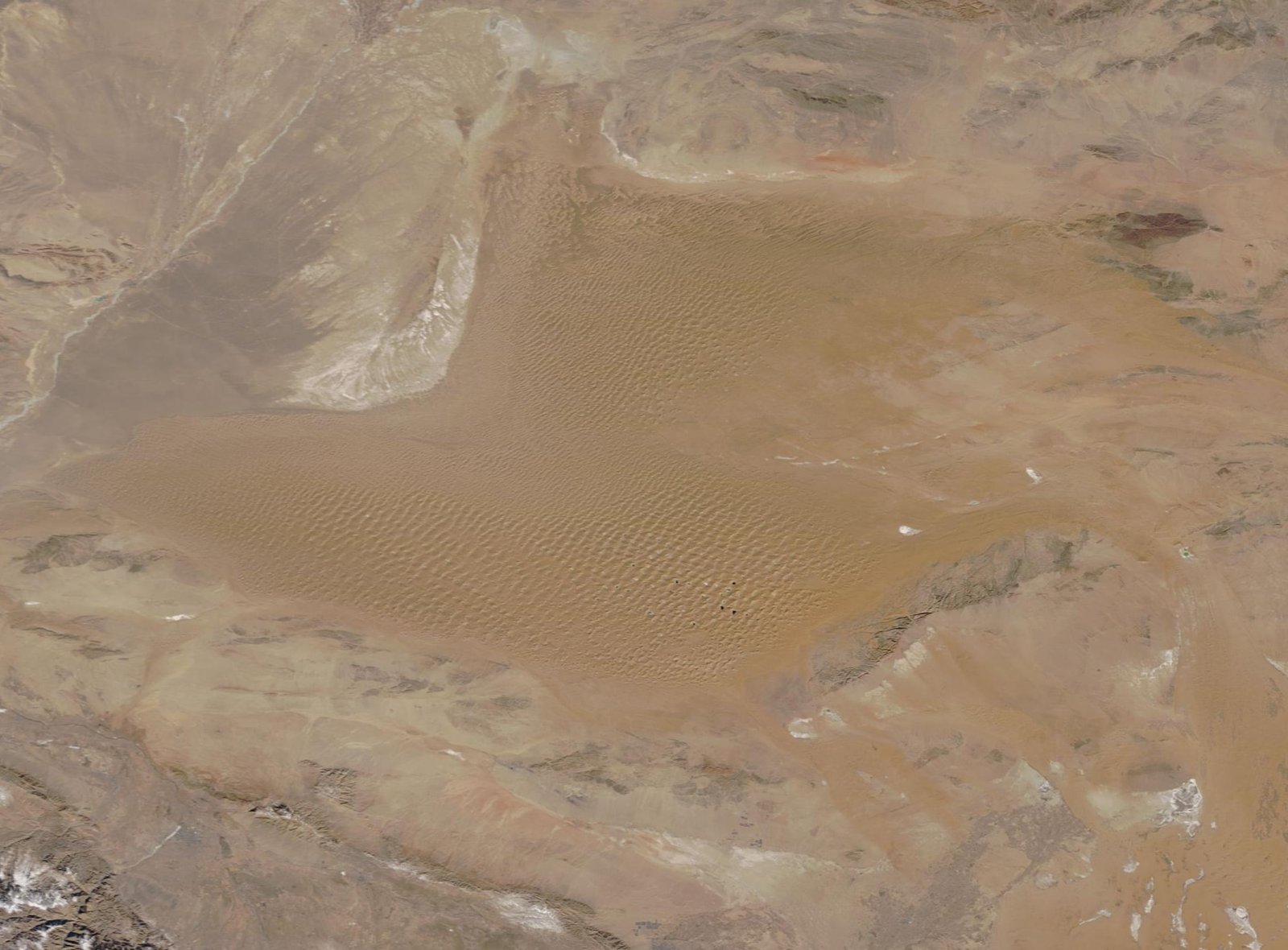
The Badain Jaran Desert sits in the far west of Inner Mongolia, in Alxa League, and it holds several records at once: the tallest stationary sand dunes on the planet, over a hundred lakes wedged between them, and, since July 2024, a UNESCO World Heritage listing as “Badain Jaran Desert: Sand Dunes and Lakes.” It is also one of the least accessible deserts in China, which is exactly why it still feels like a place rather than a theme park. This guide covers how to get there, what it costs, and what to expect. Prices and arrangements are from a 2024 trip; confirm operators and rates when you book, since desert tourism in Alxa is small and changes fast.
Where it is, and why that matters
Badain Jaran covers roughly 47,000 square kilometers, making it China’s third-largest desert after the Taklamakan and the Tengger. The name comes from Mongolian and is usually translated as something like “mysterious lake,” which is a good description, because the lakes are the oddity. Water should not exist between dunes this tall, and yet more than a hundred of them do, from freshwater springs to salt pans, their colors shifting from green to red depending on the minerals and algae in each one.
The geography dictates the logistics. The desert is far from everything: the nearest real city is Yinchuan, Ningxia’s capital, about three to four hours east by road. The gateway town is Bayantala (巴彦浩特), seat of Alxa Left Banner, a small place with fuel, supplies, and the 4×4 drivers who are the only practical way into the sand. On the desert’s eastern edge sits Ejin Banner (额济纳旗), which has its own airport and the famous poplar forests, and can be used as a second entrance if you are approaching from the east.
What you actually do out there
Nobody hikes Badain Jaran with a backpack and a map. The dunes are too big, the distances too empty, and the lakes too scattered. What visitors do is hire a local driver with a serious 4×4, typically a Toyota Land Cruiser or a similar vehicle, and spend two or three days on a loop that links the biggest dunes to the most interesting lakes.
The standard highlights:
- Bilutu Peak (必鲁图): the tallest stationary dune in the world, roughly 500 meters of relative height. The climb takes an hour or two in loose sand and is the hardest physical work on the trip. The view from the top explains the entire desert.
- Miao Haizi (庙海子): the best-known lake, with a small Tibetan Buddhist temple on its shore, built in the Qing era when the lakes were stops on pilgrimage routes. It is still a working shrine, and the monks are used to visitors.
- Dune driving: the reason to come with a local. The runs between ridges are steep, soft, and genuinely dangerous without experience, and the drivers know which slopes hold.
- Sandboarding and camels: camels are available at the base camps; sandboards are usually borrowed from the driver.
- Nights: the desert has no light pollution. On a moonless night the sky is the show, and the temperature drops hard even in summer.
There are a handful of nomad families living inside the desert, the last of the desert households, and some tours include a stop. Treat these as real visits to real homes, not as a folk-culture display.
Getting there and the money
Two practical routes in. From Yinchuan, drive or take a chartered car to Bayantala, roughly three and a half hours, then hire the 4×4 there. From Xi’an or Lanzhou, there are seasonal flights and trains to Ejin Banner on the desert’s east side, which works well if you want to combine the desert with the Ejin poplar forests in October. Neither route is quick, and that is part of the experience, or the problem, depending on your patience.
Expect a vehicle with driver to run 600 to 900 yuan per day, and a two-day one-night loop to total roughly 2,000 to 3,000 yuan per vehicle, split four or five ways, plus food and entry costs. Camping with nomad families or at basic camps runs 100 to 200 yuan a head; there are no hotels in the sand, only a few simple guesthouses near the banner towns. The desert itself is open; what you pay for is the vehicle, the driver, and the knowledge of where the water is.
How the desert compares
| Desert | Where | Signature | Access and best fit |
|---|---|---|---|
| Badain Jaran | West Inner Mongolia (Alxa) | Tallest stationary dunes, 100+ lakes, UNESCO 2024 | Multi-day 4×4 loop from Bayantala or Ejin; for serious desert time |
| Tengger | Alxa, touching Ningxia | Shapotou dunes, desert camps, five-lake crossings | Easy access from Zhongwei by train; best short desert trip |
| Kubuqi | Ordos, near the Yellow River bend | Resort dunes at Xiangshawan, desert greening story | Close to Baotou and Ordos; best for families and first-timers |
| Taklamakan | Tarim Basin, Xinjiang | Desert highways, oasis ruins, autumn poplar forests | Self-drive or long road trip; for Silk Road travelers |
If your time is short, the Tengger via Zhongwei is the sensible pick, and the Kubuqi is the family option. The Taklamakan is a road trip, not a stop, and the Badain Jaran is the one you go to when you actually want to be in a desert for a few days. Guides to each are on the site: the Tengger Desert, the Kubuqi Desert, and the Taklamakan Desert.
When to go
May through October, without argument. September and early October are the sweet spot: daytime highs in the low 20s Celsius, cold nights, and the Ejin poplars turning gold at the desert’s edge. Summer (July and August) is survivable but midday heat on the dunes is punishing, and the lakes draw mosquitoes. Spring (March to May) is sandstorm season in Alxa, and winter effectively closes the desert, with temperatures far below zero and no drivers working.
One calendar warning: the Heroes’ Meeting (英雄会), Alxa’s enormous off-road festival, runs around the National Day holiday at the start of October, about an hour from Bayantala. Hotels in the region sell out months ahead, and prices double or triple. It is a spectacle if you like off-road culture, and a booking nightmare if you do not care about it. Check the dates before you fix your travel days.
Practical notes
- Do not self-drive your first time. Rental cars are prohibited from the soft dunes, and insurance will not cover the recovery bill. Hire a local vehicle.
- Pack: sun hat, high-SPF sunscreen, sunglasses, a wind layer, closed shoes you can shake sand out of, and a sleeping bag rated below zero if camping.
- Water: carry more than you think, at least three liters a day per person, and drink it even when you are not thirsty.
- Money: phone payment works in the banner towns. There are no ATMs between Bayantala and the dunes.
- Altitude: the desert sits around 1,200 to 1,600 meters, low enough that altitude sickness is not a concern for most people.
- Respect: the temple lakes are active religious sites. Ask before photographing monks, and do not swim in the lakes locals use.
Planning the trip
The realistic itinerary is three days: one to get from Yinchuan to Bayantala and organize the vehicle, two in the desert with a night at a lake camp. Add a day on either side if you are continuing to Ejin for the poplar forests and the Heicheng ruins in October. Driving routes and the wider region are covered in the Inner Mongolia drive and road trip in China guides, and the city you will most likely fly into is covered in the Yinchuan travel guide, which also makes a good base for the Western Xia tombs.
The Badain Jaran is not a convenient desert, and that is the point. It asks for a driver, a few days, and a tolerance for sleeping on the ground, and it pays back with dunes that hum in the wind and lakes that have no business being there. If you want help building a route that combines it with Alxa’s other desert, or with a longer Inner Mongolia loop, get in touch through our contact page and we can sketch something custom.
Frequently asked questions
When is the best time to visit Badain Jaran?
September and early October for the balance of temperature and light, with the Ejin poplars turning nearby. Avoid spring sandstorms and winter cold, and check the Heroes’ Meeting dates in early October before booking.
Do I need a guide or driver?
Yes, in practice. The dunes are too steep and empty for independent driving, and the lakes are hard to find without local knowledge. Hire a 4×4 with a driver from Bayantala or through a Ejin operator, and expect to pay per day, not per person.
How do I get to Badain Jaran?
Fly or train to Yinchuan, then drive three to four hours to Bayantala in Alxa Left Banner. From the east, fly to Ejin Banner, which also puts you near the poplar forests. There is no public transport into the desert itself.
How much does a trip cost?
Budget roughly 2,000 to 3,000 yuan per vehicle for a two-day loop with driver, split among four or five travelers, plus food, camping, and entry costs. For a solo traveler this is the expensive way to travel; it is much cheaper with a group.
Are there really lakes in the desert?
More than a hundred, fed by underground water, ranging from freshwater springs to salt pans. Their colors change with mineral content and algae, and several have small temples on their shores, leftovers from the era when the lakes were pilgrimage stops.
Can I visit Badain Jaran as a day trip?
Not usefully. The drive alone eats most of a day, and the highlights are hours apart inside the sand. Plan at least two nights, one on the way in and one in the desert.
What should I pack for a desert night?
A sleeping bag rated for below zero even in summer, a wind layer, closed shoes, sun protection for the day, and three liters of water a day per person. Showers do not exist at the lake camps; wet wipes are your friend.
Written by the ChinaTravelFood editorial team.