Shandong, the northern root of Chinese cooking
Ask a Chinese chef where the country’s serious cooking comes from and a lot of them will say Shandong. Lu cuisine (鲁菜, Lu cai) is one of the four great regional traditions, and it taught Beijing and the imperial kitchens their fundamentals: clear stocks, quick frying, and a respect for the raw ingredient that you can taste. I went to Shandong expecting dumplings and got a week of food that changed how I think about northern Chinese eating.
This is a guide to eating your way across the province, from the seafood of Qingdao to the Confucian banquets of Qufu and the street stalls of Jinan. It is practical: what to order, what it costs, and how the regional styles differ. For the background on the tradition itself, our Shandong cuisine guide explains the technique and history. And if you are building a wider eating plan, our best food cities guide ranks where Shandong sits among them.
Jinan: the capital and its breakfasts
Jinan is plain, hot in summer, and underrated for food. It is the home of baizi rou (把子肉), a slab of braised pork belly served over rice with a spoon of dark, sweet-soy gravy, eaten at lunch counters for 15 to 25 RMB. The city is also famous for its springs (it is called the City of Springs) and for a breakfast of you bing (油饼, fried dough cakes) and doufu nao (豆腐脑, savory tofu custard with soy and scallion). I ate baizi rou three days running and do not regret it.
Jinan is also where you find the clearest versions of Lu cooking before the coastal seafood takes over. Look for “qing tang” (clear soup) dishes, light broths built from chicken and ham, which show the technique the province is proud of.
Qingdao: beer, seafood, and the sea
Qingdao is the tourist favorite, and for good reason. It has the seafood and beer pairing that defines the coast: a paper bag of boiled clams, a plate of grilled squid, and a fresh Tsingtao drawn from a neighborhood microbrewery. The beer here is not the bottled export; it is “laoshan” and fresh draught served in plastic bags or mugs for 5 to 10 RMB. The seafood is priced by the jin (500 g) and cooked simply, steamed or with garlic and vermicelli.
Order the sea cucumber (hai shen) if you want the luxury dish; it is expensive (100 to 300 RMB) and an acquired texture. The everyday win is the clam and the small fried fish with a cold beer. Go to the seafood markets near Yunxiao Road and have your purchase cooked at a neighboring stall for a small fee.
Qufu: the Confucian table
Qufu, Confucius’s hometown, is the place for Kong fu cai (孔府菜), the Confucian family cuisine. It is refined, symbolic, and served as a set banquet rather than à la carte. Dishes have names drawn from the classics, and the presentation is careful. A full banquet is pricey (200 to 500 RMB per person) and geared to groups, but smaller set menus exist. I tried a “scholar’s” set at a restaurant near the Confucius Temple and found it lighter and less oily than I expected, with a lot of gently braised vegetables and a famous pear-shaped dumpling.
Qufu is a half-day sight (the temple and the mansion) plus a meal, easily done from Tai’an or Jinan by train. The food is the reason to stop rather than the sights alone.
Taian, Dezhou, and the staples
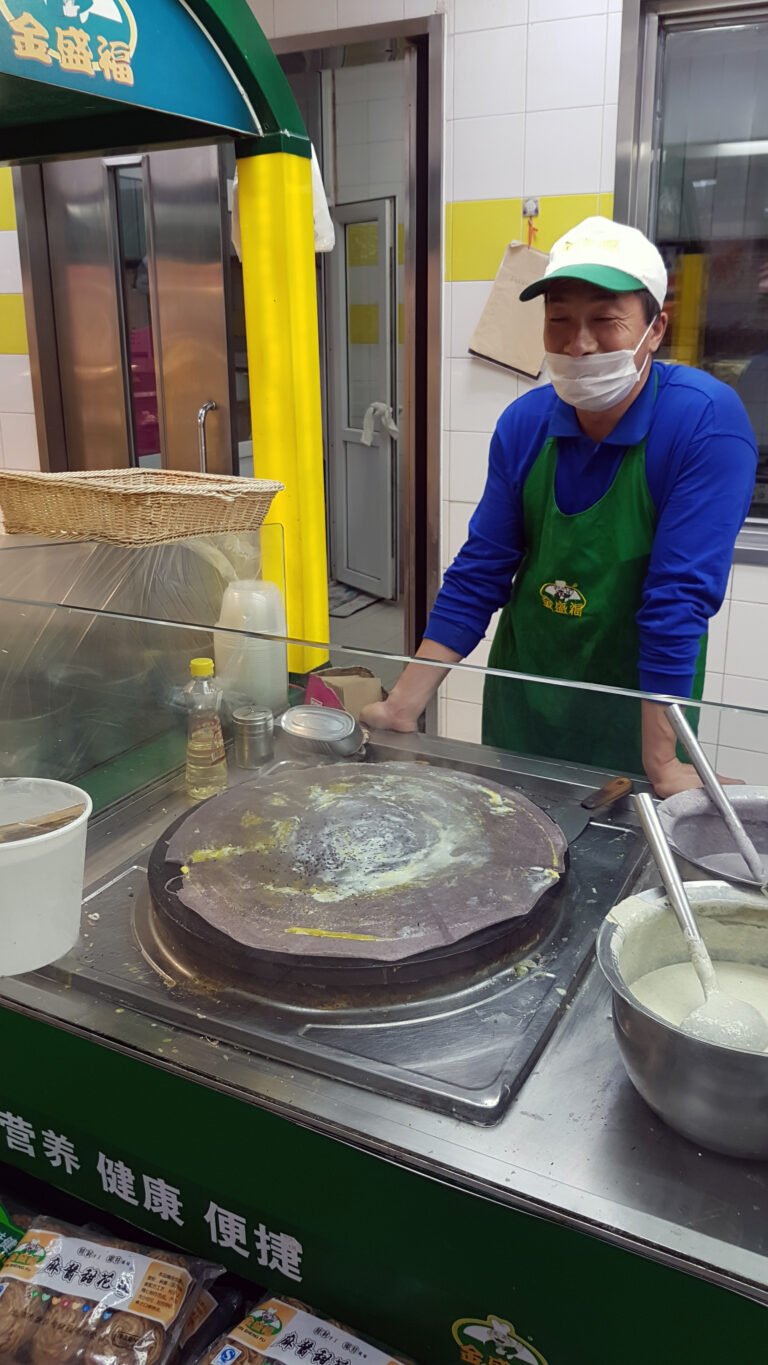
Near Mount Tai, Taian serves the mountain-pilgrim staples: tai’an pancake (taishan jianbing, different from the breakfast jianbing) and simple noodle soups. Dezhou, on the rail line, is famous for Dezhou pai ji (德州扒鸡), braised chicken so tender the meat slides off the bone, sold at stations and shops for 25 to 40 RMB a bird. Buy one at the Dezhou station on your way through; it travels well and tastes better at room temperature than hot.
Across the province, the bread is the story. Shandong makes thin, large pancakes (jianbing in the local sense, not the breakfast crepe) wrapped around scallions and sauces, and big steamed buns (mantou) that are a meal themselves. Our baozi guide covers the stuffed version; the plain mantou here is the local everyday carb.
Noodles and dumplings
Shandong noodles are wheat, firm, and served in clear broth or with zhajiang (fried bean paste) sauce. The dumplings are large, often with leek and pork or seafood fillings on the coast. A plate of 15 dumplings runs 20 to 35 RMB. For the regional range, our Chinese noodles guide maps where Shandong’s wheat ribbons fit, and the dumpling guide explains the folds you will see on the plate.
| City | Signature dish | Typical price | Where to eat it |
|---|---|---|---|
| Jinan | Baizi rou (braised pork over rice) | 15 to 25 RMB | Lunch counters, old city |
| Qingdao | Fresh Tsingtao draught and clams | 5 to 30 RMB | Neighborhood breweries, Yunxiao Rd |
| Qufu | Kong fu cai banquet | 200 to 500 RMB/person | Set menus near the temple |
| Dezhou | Dezhou braised chicken | 25 to 40 RMB/bird | Station shops, takeaway |
| Taian | Mount Tai pancakes, noodle soup | 10 to 20 RMB | Foot of Mount Tai |
Quick facts
- Lu cuisine is one of China’s four great regional traditions, rooted in Shandong
- Jinan’s baizi rou is a braised pork lunch for 15 to 25 RMB
- Qingdao’s fresh draught Tsingtao costs 5 to 10 RMB, not the bottled export
- Qufu’s Confucian banquet is symbolic and served as a set menu
- Dezhou braised chicken is sold at stations and travels well
- Shandong’s everyday carb is the thin pancake and the big mantou bun
- Seafood on the coast is priced by the jin (500 g) and cooked simply
How a Shandong meal ends
The close of a northern meal is different from the south. In Shandong you do not get a sweet dessert by default; you get fruit, or a bowl of congee, or nothing, and the table often ends with tea poured round again. The baijiu appears at banquets (see our baijiu guide for the toasting etiquette) and business dinners, never at a casual noodle lunch, and the toast ritual is the same as elsewhere: raise with both hands toward the senior person, sip, and set it down. Beer is the relaxed choice, especially the local Tsingtao in Qingdao, and a row of empty green bottles at the end of a seafood meal is the regional sign of a good time.
Breakfast deserves its own note because it is where the province’s everyday carb shows up. The mornings run on youtiao (fried dough sticks) dipped in soy milk, on congee with pickles, and on the thin Shandong pancake wrapped around a scallion and a smear of sauce. The pancake here is not the Beijing breakfast crepe; it is a large, dry, pliable round that keeps for a day and was the traveler’s bread before the railway arrived. I bought one from a grandmother near the Jinan station and ate it across two train rides; it held up better than any sandwich would have.
Frequently asked questions
Is Shandong food spicy?
No. It is salty, savory, and built on clear stocks and quick frying, with little chili. If you want heat, you add it yourself. This makes it a good region for travelers who find Sichuan and Hunan too hot.
What is the one dish I should not miss?
Baizi rou in Jinan for the everyday version, and the seafood-plus-beer ritual in Qingdao for the experience. The Dezhou chicken is the best thing you can carry on a train.
Is the Confucian banquet worth the price?
If you care about food history, yes, as a one-time splurge with a group. Solo travelers can order a smaller set. It is more about refinement and symbolism than bold flavor, so set expectations accordingly.
How do I get between these cities?
The high-speed rail connects Jinan, Qingdao, Qufu, Tai’an, and Dezhou tightly; most hops are under two hours. Fly into Jinan or Qingdao. The province is one of the easiest to tour by train in China.
Can vegetarians eat well in Shandong?
Better than in meat-heavy north. There are braised vegetables, tofu dishes, and the Buddhist-influenced items on the Confucian set. Tell the cook “chi su” (I eat vegetarian) and expect more options than in Sichuan.
What should I drink with the food?
Beer in Qingdao, of course, and baijiu at banquets elsewhere. Tea is the default table drink. The coastal clam-and-beer combo is the regional signature and hard to beat on a summer evening.
When is the best time to visit for food?
Autumn (September to November) for seafood and mild weather. Summer is good for the Qingdao beer scene but hot inland. Spring is fine and less crowded than the holiday weeks.
If you want a Shandong route built around the seafood, the Confucian banquet, and the station chicken, we can plan a custom food-and-travel itinerary through the contact page. The province rewards a slow train ride with a full stomach at every stop.
Written by the ChinaTravelFood editorial team.