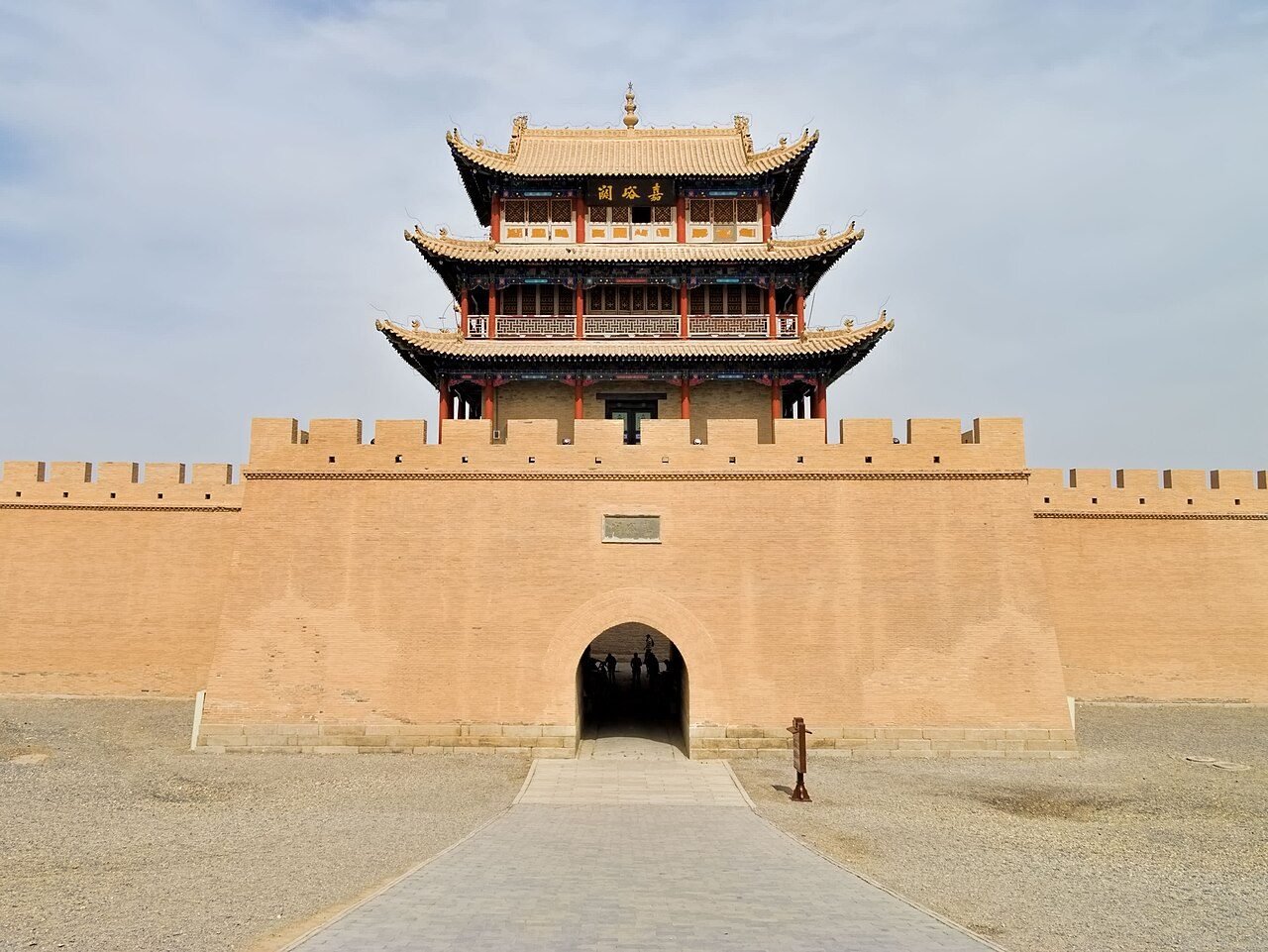
Everyone meets the Great Wall in Beijing first, where it climbs green ridges and behaves like a monument. The other end is a different object entirely. Jiayuguan Fort (嘉峪关) sits at the western terminus of the Ming Wall, built in 1372 where the Hexi Corridor pinches down to a narrow ribbon of farmland between the Gobi and the snow peaks. I stood on the rampart there with wind coming off the desert and understood the logic in about five seconds: past this point there was no more land worth enclosing, so the empire stopped.
Jiayuguan is not a wall segment so much as the full stop at the end of a very long sentence. Two centuries of defensive building across northern China ran west along the corridor and then quit here, in open scrub, because everything beyond was trade routes, pasture, and raiders.
Why the builders stopped exactly here
The Hexi Corridor is the reason anything exists in western Gansu. For roughly a thousand kilometres it is the only reliably passable strip between the Tibetan plateau to the south and the deserts to the north, carrying water from the Qilian mountains and every caravan going east or west. Whoever held the narrow points held the Silk Road.
Jiayuguan sits at the western narrowing. By the Ming dynasty the dynasty was in retreat mode: it had lost the steppe, it was paying for garrisons it could not properly supply, and it wanted tariffs and control rather than conquest. A fortified customs point at the pinch was the sensible purchase. Everything farther west could be handled by desert.
Walking the fortress
The fort is a compact citadel with an inner and an outer enclosure, corner towers, and a gate complex protected by screens so that attackers entering one gate could not see straight through to the next. The material is tamped earth with brick facing, built in layers of soil, sand, and gravel pounded until it sets nearly like concrete. Unlike the Beijing sections that have been rebuilt into crisp staircases, this is largely original fabric, and it shows its age honestly: blunt edges, wind-scoured corners, colour that runs from grey to ochre depending on the hour.
Climb the main tower. From the top you look east down the line of the wall and toward the farms of the corridor, then turn and look west into open desert with the snow line of the Qilian range lying along the horizon. That two-way view is the reason to come. Nothing in a museum explains it half as well.
The brick-count legend
Every Chinese fort has a legend and Jiayuguan’s is good. When the outer wall was commissioned, the story goes, an official demanded to know how many bricks would be needed. A supervisor named Yi Kaizhan gave an exact figure, and when the work finished there was reportedly one brick left over, which was set in a niche above the western gate where you can still see it. Whether or not you believe it, the story tells you what locals value about the place: precision, honesty, and the idea that wasting nothing is a virtue.
The Gate Tower and the small museum
Inside the enclosure there are displays on garrison life, construction technique, and the trade that passed through. English signage is thinner than in Beijing but better than nothing, and the diagrams of the tamped-earth method are worth stopping for. I would not build my day around the museum, though thirty minutes there makes the wall legible.
The Overhanging Wall: take this one if time is short
A few kilometres north of the fort is the Crouching-Arm Wall, usually called the Overhanging Wall, a restored section that climbs a ridge at grades around forty degrees because the ridge itself is steep. It looks like a wall trying to stand up straight on a slope, hence the name. It is a short, hard afternoon: maybe ninety minutes round trip with photo stops.
This is the part that gives you the physical moment. You climb steps set into a gradient, the corridor drops away behind you, and the wind arrives unimpeded. Carry water, because there is none on the ridge, and go in the morning before the metal gets hot and the light becomes flat.
If what you actually wanted was the classic Beijing experience, the Mutianyu section near Beijing is the one I send people to: forested ridges, restored paving, easy access. Jiayuguan is its opposite in every respect, and seeing both changes how you read the whole defensive system.
The First Beacon Tower and the areola extras
The First Beacon Tower sits south of the fort on the far bank of a river gorge, a tall, stark tower on a bluff with the corridor laid out beneath it. Most visits include it on a combined ticket. It photographs well at sunset and it takes twenty minutes.
Also nearby and too often skipped: the Wei and Jin tombs east of the city. These are third-to-fifth century brick-lined graves decorated with painted bricks showing hunting, herding, kitchen scenes, and feasting. If you have ever wondered what ordinary life looked like on this corridor before the Tang dynasty, those small painted bricks answer it better than any amount of reading. I went expecting a cave and came out thinking about the cooking bricks.
Getting there and building the Hexi Corridor route
Despite the emptiness around it, Jiayuguan is easy to reach. The city has its own high-speed station on the Lanzhou to Xinjiang line, with Lanzhou roughly four to six hours east depending on the service and Dunhuang a couple of hours west. The fort itself is a short taxi ride from town, cheap enough that nobody bothers with the bus for the last leg.
The natural loop is a slow run west along the corridor: Lanzhou, then the Danxia cliffs near Zhangye, then Jiayuguan, then Dunhuang. From Dunhuang the Mogao Caves are the artistic payoff of the whole province, and the singing dunes and Crescent Lake are twenty minutes outside the same town.
| Stop | See it for | Time needed | Drawback |
|---|---|---|---|
| Lanzhou | Beef noodles, rail hub | Half day | Few sights worth more |
| Zhangye Danxia | Banded rainbow cliffs | Half day | Light-dependent: go at sunrise or late afternoon |
| Jiayuguan | The western wall terminus | One day | Wind |
| Dunhuang | Mogao, dunes, night market | Two days | Long distances either side |
Food in Jiayuguan
This is northwest China, so the plate is lamb, wheat, and more lamb. The local pride is the skewers: chunks of mutton over coal with heavy cumin and chili, eaten standing at a stall with a cold beer. Prices per stick run a few yuan, and a proper evening eating thirty skewers between two people costs less than a hotel breakfast in Shanghai. The tradition is the same one described in our Chinese BBQ skewer guide, and the differences here are subtle: coarser salt, fattier meat, more Xinjiang influence than Beijing gets.
Beyond skewers, look for hand-pulled lamian with lamb, fried flatbreads that soak up juice, and the local take on cold noodles. The Xinjiang food tradition across the border to the west is the deeper version of everything you eat here, and if this is your first exposure, expect it to be heavier and more cumin-forward than anything in the south.
The night market by the central square is where I would eat. I paid about 35 yuan for cumin lamb and a bowl of pulled noodles and watched grill smoke drift across the square on a night that was near freezing by eleven. The food here is fuel as much as pleasure, which makes sense once you have stood on that rampart in October.
Wind, season, and what to carry
The wind is the thing everyone underestimates. It comes off the Gobi carrying grit, it finds the gap in your jacket, and it turns the Overhanging Wall from a pleasant climb into sandblasting on a bad day. Sunglasses, something to cover your face, and lip balm are not fussy extras. Check the forecast before you commit to the ridge.
September and early October are my recommendation: clear air, snow already on the Qilian peaks, comfortable days, cold nights. Summer is hot and glaring with heavy Chinese holiday traffic. Winter gets to minus fifteen and the fort is empty, which some people will love. Our Silk Road food trail from Xi’an to Kashgar traces the same corridor and covers seasonal timing along the whole route.
Where to stay and how long you need
The town has mid-range hotels from roughly 250 yuan and a cluster near the station. One night is standard. A half day covers the fort and the First Beacon Tower, another ninety minutes handles the Overhanging Wall, and the tombs need another hour if you go. With travel from Dunhuang or Lanzhou, Jiayuguan is a one-day, one-night stop rather than a destination to settle into.
I stayed one evening and the best part was after everything closed, eating in town with the wind banging the signage outside. That is the honest pattern here: the sights do their job in daylight, the food does the rest.
Quick facts
- Location: Jiayuguan city, Gansu, at the western narrowing of the Hexi Corridor.
- Built: 1372, marking the western end of the Ming Great Wall.
- Structure: inner and outer enclosures, corner towers, mostly original tamped earth.
- Nearby: the Overhanging Wall climb, the First Beacon Tower, the Wei-Jin painted tombs.
- Access: own high-speed rail station; roughly two hours east of Dunhuang.
- Typical visit: half a day at the fort, ninety minutes at the Overhanging Wall.
- Food: lamb skewers with cumin, hand-pulled noodles, flatbreads.
- Weather: persistent Gobi wind; bring eye protection and a face covering.
- Best window: September to early October.
Frequently asked questions
How long should I spend at Jiayuguan?
Half a day for the fort and the beacon tower, plus ninety minutes at the Overhanging Wall. Add travel and it is a comfortable one-day stop with one overnight.
Is it worth coming all the way west for this?
If you already care about the wall, yes, because the emptiness is the point. If walls leave you cold, pair it with Dunhuang so the day has the caves and the desert too.
Can I walk on the wall itself?
Yes on the fort ramparts and the restored Overhanging Wall. The unrestored earthen stretches outside the fort are protected and off limits, so stay on marked paths.
How do I get there from Dunhuang?
By high-speed train, roughly two hours, or by road in about four. Taxis from Jiayuguan centre to the fort gate are cheap and take minutes.
What should I wear?
Sturdy shoes for the steep steps, a windproof outer layer, sunglasses, and something over your mouth on a bad day. Sunscreen matters even in autumn.
Is English spoken at the site?
Some signage, less than in Beijing. A translation app handles anything unclear, and the simple and perhaps obvious things like tickets and directions need no language at all.
What else should I not miss nearby?
The Wei-Jin painted tomb bricks, twenty minutes from town. They are small, quiet, and often completely empty of visitors.
Want a Hexi Corridor route that strings Jiayuguan, Zhangye, and Dunhuang together with skewer stops that are actually worth it? Send your dates and how you like to travel on the contact page.
Written by the ChinaTravelFood editorial team.