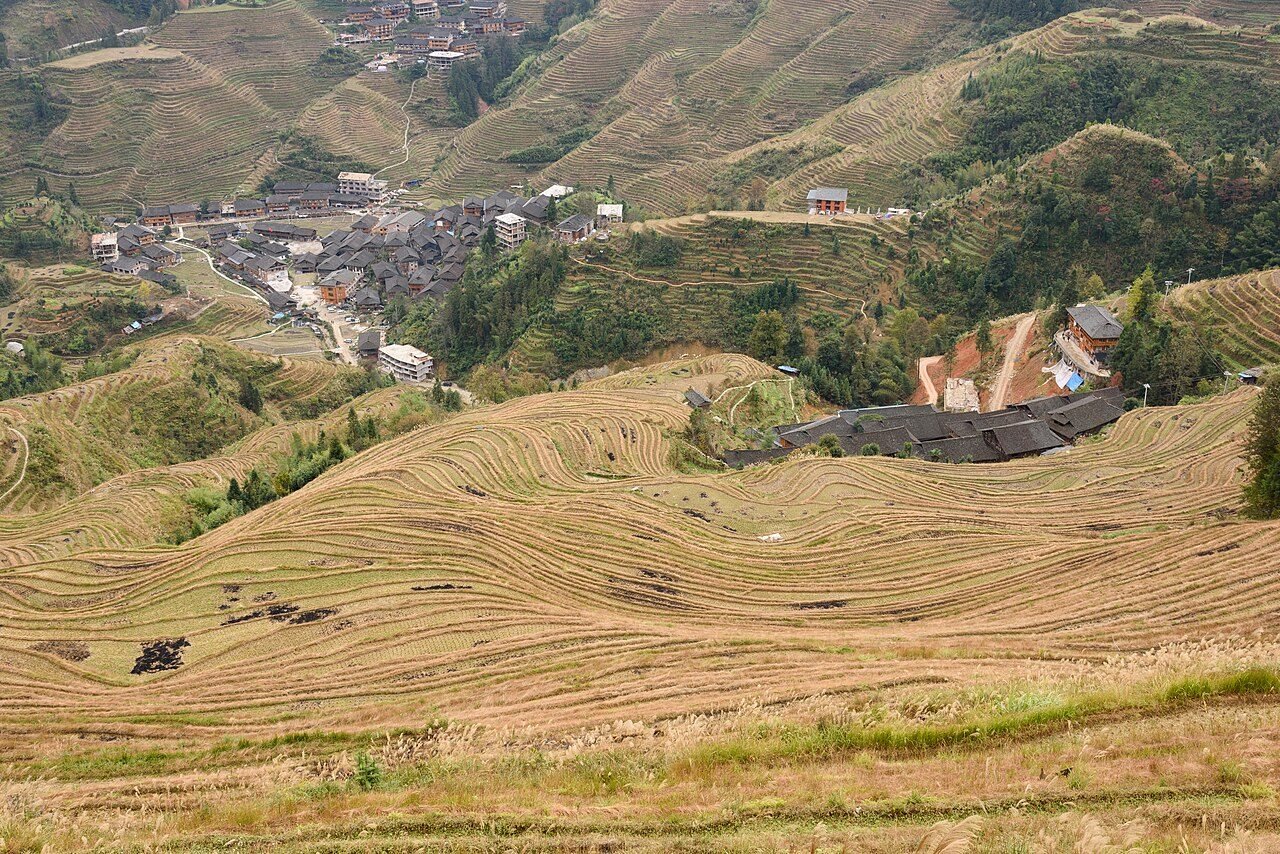
The hills that look like dragon scales
I had seen photographs of Longji, the “Dragon’s Backbone” terraces, for years and assumed they were doctored. They are not. The rice terraces climb the slopes in ribbons so precise they look embroidered, layer after layer up to the ridgeline, and when I stood at the top viewpoint at sunset and watched the water-filled paddies turn to mirrors, the real thing beat the picture for once.
Longji sits in Longsheng county in northern Guangxi, a few hours by road from Guilin, and the terraces have been cut into these slopes by Zhuang and Yao families since around the Yuan dynasty, so roughly six or seven centuries of continuous farming. That matters, because this is not a park built for visitors. People still plant, weed, and harvest these fields, and the reason the water is let into the paddies in May is agricultural, not photographic. What you are looking at is a working landscape that happens to be spectacular.
Getting there from Guilin
Most visitors base in Guilin and go north by road, about two to three hours depending on which village you are heading to and how the last stretch of mountain road is behaving. I did exactly that, and the drive past karst peaks and river towns was a decent warm-up for the main event. Trains reach Guilin from most of the country, and you can book them through the same national system described in how to buy China train tickets. Plenty of travelers combine the terraces with Yangshuo downstream, which works if you are happy with two rural stops in one trip.
| Route | Time | Note |
|---|---|---|
| Guilin to Ping’an village | About 2 hours by car | Tourist buses and private cars both run it |
| Guilin to Jinkeng Dazhai | 2.5 to 3 hours by car | Longer, rougher final climb |
| Guilin to Longsheng town, then local bus | Half a day | Cheapest, slowest, needs patience |
| Yangshuo to Longji | 3 to 4 hours | Direct tourist buses in season |
| Parking lot to village | 20 to 40 minutes on foot | Uphill; porters available for bags |
The last detail catches people out. The road ends at a parking area below each village, and from there you walk up stone steps for twenty to forty minutes. Porters will carry your bag for a small fee and it is money well spent if you have a wheeled suitcase, which is genuinely useless here. Pack a soft bag.
The three terrace areas, side by side
Ping’an, the Zhuang village
Ping’an is the classic Zhuang settlement and the one on most postcards. It is compact, the terraces wrap tightly around it, and the two named viewpoints you will see referenced everywhere, “Seven Stars with the Moon” and “Nine Dragons and Five Tigers,” are both a short climb above the village. I stayed here for the atmosphere: wooden houses stacked up the slope, laundry lines, and dogs asleep in the shade of the drum tower. The scale is smaller than Dazhai’s but the composition is tighter and, to my eye, better.
Jinkeng Dazhai, the Red Yao area
Dazhai is the larger and higher Red Yao area, with three separate viewpoints strung along the ridge: Xishan Shaole for the sunset, the Thousand-Layer Stairway for the middle terraces, and Golden Buddha Peak at the top. A cable car runs up to Golden Buddha Peak, which opened in the 2010s and saves a serious climb. The vistas here are bigger and more open, and the village itself has spread a lot as guesthouses have multiplied. I like it for scale and prefer Ping’an for feel.
The Ancient Zhuang village and Huangluo
The Ancient Zhuang village, below Ping’an, has the oldest surviving terraces and far fewer visitors. It is a quiet hour’s add-on and worth it if you have the time. Huangluo, near the park entrance, is the Red Yao village known for the women’s long hair, often worn coiled and reaching past the knee. Huangluo stages regular song-and-dance performances for tour buses. I have mixed feelings about it: the hair tradition is real, the show is a show, and the two get blurred together in a way that made me uncomfortable.
The viewpoints and where the light goes
Three times of day matter, and they are not equal. Sunrise on the water terraces gives you the mirror effect with mist in the valleys, and it requires an early start from whatever guesthouse you are in. Late afternoon into sunset is the reliable one, when the flooded paddies go copper and the ridge lines flatten into layers. Midday is the time to sleep, eat, or walk the trails, because the light is flat and the terraces lose their depth.
Which viewpoint you choose depends on the season’s look. In the flooded months the low viewpoints near the water work better, since reflections need you close to the surface. At harvest, the higher viewpoints do more, because the pattern of gold bands only reads from above. I shot both seasons and thought the harvest needed the height more.
When to go, season by season
| Window | What you see | Verdict |
|---|---|---|
| Late April to mid-June | Flooded paddies, mirror reflections, planting | My favourite; go in May |
| July to August | Green rice, growing tall, no mirrors | Lush but visually flat |
| Late September to mid-October | Golden rice, harvest in progress | The other iconic look |
| Late October onward | Cut fields, bare terraces, some flooded for photography | Hit and miss |
| Winter | Bare steps, occasional snow at the top | Empty and cold |
Best time to visit China answers this differently for nearly every region, and for Longji specifically the answer is May or the last week of September into the first half of October. Avoid the first week of October if you possibly can: the National Day holiday empties the cities into the countryside and the villages fill completely, with prices doubling and the viewpoints shoulder to shoulder. I made that mistake once and will not repeat it.
The harvest date shifts by a week or two each year depending on the weather and the altitude of the particular terrace, so if you are planning around gold rather than water, ask a guesthouse owner in the village a week before you travel. They know better than any guidebook, including this one.
Hiking between the ridges
The trails connecting the villages are the real joy of the place, and they are walked by farmers rather than maintained for tourists, which is part of why they feel good. Ping’an to Dazhai over the ridge takes three to four hours at a relaxed pace and crosses two saddles with long views both ways. Shorter options run from Ping’an to the smaller hamlets on either side, and those gave me the long stretches of complete solitude I remember best: no one around but the sound of water moving through the paddies.
Wear shoes with real grip, because the stone steps turn slick after rain, and carry water. A local guide is optional for the short walks and useful for the cross-ridge route, where the path forks in a couple of places and a wrong turn costs an hour. Most guesthouses can arrange one for a modest fee.
Eating in the villages
Mountain cooking here is simple and better than it needs to be. Bamboo rice, glutinous rice packed into sections of bamboo and roasted over coals, is the signature and comes apart in a smoky, chewy cylinder. Free-range chicken goes into a clear hot pot with local greens. Smoked pork, cured over the kitchen fire, turns up in stir-fries with wild herbs and chili.
The dish I would tell you to order specifically is he hua yu (荷花鱼), fish raised in the flooded paddies alongside the rice and eaten in autumn, when they are fat from a season of eating insects off the plants. It is usually braised with pickled chili and it is excellent. Ask at your guesthouse the night before, because it is often cooked to order.
The Guilin food guide covers the regional style down in the valley, which shares the smoke-and-river-fish theme. Up here the portions are honest, the vegetables are picked that morning, and a hot pot of local greens after a day of walking hits harder than any restaurant meal you will have in the city.
Where to stay and what it costs
Stay inside one of the villages. This is the single piece of advice I would insist on, because the light at dawn and dusk is the whole point and a day trip means seeing the terraces at harsh midday. Guesthouses are family-run wooden houses with rooms in the 150 to 400 yuan range depending on season and whether you have a terrace view. Book ahead for May weekends and for the harvest window, when the good rooms go first.
Scenic area entry runs around 100 yuan at last check, with the Dazhai cable car a separate ticket if you use it. Confirm both at the gate, since prices and policies change. The villages are not fancy: hot water can be intermittent, the walls are thin, and the wooden construction means you hear every footstep above you. I find that a fair trade for waking up above the clouds.
Quick facts
- Longji is in Longsheng county, Guangxi, two to three hours north of Guilin by road.
- Terraces cut by Zhuang and Yao families over roughly six centuries.
- Best looks: flooded mirrors in May, golden harvest late September to mid-October.
- Three areas: Ping’an (Zhuang), Jinkeng Dazhai (Red Yao), and the older Zhuang village.
- Stay a night; the dawn and dusk light is the reason to come.
- Entry is around 100 yuan; the Dazhai cable car costs extra.
- The final walk up from the parking lot is 20 to 40 minutes; pack a soft bag.
- Avoid the National Day holiday in the first week of October.
- Eat the bamboo rice and the paddy-raised fish.
Frequently asked questions
Should I stay overnight or day-trip from Guilin?
Stay overnight. The light at dawn and dusk is the whole point, and a day trip means seeing the terraces at harsh midday with worse crowds. I regretted nothing about the extra night.
Which area is better, Ping’an or Jinkeng Dazhai?
Ping’an for tight, classic terraces and village atmosphere; Dazhai for bigger scale and a cable car if you do not want to hike. I preferred Ping’an’s feel and shot Dazhai’s vistas.
When are the terraces most photogenic?
Late April to mid-June for the water mirrors, and late September to mid-October for the golden rice. Confirm the harvest timing with a village guesthouse a week before you go, because it moves.
Is the hiking hard?
Moderate. Stone steps and slopes, slick when wet. Fit travelers manage fine, and the cable car at Dazhai helps anyone who would rather not climb.
How do I get there without a car?
Direct tourist buses run from Guilin and Yangshuo in season, or take a bus to Longsheng town and change. Book through your hotel or the bus station. The last stretch is mountain road, so allow extra time.
Is it respectful to photograph the Yao women?
Ask first, and expect a small fee for a posed shot. The photography etiquette guide covers this in detail; a polite request goes further than a long lens.
Can I visit in winter?
Yes, and you will have the place nearly to yourself, but the fields are bare and the top of the ridge can be genuinely cold. Only go in winter if you mainly want the walk and the quiet.
Is it suitable for children or older travelers?
Partly. The villages involve steep stone steps and a climb from the parking area, which rules out anyone with serious mobility limits. The Dazhai cable car and the lower viewpoints make a partial visit possible.
Planning a Guangxi route
Longji pairs naturally with Guilin and Yangshuo for a karst-and-terrace loop through Guangxi, and the order matters: do the river first, then climb into the hills. If you want a custom food-and-travel plan that includes the terraces with the right bus, a village stay, and the season picked to match the light you want, contact us and we will shape it to your dates.
Written by the ChinaTravelFood editorial team.