Mount Fanjing: The Two Temples on a Cloud Summit
I first saw Mount Fanjing (梵净山) in a friend’s photo and assumed the top had been edited. Two temples sitting on a thin spike of rock, separated by a crack you could almost jump, with cloud pouring past like spilled milk. Then I stood there myself in May, wind shoving me sideways, and the photo turned out to be the understatement. This is one of the strangest peaks in China, and unlike the famous mountains that everyone queues for, it still feels half-secret.
Fanjing is in northeastern Guizhou, part of the Wuling range, and it was named a UNESCO World Heritage site in 2018 for its living biodiversity. The number that stuck with me: the mountain shelters the Guizhou golden monkey (Rhinopithecus brelichi), a primate found almost nowhere else, with a pale blue face and a taste for lichen. I did not see one. Most visitors do not. The forest is too thick and the monkeys too shy, which is probably how they have survived.
The mountain that looks Photoshopped
Fanjing’s weirdness is geological. About 1.4 billion years ago the area was a shallow sea, and layers of sedimentary rock were pushed up and eroded into the isolated pillar shapes you see today. The Red Cloud Golden Summit is the dramatic one, but the mountain also has a lower Old Golden Summit (老金顶, Lao Jinding) that most visitors skip and should not, because the walk along the ridge between the two is the most beautiful stretch of the whole climb, with moss, ferns, and sudden windows of cloud.
The UNESCO listing came after years of conservation work, and the cap on daily visitors is a direct result. On a clear day you can see why the place was sacred long before the award: the pillar seems to float, and the two temples on top read as a pair of hands holding up the sky.
What the summit actually is
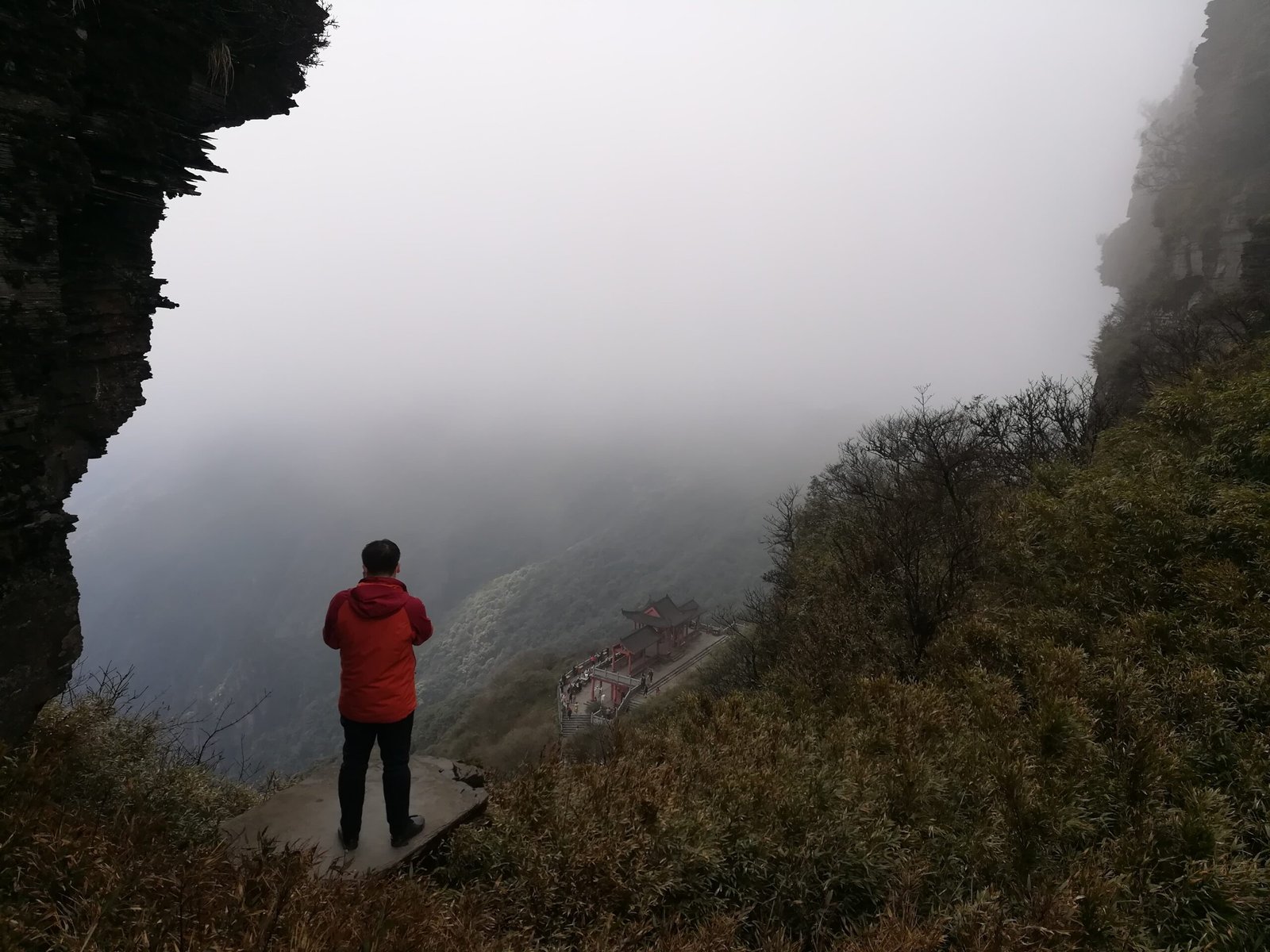
The climb ends at the Red Cloud Golden Summit (红云金顶, Hongyun Jinding), a near-vertical pillar around 100 meters tall that you reach by a chain-assisted stair. At the top, two small temples stand on either side of a narrow crevasse. One honors Sakyamuni, the other Maitreya. A tiny bridge links them, and standing on it with wind from both valleys is the moment the whole trip is built around. The locals call the gap a symbol of the past and the future meeting. I just thought it was a good place to hold the rail.
Below the golden summit, the better-known landmark is Mushroom Rock (蘑菇石), a stacking of boulders that has stood for, geologists say, ten million years. It does look like a mushroom that forgot to fall over. Early risers catch it wrapped in cloud while the sun burns the mist off the lower slopes, and that is the postcard shot. Get there before 8 a.m. if you can; by mid-morning the tour groups from Tongren fill the viewing deck.
A working Buddhist site
Fanjing is one of the holy mountains of Chinese Buddhism, associated with the Maitreya (future Buddha) tradition. The monasteries on the mountain were damaged and rebuilt more than once; the current temples are recent but the pilgrimage track is old. You will pass monks and lay visitors on the steps, and the incense smell mixes with the damp pine. I found the religious layer quieter and more sincere than at some better-known sites, maybe because the climb keeps the casual crowd down. The fasting cliff (舍身崖), where pilgrims once made vows, is a short, dizzying side path I would not take in wet weather.
Getting to the trailhead
The gateway town is Tongren (铜仁), which has a high-speed rail station and an airport with limited flights from Guiyang and Chongqing. From Tongren you take a bus or hired car to the Fanjing visitor center at the foot of the mountain, roughly an hour and a half by road; the public shuttle runs hourly and costs about 20 yuan. Trains from Guiyang take around two hours, and from Chongqing about three, so the mountain fits into a Guizhou or Chongqing loop better than you might expect.
At the base, a sightseeing bus carries you up a long winding road to the lower cable car station, included in the ticket. You can walk instead, but the walk is steep and long, and most visitors take the cable car up and decide on the descent later. The cable car itself is a ride worth the money: it rises through layers of forest and, on a clear day, gives you the first real look at the summit pillar from a distance.
The stairs are the real test
From the upper cable car station to the golden summit is a serious climb on stone steps, some of them steep enough that the handrails are slick from use. The local claim is 8,888 steps from the base, which is an exaggeration in the useful direction. I am reasonably fit and it took me about an hour and a half with stops. People with bad knees or weak lungs should take it slow. The air at the top is thin enough to notice if you come from sea level, though the summit is only around 2,570 meters. For context on how your body handles Chinese heights, our altitude sickness notes for Tibet and the west cover the bigger climbs, and the advice on pacing applies here too.
Tickets, costs, and the daily cap
| Item | Cost | Note |
|---|---|---|
| Park entry | ¥90 low / ¥110 peak | Peak is roughly March-November |
| Sightseeing bus | ¥20 round trip | Included in some combo tickets |
| Cable car | ¥160 round trip | ¥90 up / ¥70 down if split |
| Daily cap | about 8,000 entries | Sells out on holidays, book online |
Buy the combined ticket through the official WeChat mini-program before you travel, and pick a date and a morning entry slot. The mountain limits daily visitor numbers to protect the ecology, and during the two Golden Weeks the slots sell out days ahead. Our month-by-month travel guide has the broader regional picture if you are planning a longer trip.
When to go, and what to expect from the weather
Fanjing sits in a wet belt, so cloud and drizzle are common in any month. That is also why the sea-of-clouds shows up, but it means you should pack for rain and disappointments. I went in May and got one clear sunrise and one fully socked-in afternoon. Spring and autumn are the steadiest bets for views. Summer is green and busy; winter can close the upper paths after ice, though the rare clear winter day is spectacular.
Food around the base
The town at the foot of Fanjing is small and the food is plain Guizhou: sour, hot, and built around rice and river fish. Try the local tofu and the cured meats, and ask for the wild greens in spring. The mountain itself has no restaurants past the lower stations, so eat before you go up or carry snacks, because the climb burns through calories fast. For a wider map of what the province eats, the minority and mushroom cooking of neighboring Yunnan is worth reading, and if you want the signature sour soup, our Xijiang Miao village food walk explains suantangyu in detail. The Miao villages northwest of Tongren also make a good cultural add-on to the mountain day.
Quick facts
- Location: Tongren, northeastern Guizhou, in the Wuling mountains.
- Status: UNESCO World Heritage site since 2018.
- Summit: Red Cloud Golden Summit, about 2,570 meters, with two temples split by a gap.
- Landmark: Mushroom Rock, a balanced stone stack said to be ~10 million years old.
- Wildlife: home of the endangered Guizhou golden monkey, rarely seen.
- Access: high-speed rail or flights to Tongren, then bus to the visitor center.
- Cost: roughly ¥270 all-in (entry, bus, cable car) at peak; book a dated slot ahead.
- Tip: daily entry is capped at about 8,000; book your slot ahead, especially on holidays.
Frequently asked questions
Is the climb dangerous?
The steps are steep and exposed in places, with chains to hold, but it is a managed tourist route, not a wilderness hike. People in ordinary sneakers do it. The risk is slipping on wet stone and overuse of knees, not falling off the mountain. I saw a woman in dress shoes regret her choice by the midpoint.
Can I do Fanjing as a day trip from Tongren?
Yes. Buses run early from Tongren and get you to the base in around ninety minutes. A full visit, including the cable car both ways and time on the summit, takes most of a day, so start early. I would not try to combine it with another major sight the same day.
Will I see the cloud sea?
Maybe. It depends on weather and timing; clear mornings after rain are best. Treat the cloud sea as a bonus, not a promise, or you will leave annoyed at a mountain that did nothing wrong.
What should I pack?
Rain shell, grippy shoes, water, and a layer for the summit wind even in summer. The temperature drops sharply once you are above the cable car. A walking stick helps coming down, and the buses run on a schedule that rewards an early start.
Is it worth it if I have already done Huangshan?
They are different mountains. Huangshan is grander and busier; Fanjing is weirder and quieter, with the temple-on-a-spike view you will not see elsewhere. If you liked the sea of clouds at Huangshan, Fanjing will feel like its stranger cousin.
Are there monkeys I should worry about?
The famous golden monkeys stay deep in the forest and rarely appear near the trail. The bolder macaques you might meet near the lower stations are the usual opportunistic sort; do not feed them and keep your snacks zipped, because they open zippers with practice.
How do I fit Fanjing into a bigger route?
It pairs naturally with Tongren old town, or as a stop between Chongqing and Guizhou’s capital Guiyang. If you are chasing scenery, the sandstone pillars of Zhangjiajie and the spires of Wulingyuan make a strong southern-mountain trio, and Fanjing is the quieter bookend to both.
Want a custom Fanjing-and-Guizhou route that balances the famous peaks with the quiet villages? Tell us your dates and fitness level on the contact page and we will sketch one for you.
Written by the ChinaTravelFood editorial team.