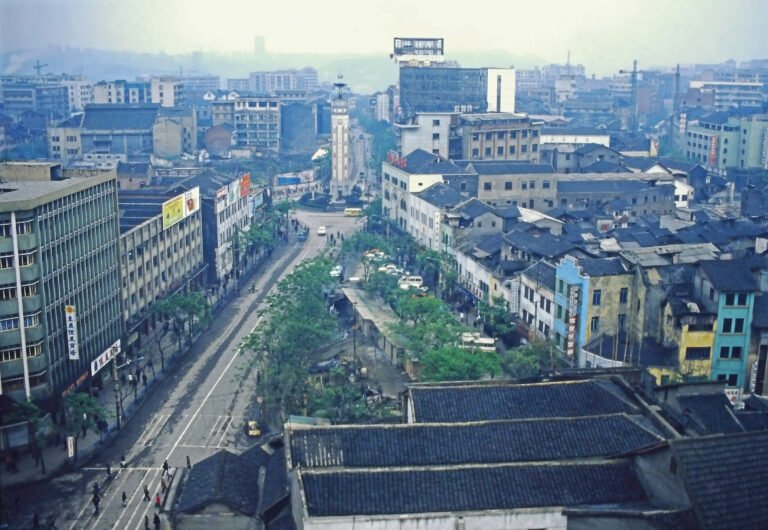
A city built for walking slowly
Kunming does not announce itself. The airport is the largest in the southwest, the high-speed line to Dali runs every twenty minutes, and the towers downtown could be any mid-sized Chinese city. Then you walk into a park at 8 a.m. and find ten thousand people doing tai chi under blossoming camellias in February, wearing down jackets over sweaters, and you remember what the guidebooks mean by the Spring City. At 1,900 meters above sea level, Kunming sits in a basin where the temperature rarely drops below freezing or climbs past 30. Locals say the city has no summer and no winter, which is wrong about specifics and right about feeling.
I have passed through Kunming nine times, usually on the way to somewhere else. The year I gave it two full days on foot, it became one of my favorite cities in China. Not because of any single sight, but because the walking works: old lanes and modern avenues alternate every few hundred meters, the parks are free, and the food appears exactly when you get hungry. These are the four walks I do now, in the order I do them.
Walk 1: Green Lake, the university, and the military academy
Start at Cuihu, Green Lake, in the city center. The park is free and it is where the whole city comes in the morning: retirees dancing, students reading aloud along the willows, kite sellers. Between November and March, black-headed gulls migrate here from Lake Baikal and fill the lake by the thousands. Bring nothing shiny and the birds will take bread from your hand; a bag of bird feed costs 10 RMB from a stall by the south gate.
Leave the park by its northeast corner and walk two blocks to Yunnan University, founded in 1922 as the private Donglu University. The old campus is one of the prettiest in China: a French-style hall called Huize Court at the top of the entrance steps, wooden science labs from the 1930s, and ginkgo trees that turn the main path gold in November. Weekend visits sometimes require an online reservation, so register the day before if you want to be sure.
A ten-minute walk north sits the Yunnan Military Academy, the Jiangwu Tang, opened in 1909. It trained the officer class of the late Qing and early republic, and its graduates include Zhu De and Ye Jianying. The grounds are free to walk, the exhibition hall may charge a small fee, and the drill ground at the center is where you understand the scale of the place: a brick square the length of two football pitches, surrounded on all four sides by two-story barracks that still stand.
The whole circuit is about three kilometers and takes two hours at a slow pace. Finish it with breakfast you should have had first: a bowl of crossing-the-bridge rice noodles at one of the shops near the university, where the broth arrives scalding in a covered bowl and you slide the raw meat, vegetables, and rice noodles in yourself. A basic bowl runs 15 to 25 RMB.
Walk 2: The old lanes and the archways
Kunming’s old street district sits just south of the center, a renovated grid of two- and three-story wooden buildings along Guanghua, Wenming, and Jingxing streets. It was the commercial heart of the city until the 1950s, and after a long stretch of decay it reopened around 2019 as a pedestrian district with shops, cafes, and snack stalls. Some of the restoration is too clean for its own good, but the layout is original and the lanes still turn at odd angles.
Two things here are genuinely worth time. The first is Nie Er’s former home: the composer of China’s national anthem was born in Kunming in 1912, and the small house, a few doors down a side lane, holds his study more or less as he left it. Entry is free with ID. The second is the pair of ceremonial archways at Jinma and Biji streets, rebuilt in 1999 on the footprint of Ming dynasty originals, standing at the head of Nanping Street. Go at dusk, when the archways light up and the shopping street fills.
Dinner on this walk is the point. Nanqiang Street Lane, running parallel to the old district, is Kunming’s snack lane: small copper pots of rice noodles, tofu pudding with chili, grilled rice cakes called erkuai, and boxes of rose flower cakes from Jiahua bakery. Ten to twenty RMB buys a full meal of samples. For a broader look at the city’s cooking, the Kunming food guide covers the restaurants I go back to, and the Yunnan cuisine overview explains the regional styles behind the snacks.
Walk 3: Daguan Pavilion and the western lakeshore
This walk needs half a day and a metro ride to the west. Daguan Pavilion sits in a park at the head of the Daguan River, where it feeds Dianchi Lake, and it is a four-story tower rebuilt in the Qing dynasty over the water. The reason people come is a couplet written above the entrance by Sun Ranweng in the 18th century, 180 characters long, describing the lake and the seasons. It is the most famous couplet in Chinese literature, and it is worth standing under for a while even if you cannot read it.
The park around the tower is where Kunming comes to walk on weekends: willows, boats for hire, and the long embankment that runs into the lake. Entry has been free in recent years, but the park has charged fees at various times, so check before you count on it. Walk the embankment to its end, then loop back along the shoreline path through Haigeng wetland park, where reeds and egrets have taken over a stretch that used to be more concrete than marsh. On a clear day the view across Dianchi to the Western Hills justifies the walk, and our guide to Dianchi Lake covers the boat trips and the cable car up to the Dragon Gate on the hills.
Walk 4: Guandu and the provincial museum
North of the city center, Guandu Ancient Town sits where the old caravan routes from Sichuan and Tibet met. The main lane is another restored district, busier with domestic visitors than foreigners, but the Vajra Tower at its center is real: a square brick pagoda from the Ming dynasty, one of the few of its type left in Yunnan. It takes an hour to see, plus another for the side lanes selling clay whistles and palm-leaf candy.
The Yunnan Provincial Museum, opened in its current building in 2015 a few kilometers east of Guandu, is the best museum in the province and, for a traveler, the fastest way to understand where you are. The bronzes from the ancient Dian kingdom, the textiles from the minority groups, and the fossil halls cover three thousand years in a morning. Entry is free with passport registration, closed Mondays, and the building itself is worth a look for its architecture. If you have time for one more stop, the Zhuanxin produce market near the center is the city’s great food market: wild mushrooms in season from June to October, including the porcini and matsutake that make the Yunnan plates famous. Our guide to the mushroom season explains what to look for and how not to get poisoned, which matters more than it sounds.
The walks side by side
| Walk | Distance | Time | Cost | Best time |
|---|---|---|---|---|
| Green Lake, Yunnan University, Military Academy | ~3 km | 2-3 hrs | Free; noodles 15-25 RMB | Morning |
| Old lanes, Jinma archways, Nanqiang food street | ~2.5 km | 3-4 hrs with eating | Free; snacks 10-20 RMB | Late afternoon into evening |
| Daguan Pavilion and Haigeng wetland | ~6 km | Half day | Park free in recent years; boats extra | Morning for clear mountain views |
| Guandu town and Provincial Museum | ~4 km plus metro | Half day | Free with ID | Afternoon; museum closed Monday |
Quick facts
- Elevation is 1,900 m; most visitors feel nothing, but take the first day slowly if you flew in from the coast
- The gulls arrive at Cuihu in November and stay until March; a bag of feed costs about 10 RMB
- Crossing-the-bridge rice noodles are served with a covered bowl of scalding broth; add the ingredients yourself
- Wild mushroom season runs June to October, and Zhuanxin market is the place to see the range
- Metro fares start at 2 RMB; taxis are cheap but the afternoon traffic around Nanping Street is not
- Even in summer, evenings cool fast enough to need a light jacket, which locals call the city’s one season
What I would skip
Two honest omissions. The Bird and Flower Market, near the old lanes, has declined to a few stalls of caged birds and succulents, and it takes ten minutes to see. The Biyun temple? No, skip my hesitation: the temple on the Western Hills is fine, but the mountain and the lake are better spent on the Daguan walk. Kunming rewards a slower itinerary than the one most people give it. Two days on foot here changes how the rest of Yunnan feels, because you stop moving every third day. For planning the wider province, the Kunming travel guide covers transport and day trips, and the rice noodle map explains how the bowls differ from town to town.
Frequently asked questions
How many days does Kunming deserve?
Two. One covers the central walks, and one handles Daguan and Guandu or the museum. Kunming is also the natural acclimatization stop before Shangri-La or Tibet, which is how I use it most often.
Is the altitude a problem?
At 1,900 meters, most people notice nothing beyond mild breathlessness on stairs. If you are continuing to higher places like Shangri-La at 3,200 meters, a day or two in Kunming helps you adjust before you climb further.
Do I need Chinese for these walks?
The museum has English labels, the metro has English signage, and hotel staff speak some English. For the markets and the smaller noodle shops, a translation app and pointing cover most of it.
When is the weather best for walking?
March through May and September through November. Summer is humid with daily rain, and January can be grey and raw despite the mild averages. February brings the camellias and the last of the gulls.
Can I eat vegetarian in Kunming?
Easily than in most Chinese cities, because Yunnan’s wild mushrooms and vegetables are the stars rather than the supporting cast. Mushroom hot pot restaurants, tofu shops, and the rice noodle stalls all have meat-free options, though ask about meat broth in noodle shops.
What should I try that I cannot get elsewhere?
Crossing-the-bridge rice noodles done properly, steam-pot chicken, and rose flower cakes fresh from the bakery. If it is mushroom season, order whatever the market has and let the restaurant cook it; that is the Yunnan plate you cannot replicate at home.
Is two days enough before a train to Dali?
Yes. The morning train reaches Dali in under two hours, so you can finish the old-lanes walk in Kunming on the afternoon of your last day and still be in Dali for dinner. Plan the reverse if you want a relaxed arrival instead.
Written by the ChinaTravelFood editorial team.