What kind of city Harbin is
Short answer: a Russian-built railway town on the Songhua River that happens to be one of the coldest large cities on earth, and that spends three months a year turning that liability into an industry. If you come in January you are coming for the ice and you should plan around it. If you come in July you will find a mid-sized Chinese city with good beer, wide boulevards, Orthodox domes, and weather that feels like a reward after Beijing’s summer.
I have been twice in deep winter and once in August, and August was the trip that changed my opinion of the place. Winter Harbin is an event you attend. Summer Harbin is a city you live in for a few days, and the contrast between the two is bigger than anywhere else I know in China.
When to go
January is the obvious answer and it is also the most expensive, most crowded, and coldest month. Here is how the year actually breaks down.
| Season | Months | Typical daytime temperature | What is on | Verdict |
|---|---|---|---|---|
| Early winter | Late December | -10 to -20 C | Ice and Snow World opens, usually in the last week of the month | Cheaper, and the sculptures are built but crowds have not arrived |
| Peak ice season | January to mid February | -15 to -25 C, colder at night | Ice and Snow World, Sun Island snow expo, Ice Festival from 5 January | The full thing, and the full crowd |
| Late winter | Late February to early March | -5 to -12 C | Sculptures still standing, beginning to soften | My pick if you can be flexible |
| Shoulder | April, May, September, October | 5 to 20 C | Nothing ice-related | Quiet city, cheap hotels, ordinary architecture tourism |
| Summer | June to August | 20 to 30 C | River cruises, Sun Island, the summer music season | Underrated, genuinely pleasant |
One hard number, because people underestimate it: a January night in Harbin regularly sits below -25 C and can reach -35 C with wind. That is not a number you dress for with a good coat. It is a number that ends phone batteries, freezes exposed skin in minutes, and makes a twenty-minute outdoor queue a real commitment. Our China weather notes cover the regional picture if you are combining Harbin with anywhere else.
Worth noting for 2026: Harbin hosted the Asian Winter Games in February 2025, and the city put real money into venues, transport, and English signage ahead of it. Some of that infrastructure is still visible, and it has made the place easier to move around in.
Central Street and the Russian layer
Harbin exists as a big city because of a railway. The Chinese Eastern Railway was pushed through here from 1898, and for the first half of the twentieth century this was a city with a large Russian population, then a wave of White émigrés after 1917, and a Jewish community large enough to leave a synagogue and a cemetery behind.
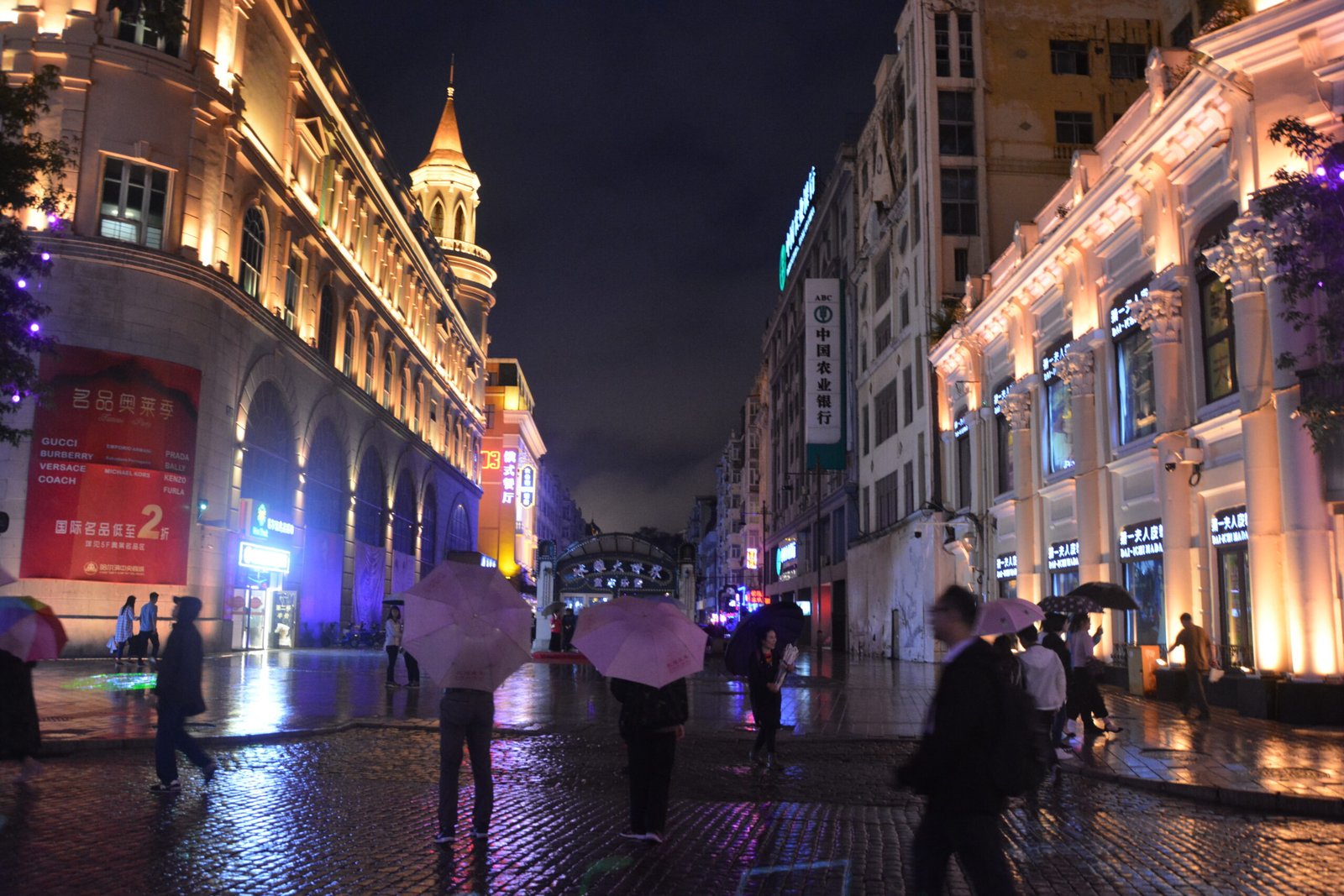
Central Street (中央大街) is where that history is most legible. It runs about 1.45 kilometres from the river up into the old town, paved with the granite setts known locally as bread stones, and it is closed to traffic. Down its length is a run of early twentieth-century facades in the styles that were fashionable in Moscow and Paris at the time: baroque revival, art nouveau, and a lot of eclectic commercial work from the 1920s.
The single thing to do here is buy a Madier popsicle. The Madier brand has been selling ice cream on this street since the early 1900s, and the local habit is to eat one outdoors in the middle of winter, standing on the setts, in a temperature that would freeze it solid anywhere else. It costs a few yuan. It is a genuinely good joke on the climate, and I have done it every time.
The same street holds the red sausage shops, the Russian bread counters where the dalieba is stacked like cannonballs, and in the evening a run of buskers. Full detail on the street itself is in Central Street Harbin. It gets very crowded in January. Go early in the morning for photographs and come back after dinner for the atmosphere.
Saint Sophia and the rest of the old town
The cathedral is the image on every Harbin postcard, and it is worth more than the photograph. The original was a small wooden church built for railway troops in 1907; the building standing now went up in brick and concrete over roughly a decade from the 1920s, an onion dome over a Byzantine-influenced body, rising to around 53 metres.
It is a museum rather than a working church, and the interior is more exhibition than sanctuary, which disappoints some visitors. The exterior in snow, lit at night, is the reason to go. Details and opening notes are in Saint Sophia Cathedral.
Around it, a short walking loop covers most of what is left: the old Jewish synagogue on Tongjiang Street, the flood control monument and Stalin Park on the riverbank, and the stretches of Russian brick apartment blocks in the blocks northwest of Central Street. When the Songhua freezes, the river itself becomes the attraction, with ice fishing holes, horse carts, and people walking across where the ferries run in summer.
Ice and Snow World, done properly
This is the main event and it is genuinely unlike anything else. Harbin Ice and Snow World has run since 1999 on the north bank of the Songhua, and it is built every year from scratch: blocks cut from the river ice, stacked into full-size buildings, towers, slides, and illuminated from inside with coloured lighting. The scale is what surprises people. These are not statues, they are structures you walk through.
| Practical point | Detail |
|---|---|
| Where | Songbei district, north bank of the Songhua River, separate site from Sun Island |
| Tickets | Expect roughly 300 to 400 yuan at peak in recent seasons. Confirm the 2026 price when you book, it has risen most years |
| Timing | Arrive mid-afternoon, around 3 pm, before dark. You get the blue-hour light and then the full illumination |
| How long | Three to five hours, and you will need indoor warm-up breaks |
| Warm-up rooms | There are heated halls with food and hot drinks. Use them. Set an alarm to go in every hour |
| Slides | The long ice slides are included or cheap, and they are the best part. Queues are long after 6 pm |
| Crowd | Heaviest in the first two weeks of January and around Chinese New Year |
Sun Island, on the other side of the river, hosts the snow sculpture exhibition and it is a different experience: daylight, white snow rather than clear ice, enormous carved figures, and far fewer people. Do Snow World at night and Sun Island in the morning of another day. Trying to do both in one day in January is how people end up with frostnip.
Also worth a look is Zhaolin Park near Central Street, where the ice lantern tradition started, with smaller illuminated ice carvings in a city park and a much cheaper ticket. Full details on the main site are in Harbin Ice Festival.
Beyond the ice: tigers, manors, and skiing
The Siberian Tiger Park, about twenty minutes north of the city, is one of the strangest and best half-days in Harbin. You board a caged bus and drive through enclosures containing Amur tigers at close range, including cubs in a walk-through area. I have mixed feelings about captive breeding operations of this kind, and I will say plainly that this one is a breeding and tourism facility rather than a conservation story. It is also the closest you will ever get to a tiger, and it runs in any season.
Volga Manor, out on the eastern edge, is a purpose-built park of wooden Russian-style buildings including a replica church and a vodka hall. It is unashamedly a theme park, it looks excellent under snow, and I would put it low on the list if your days are short.
Yabuli is the real ski destination, roughly two and a half to three hours away, and it is the biggest ski area in China with a vertical drop and lift system that would be ordinary in Europe and is exceptional here. If you are going to ski, go for at least two days and stay on the mountain. Day trips from Harbin spend most of the day in a vehicle.
Eating in Harbin
Northeastern Chinese food, Dongbei cuisine, is the least internationally known of China’s regional kitchens and it is one of the most satisfying, because it is built for cold: heavy, salty, sour, and generous.
- Guo bao rou (锅包肉): thin slices of pork in a crisp batter, tossed in a sweet-and-sour sauce. It was created in Harbin in the late Qing, supposedly adapted for Russian palates who wanted something less salty, and the city still argues about the correct ratio of sugar to vinegar.
- Harbin red sausage (红肠): a smoked, garlicky sausage descended from the Russian kolbasa, sold whole or sliced in shops all over the city, best known from the Churin brand.
- Dalieba (大列巴): a huge round of Russian sourdough, dense and slightly sour, sold in paper bags. It was once a ration staple and is now a souvenir people actually eat.
- Iron pot stew (铁锅炖): a wood-fired cast iron pot at the table, usually river fish or chicken with corn bread stuck to the sides. Order it for a group, not alone.
- Frozen fruit: 冻梨 and 冻柿子, pears and persimmons frozen solid then thawed in water and eaten by sucking the sweet pulp out. Do not try to bite one.
- Harbin Beer: the brewery was founded in 1900 and is one of the oldest in China. The local lager is light, cheap, and everywhere.
The full eating list, with streets and price ranges, is in Harbin food, and the regional picture across the northeast is in Dongbei food.
Getting there, and how to dress
Harbin Taiping International Airport is about 45 minutes from the centre by car, and the airport rail link plus the metro make it cheap and easy. The bigger change in recent years is rail: the high-speed line from Beijing has cut the trip to roughly four and a half to five hours, which makes Harbin a realistic weekend from the capital. Harbin also has good high-speed connections to Dalian, Shenyang, and Changchun. Check current timetables before you book, since winter schedules are adjusted.
On clothing, be more serious than your instinct:
- A real down parka rated well below zero, not a fashion coat. Synthetic or down, either is fine, but it needs to be bulky.
- Thermal base layer top and bottom. Cotton against the skin is a mistake.
- Boots with a thick sole and aggressive tread. Ice and packed snow on setts is genuinely slippery.
- Mittens rather than gloves, plus a hat that covers your ears, and a scarf or neck gaiter for your face.
- Hand and toe warmers from any convenience store. They cost a few yuan and they are the difference between an hour outside and three.
- A power bank, carried in an inside pocket. Lithium batteries stop working at these temperatures and phones routinely shut down at 30 percent.
Quick facts
- Harbin sits on the Songhua River and grew around the Chinese Eastern Railway from 1898.
- January nights regularly fall below -25 C; record lows are far colder.
- Ice and Snow World usually opens in the last week of December and runs to late February.
- The Ice Festival is dated to 5 January, but the sculpture parks open earlier.
- Central Street is about 1.45 kilometres of pedestrianised granite setts.
- Saint Sophia Cathedral stands around 53 metres and is now a museum.
- High-speed rail from Beijing takes roughly four and a half to five hours. Confirm current times for 2026.
- Harbin hosted the Asian Winter Games in February 2025.
Frequently asked questions
How cold is it really, and can I cope?
Colder than you think, and yes. Layers, a serious coat, boots with grip, and mittens handle it. The failure mode is not the cold itself, it is standing still in it for an hour, so plan warm-up breaks indoors and keep moving.
How many days do I need?
Three full days in winter: one for Central Street, Saint Sophia, and the river; one afternoon-and-evening for Ice and Snow World; one for Sun Island plus either the tiger park or a museum. Add two days if you are skiing at Yabuli.
Is Ice and Snow World worth the ticket?
Yes, once. It is the largest thing of its kind anywhere and the illuminated buildings are genuinely spectacular. It is also expensive, crowded, and physically uncomfortable, so decide in advance that you are doing it and then commit rather than half-doing it on a cold night.
Can I visit in summer instead?
Yes, and I think more people should. August gives you 25 C days, the river with boats on it, Sun Island as ordinary parkland, and the same architecture with no queues. You lose the ice entirely and that is most of the reason people come.
Is Harbin safe?
Very. It is a large Chinese city with the usual low level of street crime and heavy policing around the festival sites. The realistic hazards are falls on ice, cold exposure, and traffic.
Do people speak English?
Less than in Beijing or Shanghai. Hotels and major attractions manage; restaurants and taxis mostly do not. Have your hotel write your destinations in Chinese, and carry a translation app with offline mode.
What should I buy as a souvenir?
Red sausage and dalieba, both of which travel well and are cheap. Russian chocolate from the shops on Central Street. Avoid the fur hats sold on the street in January, which are usually synthetic at genuine-wool prices.
Can I see the ice without paying for the big park?
Partly. Zhaolin Park’s ice lanterns are much cheaper, the frozen Songhua is free and full of activity, and the city puts ice sculptures on street corners and hotel forecourts all over the centre. You will miss the scale, not the idea.
Where should I stay?
Near Central Street for winter, so you can walk back to your hotel in five minutes rather than waiting for a taxi at -25 C. In summer, anywhere near the metro works and prices drop sharply.
Plan a northeast route
Harbin works well as the top of a northeast loop, with Changchun, Shenyang, and Dalian strung below it by high-speed rail, or as a three-day standalone in the middle of winter. If you want a route that fits the ice parks around your cold tolerance and puts the right restaurants on the right nights, tell us your dates on our contact page and we will build a custom food-and-travel plan for you.
Written by the ChinaTravelFood editorial team.