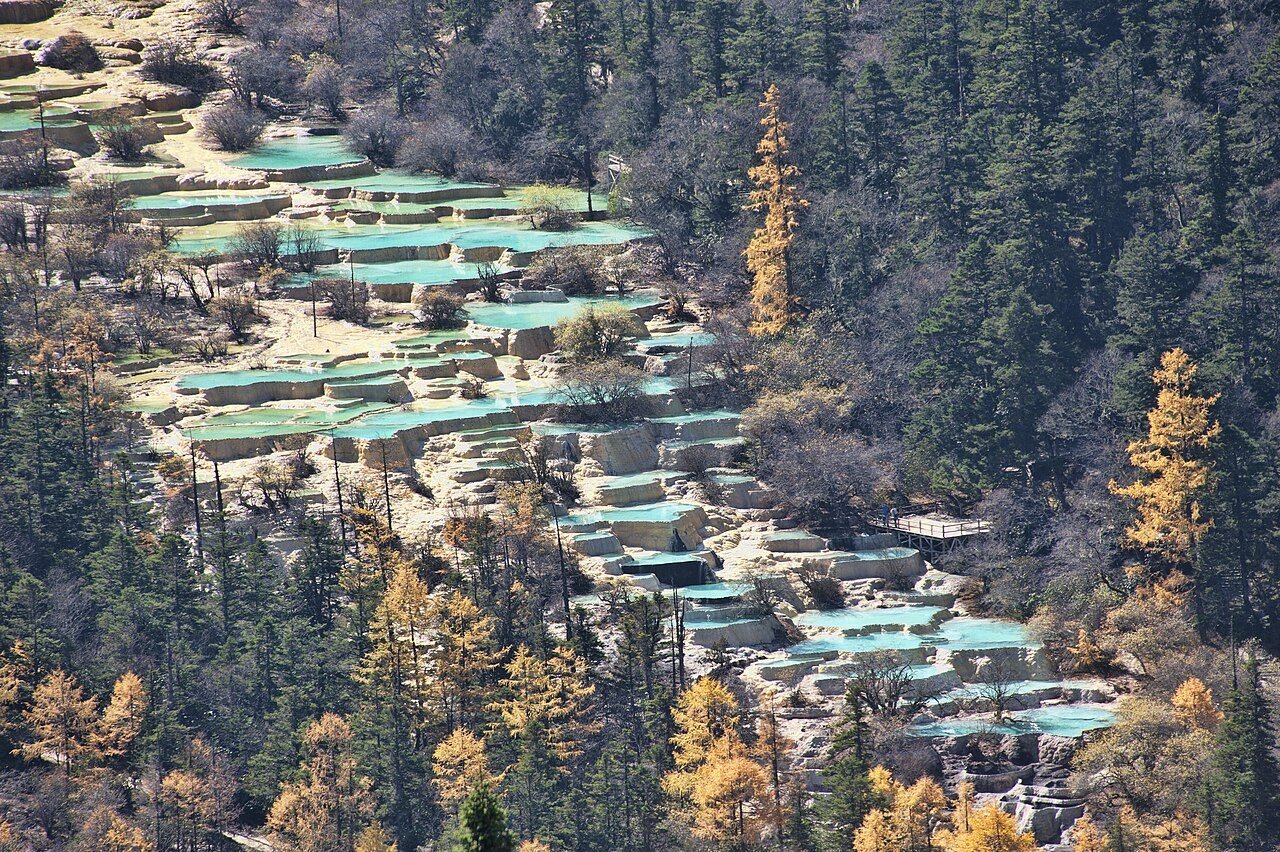
Most people who go to Jiuzhaigou add Huanglong (黄龙, Yellow Dragon) as a footnote, and that is the wrong order. Huanglong is the one I would protect if I had to choose. It is a valley of terraced calcium pools stepping up a mountainside, each one a different shade of blue and green and gold, fed by water that deposits travertine the way a dripping tap builds a stalactite. I expected pretty pools and got something closer to a natural cathedral of limestone. The catch is the altitude and the climb, which is why so many visitors rush it and miss half of it.
Huanglong Scenic Valley: Terraced Pools and the Five-Colour Pools
Huanglong sits in northern Sichuan, a few hours from Jiuzhaigou, and the two are almost always sold as a pair. In my view Huanglong is the sharper memory. The valley is a staircase of travertine pools, thousands of them, coloured by minerals and depth, climbing to a set called the Five-Colour Pools that looks edited even in person. This guide explains the colour, the walk, the altitude, and how to time it so you actually see the water turn electric.
What makes the colours
The water here is saturated with calcium carbonate from the surrounding limestone. As it flows down over thousands of years, the mineral precipitates and builds the terraces, and the shallow water over the white travertine acts like a filter, throwing back blues and turquoises that change with the light and the depth. The Five-Colour Pools (Wuse Chi) at the top are the famous set, a cluster of small pools in layered colours that look edited. They are not. I have photos that look fake and were not.
The effect is strongest in clear sun and weakest under flat cloud, so the day’s weather matters more than the season for the colour, though autumn gives the surrounding forest its red-and-gold frame. A detail guides miss: the colour shifts through the day as the sun angle changes, so a pool that looked green at eleven can look cobalt by two. I went up once in grey and once in sun, and the second visit was a different place.
The walk and the cable car
The valley runs uphill from about 3,100 metres at the entrance to over 3,600 at the top, and the walk is a steady climb on boardwalks. Most people take the cable car up and walk down, which spares the lungs on the ascent and lets you linger on the descent. Walking the whole thing both ways is a serious effort at that altitude and not advisable for anyone unsure of their fitness.
Allow at least three hours, more if you stop, which you should. The Golden Sand Beach section, a wide sloping sheet of calcified river, is the oddest and best part, and it comes before the Five-Colour Pools, so do not turn back too early. The boardwalk is well built but there are steps, and the thin air makes the steps feel like three times their height. I paced myself to a stop every few minutes and still felt it at the top.
The Huanglong Temple and the summit
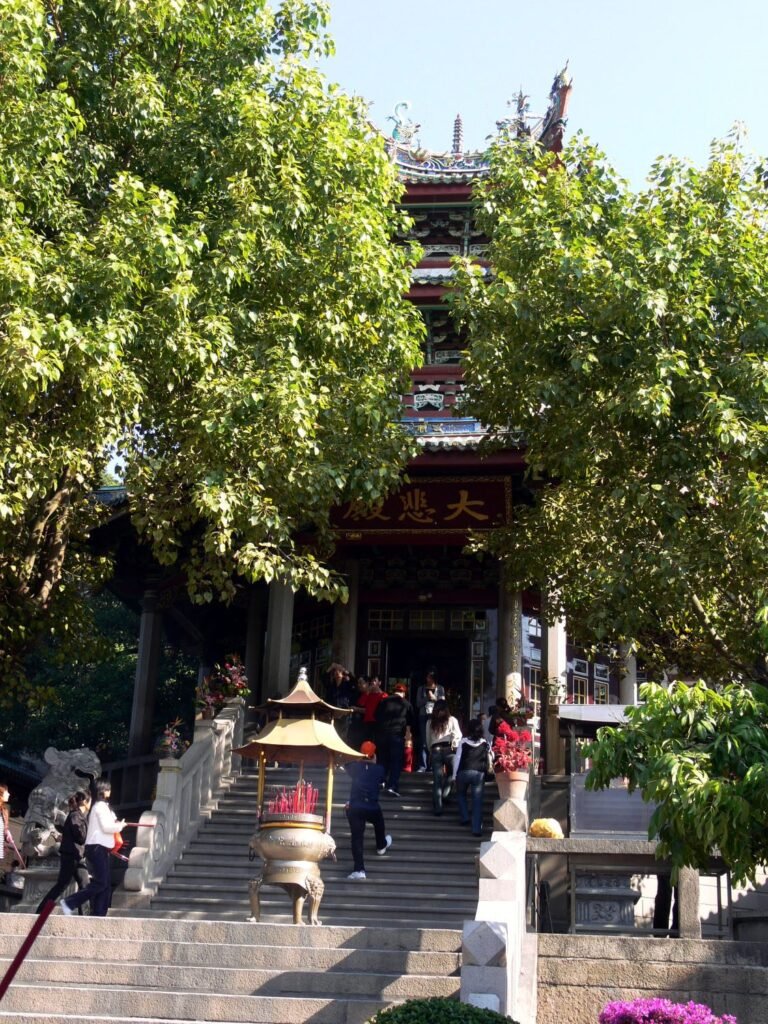
At the top, past the pools, is the Huanglong Temple, a small Tibetan-Buddhist monastery set against the snow peaks, with a festival in the lunar spring that draws pilgrims. The temple is modest but the setting is the point: you are high, the air is thin, and the peaks behind the valley are still snowed even in summer. This is where I sat for twenty minutes doing nothing, which is rare for me on a packed itinerary.
The temple also marks the turnaround. Past it the boardwalk continues a short way to a viewpoint, then you double back. If you are walking down, this is the moment to start; the descent is longer than it looks on the map and the lower terraces stay in shadow until early afternoon, so time your down-walk for when the sun has moved round.
Altitude is the real issue
Huanglong is high enough that altitude sickness is a genuine risk, especially if you have come straight from Chengdu. The walk is moderate in distance but the lack of oxygen makes it feel like twice the climb. The altitude sickness notes explain the symptoms and the line not to cross; I would read them before this trip specifically. Carry water, go slow, and consider the cable car even if you normally walk everything.
Practical altitude steps that worked for me: spend a night in Songpan or Huanglong town (around 2,800 m) before the visit rather than driving up same-day from Chengdu; skip alcohol the night before; and take the cable car up so the first exertion is the gentle descent. If you feel a real headache or nausea at the top, go down. The pools will wait; your lungs will not.
Getting to Huanglong and pairing with Jiuzhaigou
Huanglong has its own airport (Jiuzhaigou-Huanglong Airport), which is the fastest way in if you fly, though flights are weather-dependent and the altitude at the airport itself is high. More commonly, visitors come overland from Jiuzhaigou, about two hours away by road through mountain passes. The two are almost always done together, with a night in one of the towns between them. From Chengdu it is a long drive or a flight; the rail guide covers the train to the region’s edge, but the final leg is road.
The road between the two valleys is beautiful and boring in equal measure: gorge, tunnel, gorge, for two hours. I hired a driver rather than a tour so I could stop at a viewpoint, and it cost about the same for two people. If you fly, note the airport shuttle still leaves a drive to either valley, so “flying” does not mean “arriving.”
When to go
Autumn (late September to October) is the peak: clear skies, coloured forest, and the best water colour. Spring is good and less crowded. Summer is the rainy season and the pools can be murky with runoff, though the falls are full. Winter closes parts of the valley to snow and ice. The window is short and domestic tourists know it, so book the October dates early.
I would avoid the summer rains if colour is your goal; the runoff turns the pools grey-green and the boardwalks get slick. Late September caught me with snow on the peaks and gold in the forest, the best of both, but the lodges were full and the shuttle queued. Book the town stay two months out for an October trip.
| Section | Altitude | Highlight | Effort |
|---|---|---|---|
| Entrance to Mid-Valley | 3,100 m | First terraces, streams | Easy boardwalk |
| Golden Sand Beach | 3,300 m | Calcified river sheet | Moderate |
| Five-Colour Pools | 3,500 m | The famous colours | Moderate climb |
| Huanglong Temple | 3,600 m | Snow peaks, festival | Top effort |
Eating and staying
The tourist towns near the gate have Sichuan and Tibetan eateries; the food is hearty and a little pricier than the lowlands because everything is trucked in. Yak meat hotpot is the warming choice at altitude. For the broader regional table, the Chengdu food guide is the reference, and the panda base is the other easy add-on if you are routing through Chengdu.
Do not expect fine dining at the gate; expect filling. I ate a Tibetan barley noodle soup at the base that cost more than the city version and was half the portion, but it was hot and the broth was real. Stock a snack and water before you go, because the only food at the top is expensive and limited, and the descent is longer than the map suggests.
Photography and the light gamble
If you are here to photograph the pools, the advice is unromantic: be at the top by the time the sun clears the ridge, shoot the Five-Colour Pools in the first hour of good light, and accept that the lower terraces stay in shadow until later. A polarising filter cuts glare on the water, and a person in frame gives the scale the photos otherwise lose. I shot most of my keepers in the first forty minutes after the clouds lifted, then spent the rest of the walk just looking, which is the right priority anyway.
The weather gamble is real. On my first attempt the valley sat under flat grey all morning and the colours were muted; two days later the sun came and the water turned electric. There is no way to guarantee it, which is why an extra night in the area is worth more than any piece of gear. Build buffer days into a Huanglong plan and you will almost certainly catch one good window. The boardwalks funnel everyone the same direction, so start at the top and walk down against the flow: most groups ride up and walk down with the current, so going the other way gives you the brief gaps. Arrive at opening and you get the summit alone for a while regardless.
Bring more water and a snack than you think; the only food at the top is expensive and limited, and the descent is longer than the map suggests. The temple festival in the lunar spring draws pilgrims and adds a cultural layer most summer visitors miss.
Quick facts
- Huanglong is a travertine valley of terraced calcium pools in northern Sichuan
- The Five-Colour Pools at the top are the famous multi-coloured set
- Golden Sand Beach is a wide calcified river sheet, the oddest section
- Altitude runs 3,100 to 3,600 m; altitude sickness is a real risk
- Cable car up, walk down is the standard plan
- It is usually paired with Jiuzhaigou, about 2 hours away
- Jiuzhaigou-Huanglong Airport is the fast but weather-prone entry
- Best month: late September to October
- Allow at least 3 hours in the valley
- Spring is good and less crowded than autumn
Frequently asked questions
How long do I need at Huanglong?
At least three hours, four if you linger. Cable car up and walk down is the efficient route. Rushing it in two hours means missing Golden Sand Beach and the temple.
Is the altitude dangerous?
It is high enough to cause real sickness in some people, especially arriving from low elevation. Go slow, hydrate, use the cable car, and know the warning signs. The altitude guide is specific.
Should I do Huanglong or Jiuzhaigou?
Both if you can. If forced to choose, I pick Huanglong for the pools, Jiuzhaigou for the broader lakes and forests. Most trips do both with a night between.
When are the colours best?
Clear sunny days, most reliably in autumn when the surrounding forest also turns. Cloud and summer runoff dull the water.
Can I walk the whole thing without the cable car?
Yes, but the climb at altitude is demanding. Fit travellers do it; most take the car up. I would not walk both ways on a first day at altitude.
How do I get there from Chengdu?
Fly to Jiuzhaigou-Huanglong Airport, or drive (long), or train to the region’s edge and road the rest. The rail guide covers the train portion; the final leg is road.
Is it crowded?
October and holidays are busy on the boardwalks. Arrive at opening and go straight to the top before the coaches. Weekday spring is quiet.
What should I wear?
Layers: warm at the top even in summer, sun protection, and proper shoes for boardwalks. The temperature drops with altitude and the sun is strong.
Planning a Jiuzhaigou-Huanglong loop
Huanglong rewards a slow, altitude-aware visit, and the pairing with Jiuzhaigou is where most plans go right or wrong. If you want a custom food-and-travel route that handles the flights, the road transfers, and the altitude pacing, reach out through the contact page. We build China routes including the Sichuan high country.
Written by the ChinaTravelFood editorial team.