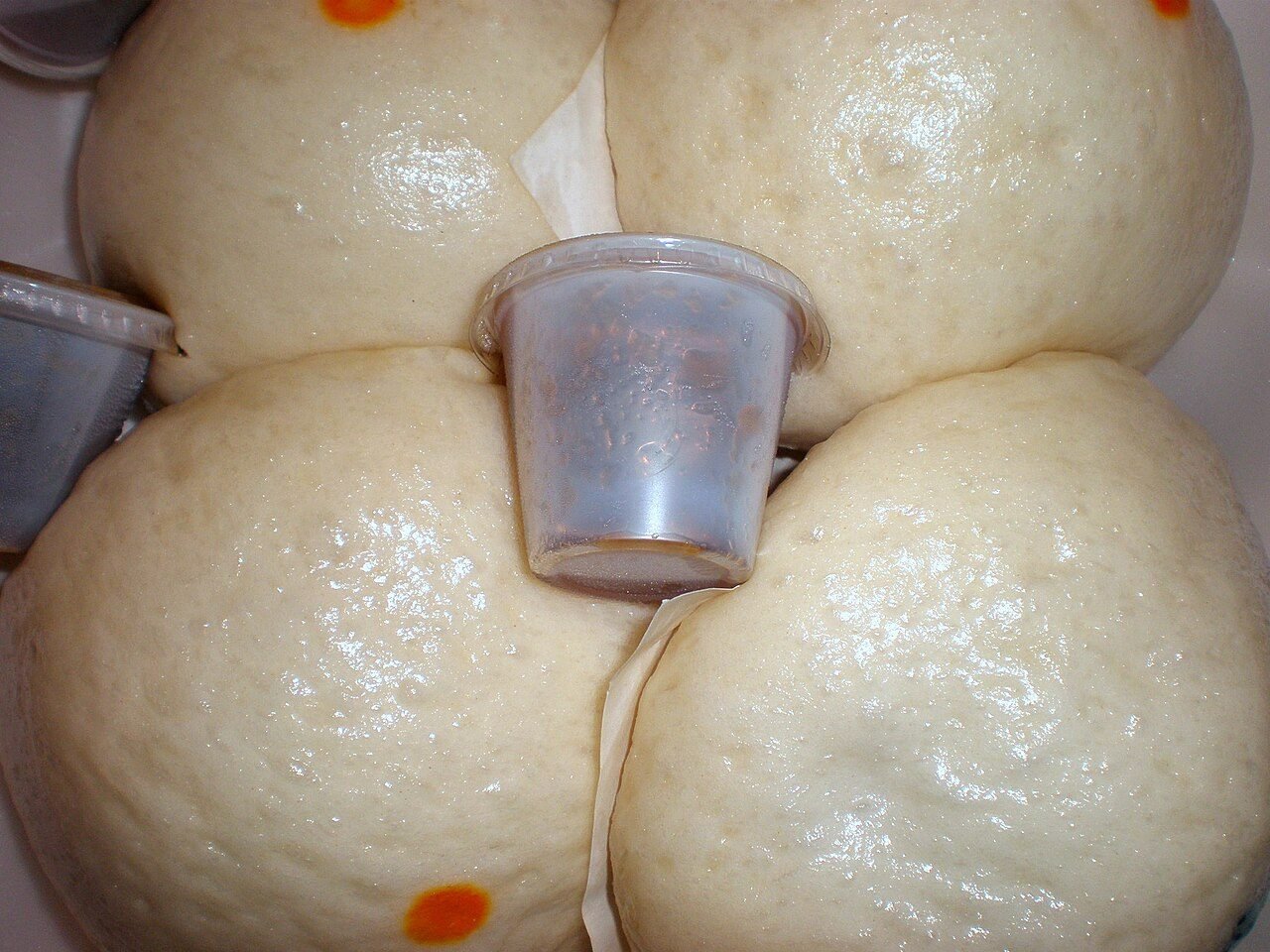
I ate my first baozi (baozi, 包子) from a street cart in Jinan in 2016, burnt my mouth, and decided the bun was the most underrated food in China. A baozi is a filled steamed bun: a risen wheat dough wrapped around pork, vegetables, red bean, or something stranger, then steamed until the skin turns cloudy and soft. It is the cheap, portable backbone of Chinese breakfast and a snack that scales from a 2 RMB corner bun to a 40 RMB soup-filled showpiece. This article covers the types, the regional differences, and how to eat one without scalding your palate.
What a baozi actually is
The word baozi means “wrapped thing.” The dough is wheat flour, water, a little sugar, and yeast or a chemical leavener. Unlike a dumpling, which is usually boiled or pan-fried and has a firmer skin, a baozi is almost always steamed and stays pillowy. The filling sets the identity. Pork and cabbage is the national default; in the north you get more lamb, in the south more sweet bean or lotus paste.
The bun matters because it solves a problem: how to feed a huge population cheap protein and starch before the workday starts. Walk any Chinese city at 7 am and you will see queues at bamboo steamer stacks. The Chinese breakfast piece I wrote covers the wider morning spread, but the baozi is the one I would pick if I had to eat one thing.
The main families of baozi
Not all buns are equal. Here is the split I use when explaining the category to first-time visitors.
| Type | Skin | Filling | Where it shines |
|---|---|---|---|
| Char siu bao | Steamed, white | Roast pork in sticky sauce | Cantonese dim sum |
| Roubao (meat bun) | Steamed, plain | Pork and cabbage | Street breakfast, nationwide |
| Xiaolongbao | Thin, pleated | Pork with soup inside | Shanghai, Jiangsu |
| Dousha bao | Steamed, white | Sweet red bean | Breakfast or dessert |
| Goubuli | Steamed, dense | Pork, 18 folds | Tianjin, tourist icon |
The xiaolongbao deserves its own mention; our xiaolongbao soup dumplings guide explains the soup-in-a-dumpling trick that confuses newcomers. A baozi is the bigger, plainer cousin.
Steamed versus baked versus pan-fried
Most baozi are steamed. But the same dough, baked in a clam-shaped mold, becomes a “shao bao” with a crisp bottom, and pan-fried it turns into sheng jian, the Shanghai street bun with a crunchy base and soup inside. I rank them steamed for comfort, pan-fried for flavor, baked for portability on a train.
Northern and southern styles
The north leans big. A Tianjin Goubuli can be the size of a fist with a dense, almost bread-like crumb. The south leans delicate, smaller, with sweeter fillings and a lighter touch. Neither is better; they answer different mornings. On a cold January in Harbin I wanted the heavy northern bun with lamb, and in humid Guangzhou the small char siu bao felt right.
If you are building a northern food stop, the Beijing food guide I wrote lists where the capital’s bun shops hide among the hutong. Beijing baozi tend to the pork-and-vegetable style, eaten with a bowl of congee.
How to eat one without hurting yourself
The mistake everyone makes is biting straight in. A fresh steamed bun holds steam and, in soup varieties, boiling broth. Tear a small opening, blow, sip, then eat. At a stall in Xi’an a vendor laughed at me and demonstrated the “shake, bite, slurp” routine that keeps the filling from shooting down your shirt.
The plain version, plain mantou, is the unfilled sibling. It is the same dough with no center, and it is the gauge for whether a shop respects its starter. A good mantou is faintly sweet and springy; a bad one is a chalky lump. I judge a breakfast joint by its mantou before I order the filled bun.
Buying baozi on the street
The cheapest and freshest come from carts with stacked bamboo steamers and a plastic cover. Prices in 2024 ran 2-5 RMB for a plain meat bun in most cities, 8-15 RMB in tourist spots like Wangfujing in Beijing. The street food map of China’s big cities I put together shows which districts to hunt in. Avoid the pre-wrapped, room-temperature buns at bus stations; they were steamed hours ago.
Making them at home, briefly
You can fold a basic baozi with supermarket flour and instant yeast. The hard part is the pleat, not the filling. I learned on YouTube during lockdown and still cannot match a Jinan auntie’s 20-fold rose. The folding logic is close to Chinese dumplings, but the dough is richer and the seal looser because steam, not a tight crimp, holds it.
How I learned to judge a bun by its pleat
On my second trip to China I treated every baozi as the same and wondered why some tasted flat. A baker in a Xi’an back lane set me straight. He showed me the “shou gan”, the hand feel, where a good wrapper is rolled thick at the edge and thin in the center so the pleat seals without a doughy lump. The filling should be coarse, not pureed into a paste; you want to see the grain of the meat. I started ordering one bun first, opening it, and only then committing to a plate. That single habit improved every breakfast of the trip.
The proof is in the steam. A fresh bun springs back when you press the side; a reheated one stays dented. I now avoid any shop where the stack sits under a heat lamp rather than over live steam. The difference is the difference between a snack and a meal, and it is visible in the first ten seconds at the counter.
Baozi through the festival calendar
The bun changes with the year. Around Chinese New Year, families fold “jiaozi” for the eve but keep baozi for the mornings after, often with a coin hidden in one for luck, a trick also used with dumplings. At the Qingming festival in the north, plain mantou and simple buns are offered at graves, which is why the unfilled version matters more than tourists expect. And in the south, the sweet red bean bao shows up in festival boxes alongside mooncakes, though it is really an everyday thing.
I once timed a trip to catch the pre-Spring-Festival bun rush in Tianjin and found the Goubuli shops selling decorative boxes no local would eat, while the corner cart beside them did the real work. The lesson stuck: the holiday packaging is for show, the plain counter bun is for eating. Follow the locals, not the gift wrap.
A baozi with coffee, the new city habit
The most interesting change I have seen is the “baozi and coffee” breakfast that has spread in Shanghai and Chengdu since 2021. Young shops steam a plain or red-bean bun next to a flat white and call it a set. Purists hate it, but it reflects how the bun survives: as comfort food that flexes with urban life. I tried one in Chengdu and the combination was better than expected, the bitter coffee cutting the sweet bean. It is not traditional, but it tells you the bun is not a museum piece.
The chain versions are consistent and clean if you are cautious about street hygiene; the indie ones are more fun but variable. I treat the coffee pairing as a safe intro for nervous eaters who fear the cartilage and the cumin of a street cart. Start with a red bean bao and a latte, then graduate to the pork version the next morning. The bun is forgiving that way, a gateway rather than a challenge.
Quick facts
- Price range: 2-5 RMB street, 15-40 RMB in restaurants for soup types.
- Best time: breakfast and late afternoon, when steamers are freshest.
- Calories: a pork bun is roughly 200-280 kcal, depending on size.
- Say it right: “bao-zi”, with a soft tone on the first syllable.
- Vegetarian option: cabbage-mushroom or red bean, but confirm no lard in the dough.
Frequently asked questions
Is baozi the same as a dumpling?
No. Baozi are steamed leavened buns with a soft skin; dumplings (jiaozi) are usually unraised and boiled, steamed, or fried. The dough is the difference you taste first.
Are baozi healthy?
They are filling and not deep-fried, but the pork filling is fatty and the white flour is refined. As a occasional breakfast they are fine; as a daily three-meal diet they are heavy. Pair with vegetables.
How do I avoid the soup explosion?
Tear a small hole, let steam escape, sip the broth, then eat the rest. This applies especially to xiaolongbao and sheng jian.
Can I get a vegetarian baozi?
Yes, cabbage-mushroom and sweet bean are common. Ask whether the dough uses lard; cheaper shops sometimes brush the steamer with it. Buddhist bakeries are the safe bet.
What is the difference between mantou and baozi?
Mantou is the same steamed wheat dough with no filling. Baozi is mantou with something inside. Think of mantou as the blank canvas.
Where is the best baozi in China?
There is no single answer. Tianjin owns the Goubuli name, Shanghai the sheng jian, Guangdong the char siu bao. I chase the small street carts over the famous brands, which have flattened into souvenirs.
How long do they keep?
Fresh is best within two hours. You can freeze them raw or cooked; re-steam from frozen for eight minutes. Do not microwave unless you like a chewy skin.
If you want a baozi crawl built into a China trip, write to us through the contact page and we will map the stops by region and season.
Written by the ChinaTravelFood editorial team.