How to use chopsticks, the short answer
Hold one chopstick still in the crook of your thumb, and move the second one against it with your index finger and thumb. That is the whole mechanism. Everything else is practice, and the skill usually clicks somewhere between twenty minutes and three days depending on how often you eat rice.
Chopsticks are not hard, but they are unforgiving of the wrong grip, and most people who struggle are fighting a bad hold rather than a lack of talent. I learned at a hot pot table in Chengdu in 2016, when a friend’s grandmother took my sticks out of my fist, repositioned them against my fingers, and watched me fail for another ten minutes until the movement became automatic. Her advice was the same advice you will get from any patient teacher: stop gripping, start moving only the top stick.
This guide covers the grip step by step, the practice drills that work, the taboos that matter at a Chinese table, and the etiquette that surrounds the sticks. Nobody expects a visitor to be graceful, but a few small things earn real credit with hosts.
The grip, step by step
Set up correctly once and the rest follows. Work through this at the table with a pair in hand rather than reading it twice and hoping.
Step one, the bottom stick
Rest the lower chopstick in the curve between your thumb and index finger, so it sits on the side of your middle finger’s knuckle. It should press against the base of your thumb and stay there, motionless, for the entire meal. If this stick slides, it is too far forward; move it back until the thumb pin locks it.
Step two, the top stick
Hold the upper chopstick like a pen, with the tip of your thumb, the tip of your index finger, and the pad of your middle finger. The thumb does two jobs here: it anchors the bottom stick and operates the top one. Beginners often grip both sticks in one rigid clamp, which kills the movement. Let the bottom stick be passive.
Step three, the movement
Open and close the tips by bending and straightening your index finger against the top stick. The motion is small. You are not opening the sticks wide like tongs; a gap the width of a peanut is plenty. Squeeze the food against the stationary lower stick, not between two moving sticks.
Step four, the grip point
Hold the sticks about a third of the way up from the tips. Too high, near the thick ends, and you lose control; too low and your fingers crowd the food. Chinese wooden sticks are long, around 25 centimeters, which leaves room to find the sweet spot.
Practice that actually works
Drills beat reading. Move a handful of peanuts or shelled soybeans from one bowl to another for five minutes a day; the irregular shape forces fine control. If you can transfer beans cleanly, dumplings and noodles are already within reach. I have never seen anyone practice this way who did not improve within a week.
The chopsticks you will meet in China
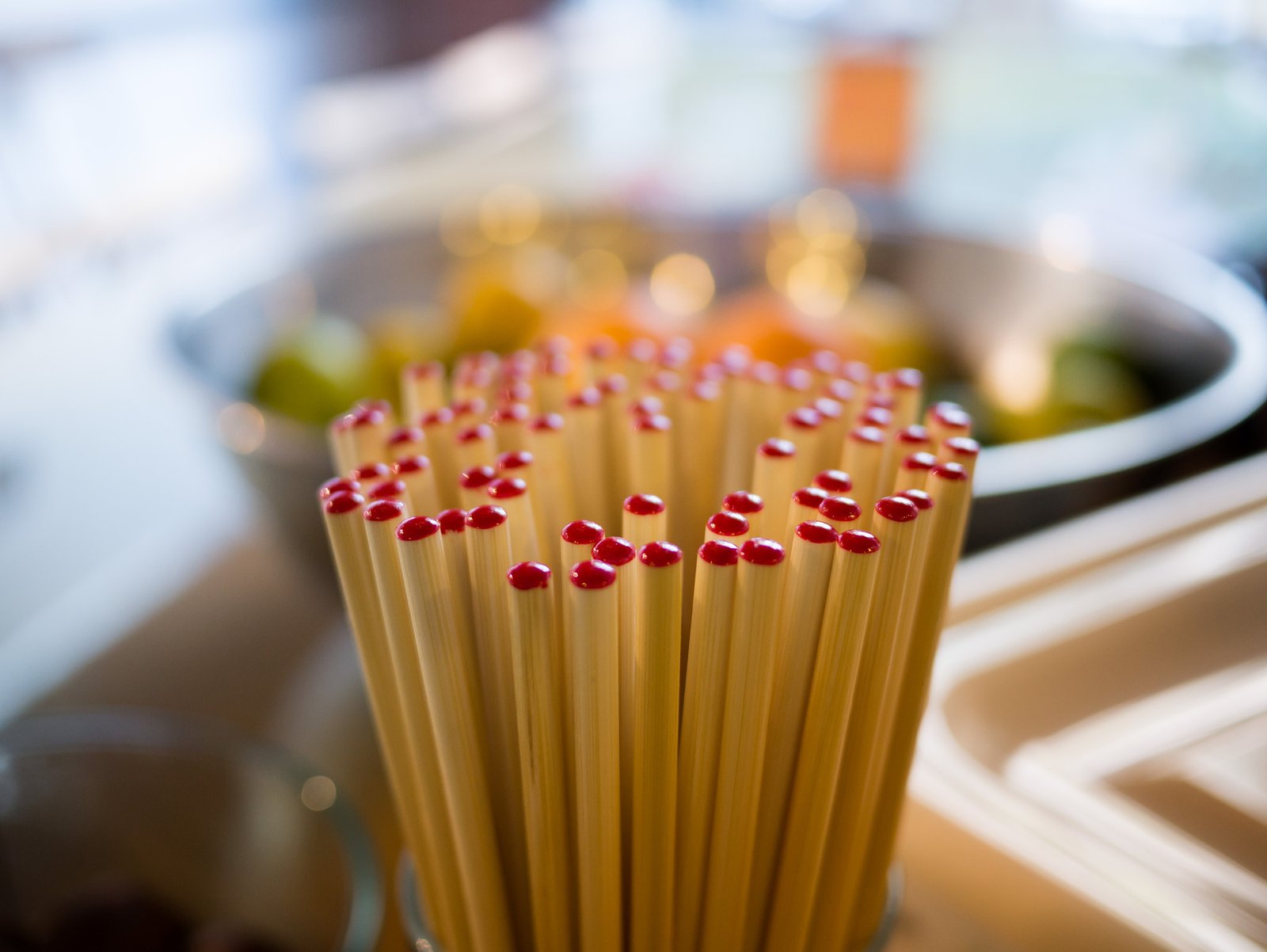
Most restaurants hand you a pair of disposable wooden sticks, sometimes joined at the top, which you snap apart and rub together to remove splinters. The rubbing is tolerated, though old-school diners read it as a comment on the restaurant’s quality.
Home and banquet tables use lacquered wood, melamine, or dark hardwood pairs that are heavier and blunter at the tip. These are the good ones, and a set costs 20 to 60 RMB at a department store. Tips are tapered to hold slippery food, unlike the blunt metal chopsticks used in Korea, which are a different tradition entirely and a poor starter tool for learners.
One modern habit to notice: since around 2020, many restaurants provide separate serving chopsticks, called gong kuai, in a contrasting color so diners take food from communal plates with the public pair and eat with their own. Using them without being asked is the single most appreciated thing a foreign diner can do.
Manners and taboos that actually matter
A few rules are close to universal in China, and violating them reads as carelessness rather than ignorance.
Never stick chopsticks upright in a bowl of rice
This is the big one. Upright sticks in a rice bowl resemble incense offerings at a funeral, and the image unsettles people. Rest the tips on your bowl edge, on the choprest, or on a napkin instead.
Do not point, gesture, or drum
Pointing at people with chopsticks is rude, and tapping the bowl rim carries an old association with begging, so staff will notice. If you need to talk, set the sticks down.
Do not pass food chopstick to chopstick
Handing food directly from your pair to someone else’s pair mirrors a funeral ritual in which bones are passed between chopsticks. To share, place the food on their plate, or use the serving pair.
Do not dig through communal dishes
Rummaging in a shared plate for the best piece is considered poor manners. Take from the top or the side nearest you. At a round table with a lazy susan, wait for the spin to stop, take what is in front of you, and never spin while someone is reaching.
Spearing is a fallback, not a technique
Skewering a piece of food because your sticks are not good enough yet is understandable, but it is not polite at a hosted meal. Use the ceramic spoon for slippery items like tofu, and practice the sticks for everything else.
| Avoid this | Why it reads badly | Do this instead |
|---|---|---|
| Sticks standing upright in a rice bowl | Resembles incense at a funeral | Lay them across the bowl rim or on a choprest |
| Pointing or gesturing with the tips | Reads as rude and aggressive | Set the sticks down before you talk |
| Tapping the bowl rim | Old association with begging | Wait patiently; refills come without tapping |
| Passing food chopstick to chopstick | Mirrors a funeral bone-passing ritual | Place food on the other person’s plate |
| Digging through a shared dish | Looks selfish at a communal table | Take from the top or the side nearest you |
Foods that test your skill
Certain dishes are the final exam, and locals know it.
Noodles come first. In China it is normal to lift the bowl close to your mouth and use the sticks to separate and lift the strands while you slurp; this is not the loud slurping etiquette of Japan, but lifting the bowl is expected rather than rude. Long noodles symbolize long life, so cutting them is discouraged. Our Chinese noodles guide covers the styles you will meet.
Dumplings are slippery and smooth, and the grip point matters more than force. Pinch the middle of the dumpling lightly, lift, dip in vinegar, and bite. If a dumpling squirts, that is the restaurant’s fault, not your sticks’. The Chinese dumplings guide explains the filling styles worth ordering.
Hot pot is the stress test: a rolling pot of broth, long waits, and ingredients that appear and vanish. Use your sticks to lower ingredients in and fish them out, and never wave them over someone else’s bowl. The Chinese hot pot guide covers the meal itself, which is as much a social event as a dinner.
Tofu and soft dishes defeat beginners. The trick is to slide the spoon under the piece and let the sticks steady it from above, a two-utensil move that experienced diners make look casual.
Etiquette around the table
Chopstick skill is only one layer. The wider habits at a Chinese table are learnable in a single meal.
If someone pours tea for you, tap two fingers lightly on the table to say thank you without interrupting the conversation. It is a Cantonese tradition that has spread, and locals find it charming when a visitor does it correctly.
When ordering through a host, let them lead; the order Chinese food guide covers the vocabulary and the rhythm of a shared meal. At banquets, dishes arrive in waves, toasts happen on the host’s schedule, and the banquet etiquette guide walks through seating and glass-clinking. For the general framework, the Chinese etiquette guide is the overview.
Two small things that make a meal easier: lift your rice bowl off the table when eating from it, which is normal in China, and pace yourself with the group. Meals are shared, and the person who finishes first waits politely rather than pushing the table forward.
Quick facts
- The grip: bottom stick still, top stick moves like a pen.
- Hold about a third up from the tips; Chinese sticks run about 25 centimeters.
- Practice by transferring peanuts or beans between bowls for five minutes a day.
- Never rest sticks upright in rice; it resembles a funeral offering.
- Use serving chopsticks (gong kuai) for shared plates when provided.
- Lift your rice bowl while eating from it; that is normal at Chinese tables.
- Tap two fingers on the table to thank someone who refills your tea.
Frequently asked questions
How long does it take to learn chopsticks?
Most people get the basic movement in an evening and become reliable within a week of daily practice. The grip is the whole battle; once your thumb and index finger understand the motion, everything else is muscle memory.
Is it rude to ask for a fork in China?
Restaurants in tourist areas keep forks, and asking is never offensive. In smaller local places there may be no forks at all, so a spoon plus practice is the better plan. Trying the sticks, even badly, is always appreciated.
Are there left-handed chopsticks?
No, and none are needed. The grip works identically for either hand; only the orientation of the top stick’s movement changes. Left-handed diners sometimes angle the sticks inward slightly for comfort.
Can I rest chopsticks across the bowl?
Yes, laying them across the rim of your rice bowl is acceptable. A choprest is better if one is provided. What you must not do is stand them upright in the rice or leave them stabbed into a dish.
Why do people rub disposable chopsticks together?
To smooth splinters on cheap wooden pairs. It is common, though some diners consider it a subtle comment on the restaurant. A quick rub before use is fine; a long, vigorous session is not.
What should I do at a hot pot with only one pair?
Use the same pair for raw and cooked items, but keep two zones in the pot: drop raw ingredients in on one side, fish cooked items from the other. In practice, everyone at the table is fishing around with their own pair anyway, and nobody minds a beginner.
Do Chinese people use chopsticks for everything?
No. Soups come with a ceramic spoon, congee is eaten with a spoon, and Peking duck is wrapped in pancakes by hand. Chopsticks are the default for solid food, not a rule that applies to every dish.
Plan a China food route
Table etiquette is easiest to learn in the country, over meals with people who will correct you kindly. If you want a route built around the right restaurants, cooking classes, and market walks, tell us your dates on our contact page and we will build a custom food-and-travel itinerary for you.
Written by the ChinaTravelFood editorial team.