Mount Tai in a short answer
Mount Tai, or Tai Shan, rises near the city of Tai’an in Shandong province and is the most revered of China’s five sacred mountains. People have climbed it for three thousand years to watch the sun come up from above the cloud line, and emperors made the ascent a state rite. When I first reached the summit before dawn, the crowd fell silent as the disk lifted out of a solid sea of cloud, and I understood why the trip is treated as a pilgrimage rather than a hike. The short advice: decide between the cable car and the steps, start in the dark, and dress for cold you will not feel at the base. The sunrise is the point, and the mountain’s history is the bonus.
Why Tai Shan matters
Tai Shan was the mountain emperors chose for the Feng and Shan sacrifices, the rituals that confirmed a ruler’s mandate from heaven. Twelve emperors are recorded as making the climb, and countless poets and officials left inscriptions on the rocks, which is why the path reads as an open-air museum of Chinese writing. The mountain is not the tallest or the most dramatic in the country; its power is cultural. Standing on the summit at first light, you are in a place where the act of watching the sun was, for two millennia, the most important thing a Chinese ruler could do. That weight is unusual and it shows in the number of stone tablets and temples packed along the route.
The geology is a separate point of pride: the mountain is one of the world’s oldest exposed rock masses, around 2.5 billion years old in places. So you are climbing both a sacred site and some of the most ancient stone on the continent. The combination is why UNESCO listed it as a mixed natural and cultural site in 1987.
The Dai Temple at the base is the other half of the story and easy to miss if you rush to the summit. It is the palace where emperors rested and performed rites before the climb, with courtyards, ancient cypresses, and steles recording their visits, including a famous one attributed to the first Qin emperor’s grandson. Give it an hour on the afternoon before your climb; the temple sets up what the mountain means, and the contrast between the formal courtyard below and the open ridge above is the point. Most travelers skip it and lose that framing, which is a shame.
The two ways up
The walking route
The classic climb is the Red Gate route from Tai’an, about 7,000 steps and 8 to 10 kilometers to the summit, gaining roughly 1,400 meters. Most people walk it through the night, starting around ten or eleven, to reach the top for the sunrise. The path is paved, lit in sections, and lined with temples, arches, and inscriptions the whole way, so it is never truly wild. I found the middle stretch, past the Midway Gate to Heaven, the hardest, because the steps steepen and the hour is late. Porters and the occasional sedan chair offer rides if your legs give out, for a price that rises with the altitude.
The cable car route
You can drive or bus to the midpoint (Zhongtianmen), take a cable car partway, then walk or take a second lift to near the summit. This cuts the effort to under two hours of easy walking and lets you sleep in the base city and come up for dawn by vehicle. It costs more and removes the pilgrimage feeling, but it is the realistic choice for families, older travelers, or anyone short on time. Both routes meet at the top for the same sunrise.
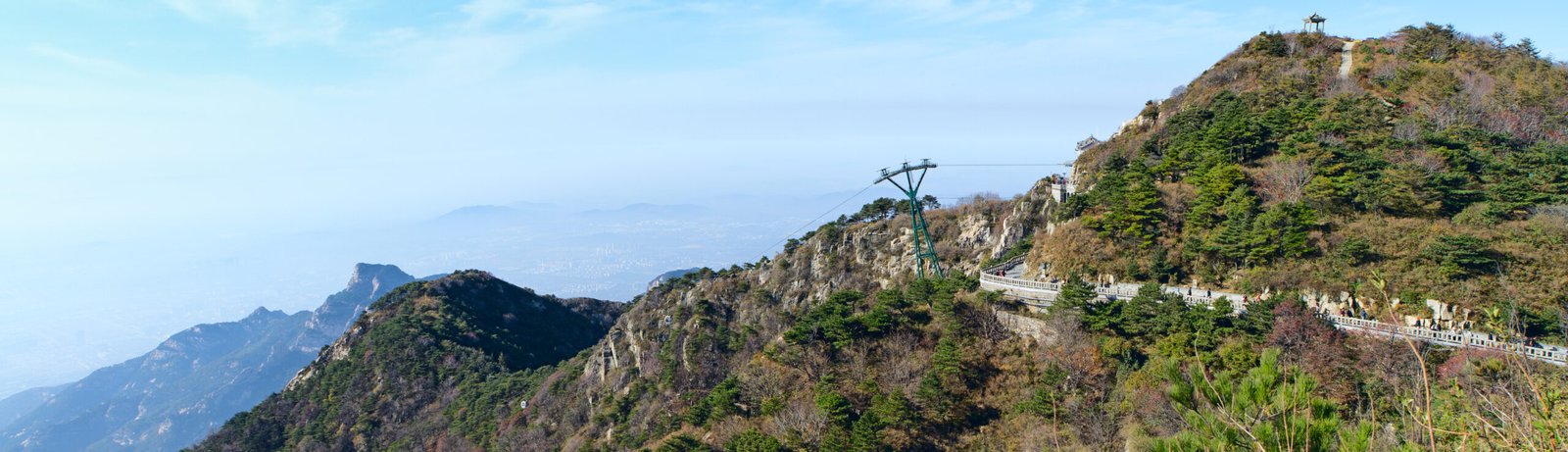
A note on the cable car itself: the cabin rises steeply through a notch in the ridge, and on a clear morning the view down the valley toward Tai’an is the best aerial look at how the plain gives way to the massif. I took the car down after a night walk up, and the descent revealed the route I had climbed blind in the dark, the temples and arches strung along the stair like beads. Doing one direction each way is a good compromise if your knees object to the steps but you still want the night climb.
Tickets, routes, and the timing
| Item | Typical range | Note |
|---|---|---|
| Peak entry | about 115 to 125 yuan (recent years) | confirm current rate |
| Cable car | separate, each segment ~100 yuan | midpoint to near top |
| Walking time | 5 to 7 hours up on foot | overnight start for sunrise |
| Summit height | 1,545 meters | cold and windy at top |
The numbers above are a planning range; the mountain adjusts the entry fee and the cable hours by season, and the sunrise time shifts across the year, so check both before you commit. Altitude here is modest compared with Tibet, but the pre-dawn cold at the top is real; our altitude sickness guide is more relevant for the high plateau, but the layering advice still applies. Tai’an is on the Beijing-Shanghai high-speed line, so it is an easy stop; our China trains guide and high-speed rail guide cover the booking and the classes.
When to go and what to expect at the top
Spring and autumn give the clearest dawns; summer is warm but cloudy and crowded; winter is cold, occasionally snowy, and quiet, with a chance of a spectacular clear sunrise after a front. The summit has a temple, a hotel, and vendors selling padded coats and instant noodles, because most people arrive cold and hungry at five in the morning. Bring your own warm layer rather than renting if you can; the rentals are fine but the queue is not. The sunrise itself is not guaranteed: on a foggy morning you get a pale glow and a cloud sea instead, which is its own reward.
Our best time to visit China page maps the national season pattern if you are linking regions. If you want bigger vertical drama after Tai, Huangshan to the south and Mount Hua in Shaanxi are the other two famous climbs, each harder than Tai but with their own reputations.
After the descent, Tai’an town is where the climb pays off at the table. The local food is solid Shandong: hand-made noodles, braised ribs, and sesame pockets that taste better than they should after a long night on the steps. The area around the base gate fills with places aimed at tired hikers, and the standard is higher than the tourist framing suggests. Sit down, order something with vinegar and garlic, and let your legs recover before the train.
Quick facts
- Location: Tai’an, Shandong, on the Beijing-Shanghai rail line.
- Height: 1,545 meters at the summit (Jade Emperor Peak).
- Status: first of the five sacred mountains, UNESCO mixed site since 1987.
- Climb: about 7,000 steps on foot, or cable car from the midpoint.
- Rite: imperial sacrifices to heaven for two millennia.
- Best: overnight walk or pre-dawn cable for sunrise.
Frequently asked questions
Is the climb hard?
The steps are steep in the upper half and the walk is long, but it is a paved, supported route, not a wilderness hike. Fit walkers do it overnight; others take the cable car. It is harder than it looks because of the repetition and the hour.
Can I see the sunrise without walking all night?
Yes. Take the cable car up in the pre-dawn window, or stay at a summit hotel. You still need to be at the viewing point before first light, which means a very early start even by vehicle.
What should I wear?
A warm layer regardless of the base temperature, because the summit is cold and windy before dawn even in summer. Good shoes for the steps, and a headlamp if walking.
Is it crowded?
Very, on holiday dawns and summer weekends. The shoulder seasons and winter are calmer. The crowd at the summit for sunrise is part of the experience, for better or worse.
How do I get there?
High-speed train to Tai’an station from Beijing, Shanghai, or Jinan, then a short bus or taxi to the gate. The city is built around the mountain.
What is there besides the sunrise?
Temples, arches, and thousands of rock inscriptions along the route, plus the Dai Temple at the base, which holds imperial steles. The cultural layer is thick if you look up from your feet.
Is it good for kids?
Older children can do the cable route; the full walk is a lot for small legs. The summit hotel and the dawn spectacle keep most kids engaged if they are warm.
Making Mount Tai part of a Shandong trip
Tai Shan pairs naturally with Jinan and Qufu, the home of Confucius, for a Shandong cultural loop, and the province’s food is a reason to slow down. Our Shandong cuisine guide covers the wheat-and-seafood cooking that defines the region, and it makes a good excuse to rest your legs after the descent. If you want a route that links the climb, the Confucius sites, and the right train times into one plan, send us your dates and we will sketch a custom food-and-travel itinerary. The mountain is best climbed at night and seen at first light.
Written by the ChinaTravelFood editorial team.