Eating vegetarian in China without starving
China is easier for vegetarians than its meat-heavy reputation suggests, but only once you learn where the meat hides. The broth, the lard and the finishing splash of oyster sauce will undo you long before an obvious slab of pork does. I have eaten meat-free across the country in long stretches: three weeks between Xi’an and Chengdu, a month based in Shanghai, ten days rattling around small towns in Guizhou where the dinner menu was one laminated page and half of it was pig. What turns an anxious trip into a good one is temple cooking, a handful of phrases, and knowing which three questions to ask before you sit down.
Buddhist kitchens here have cooked without meat for well over a thousand years, and the mock duck and mock fish they build from tofu skin fool people who eat meat daily. The problem is that “vegetarian” in an ordinary restaurant means “no big pieces of meat,” not “no animal product” — and the gap between those two sentences is where most bad meals happen. Our city-by-city vegetarian breakdown covers where dedicated restaurants cluster; this guide is about the rest.
The hidden meat problem
Three things bite vegetarians in China, and none of them show up on a menu that says “green beans” or “tofu.”
Lard in the pan
Small shops fry in pork lard because it is cheap and traditional. It turns up in dumpling fillings, in the flaky layers of northern pastries, and in anything deep-fried at a street stall. In Xi’an I ordered vegetable dumplings, ate two, and found the filling faintly pink and slick: lard, mixed in for texture. The cook was not deceiving me; in her kitchen, vegetable dumplings simply contained lard. Asking for vegetable oil is a normal, answerable request.
The broth under everything
Noodle shops build their soup base on chicken or beef bone simmered overnight, and the noodles go into that pot regardless of what you put on top. A bowl of “vegetable noodles” arrives in chicken stock unless you say otherwise. Ask before you order, not after the bowl lands, when the only fix is a new bowl and ten awkward minutes.
Oyster sauce and chicken powder
The third trap is the finish: a spoon of oyster sauce in the wok, a pinch of chicken powder instead of salt, pork stock to glaze a plate of greens. I ate a “vegetable” fried rice at a train station with that pork-stock sheen on every grain, and only noticed because I had eaten the same dish without it two days earlier. The flavour difference is subtle; the ingredient difference is not.
The fix for all three is one written note in Chinese: no meat, fish, seafood sauce or egg, and please use vegetable oil and a vegetable broth. Show it on your phone at order time; it is not rude, and clarity is what gets you fed. If you are staying a while, the basics of learning Chinese pay for themselves here, because once you can read 肉 (ròu, meat) and 素 (sù, vegetarian) yourself, you stop depending on anyone else’s patience.
Temple food: the safe haven
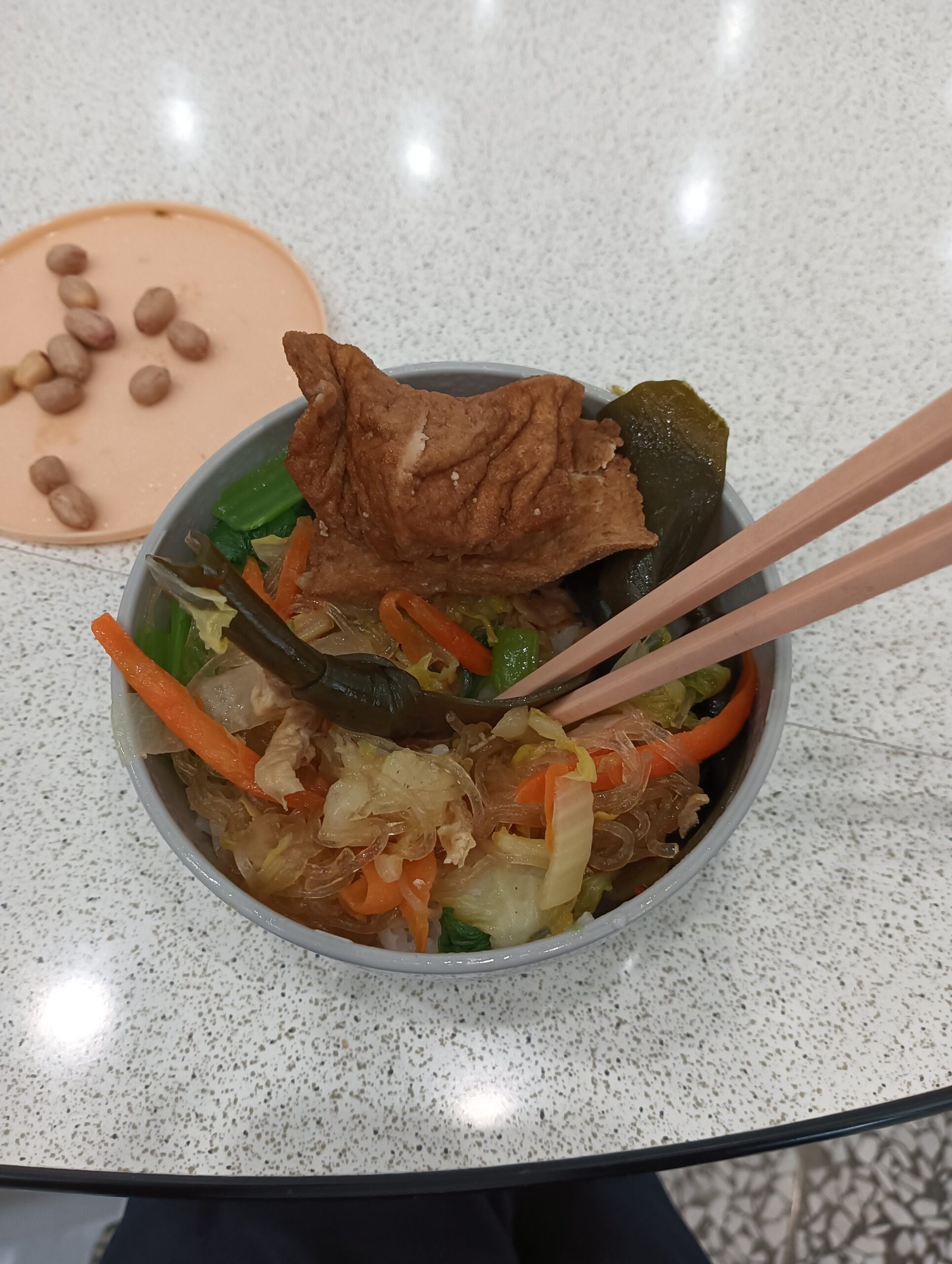
Buddhist restaurants and temple canteens are the reliable option, and not just at famous monasteries. Doctrine forbids meat, fish and egg, so the kitchen runs on soy, gluten, mushrooms and vegetables with no hidden stock to hunt for. I ate a “fish” of layered tofu skin wrapped in seaweed that fooled my meat-eating companion for three bites.
What a temple meal costs and how it works
Temple dining is usually not table service. At most city temples you buy a ticket at a window — ¥25 to ¥40 for a set meal — collect a tray, and eat in a plain hall beside pilgrims and volunteers. At one monastery outside Hangzhou we paid ¥30 each for rice, a bowl of vegetables, a tofu dish, soup and pickles, at long shared tables while a volunteer refilled the rice pot from a steel vat. Nobody spoke English; nobody needed to. At the sit-down restaurants attached to larger temples, four mock-meat dishes and rice for two runs ¥140 to ¥200, so ¥70 to ¥100 a head — half what a comparable meat banquet costs.
One caveat: temple kitchens are far better at lunch than dinner. Monks traditionally eat their main meal before noon, and by 7 p.m. you may find only noodles and leftovers. Go at 11:30.
City by city
Difficulty below is my own rough scale: 1 means you could eat vegetarian for a month without thinking, 5 means every meal needs negotiating. Counts are approximate app listings, not a census.
| City / region | Difficulty (1–5) | What actually works | Typical spend per meal |
|---|---|---|---|
| Shanghai | 1 | Roughly 120–150 dedicated vegetarian or vegan restaurants; mock-meat banquets, vegan bakeries | ¥35–¥80 |
| Beijing | 2 | About 80–100 listed spots, strong temple restaurants; easiest near the big temples | ¥30–¥70 |
| Chengdu | 3 | Around 60–80 listed spots and superb vegetable cooking, but chilli oil is often beef- or lard-based | ¥20–¥50 |
| Xi’an | 3 | Cold vegetable plates and liangpi everywhere; dumplings and fried items need an oil question | ¥18–¥40 |
| Guangzhou | 3 | Dim sum with real vegetable options and excellent tofu; ask about lard in pastry and the congee base | ¥25–¥60 |
| Lhasa and Tibetan areas | 5 | Meat-heavy tradition at altitude; lean on temples, Indian restaurants and hotel kitchens | ¥40–¥90 |
| Small towns and counties | 4 | No dedicated restaurants; egg-and-tomato, plain tofu, greens, rice, market fruit | ¥12–¥30 |
The north-south split matters as much as the city list. North of the wheat and rice line the default starch is wheat — noodles, buns, pancakes — and greens are scarce in winter; south of it, rice and a wider vegetable range make life easier year round. I ate cabbage, potato and tofu through one northern January and was grateful for it.
What to order with confidence
These dishes are close to meat-free already and can be nudged the rest of the way with one question. Prices are what I paid in mid-range neighbourhood restaurants, not tourist streets.
- Mapo tofu, ¥18–¥28. Ask for it without the minced pork (bú fàng ròu). The sauce is the dish; the meat is a habit. In Chengdu I got it meat-free in one restaurant out of three.
- Dry-fried green beans, ¥22–¥32. Confirm no pork and no lard; the blistered Sichuan version is superb.
- Smashed cucumber, ¥12–¥18. Cold, garlicky, reliable; add “no seafood sauce” for the dressing.
- Egg and tomato, ¥16–¥24. The national comfort dish and the default safe order in small towns.
- Braised or home-style tofu, ¥20–¥30. Put sù in front and you are usually fine.
- Plain congee, ¥6–¥12. Ask whether the base is water or stock; it is often water.
- Scallion pancakes and mantou, ¥3–¥10. Lard is the question. Ask in the north; in the south it is usually vegetable oil.
- Corn, baked sweet potato and steamed buns from carts, ¥4–¥10. No sauce, no negotiation.
Chengdu deserves its own warning. In a hot pot place off Chunxi Road, with a friend who speaks Sichuan dialect, we still spent four minutes on the oil question: the red half of a divided pot is almost always beef tallow, the clear half often bone broth. We ended up with a vegetarian base brought from the back at ¥28, plus ¥14 for lotus root and ¥16 for tofu skin, drinking tea through the steam while the next table ate tripe. It was one of the best meals of the trip, and only happened because four specific questions were asked first.
Mock meat is your friend in big cities and a risk in small ones, where a “vegetarian restaurant” may still season with chicken powder; ask anyway, cheerfully. If you avoid gluten too, be careful, because seitan and tofu skin are the backbone of temple cooking — our gluten-free guide to China goes into that properly.
Phrases and etiquette
Say it aloud and it gets lost in dialect and noise; show it written and it gets read and passed to the kitchen. I keep these as a screenshot on my lock screen so I can hand my phone over without unlocking it.
| Chinese | Pinyin | Meaning |
|---|---|---|
| 我吃素 | Wǒ chī sù | I eat vegetarian |
| 不要肉 | Bú yào ròu | No meat, please |
| 不要猪油,用植物油 | Bú yào zhūyóu, yòng zhíwùyóu | No lard, please use vegetable oil |
| 不要蜂油和鸡精 | Bú yào háoyóu hé jījīng | No oyster sauce and no chicken powder |
| 汤底是素的吗? | Tāng dǐ shì sù de ma? | Is the soup base vegetarian? |
| 全素,不放蛋 | Quán sù, bú fàng dàn | Fully vegetarian, no egg added |
| 有什么素菜推荐? | Yǒu shénme sùcài tuījiàn? | What vegetarian dish do you recommend? |
On etiquette: refusing a host’s dish at the table can read as rejection, so state your diet as a fixed principle on arrival rather than declining plate by plate. Frame it as a long-standing health or belief choice, thank them warmly, and eat generously from whatever fits. I once explained myself in one sentence to a family in Guizhou and watched four vegetable dishes appear in twenty minutes, followed by an apology that there was not more.
My five-step ordering routine
After enough trial and error I now do the same five things at every ordinary restaurant, and my failure rate has dropped to almost nothing.
- Read the menu for the character sù (素) before you sit down. If there is no vegetarian section, the kitchen is unused to the request and you should lower your expectations.
- Show the written note and let the server read it themselves rather than translating it aloud for them.
- Ask the two real questions: is the broth vegetarian, and is the oil lard? Everything else follows from those answers.
- Order two vegetable sides plus one tofu or egg dish and rice. One dish puts your whole dinner on a single answer; three dishes for two people is plenty.
- Check the plate before the first bite. If something looks wrong, ask quietly and early. Every such conversation I have had ended with a new plate and no hard feelings.
Quick facts
- “Vegetarian” at an ordinary restaurant may still mean lard, oyster sauce or bone broth.
- Carry a written Chinese note listing everything you avoid and show it when ordering.
- Temple and Buddhist restaurants are the reliable meat-free option; go at lunch, not dinner.
- Budget ¥12–¥48 for a vegetarian dish, ¥25–¥40 for a temple set meal, ¥70–¥100 a head for a mock-meat banquet.
- Safest orders: smashed cucumber, dry-fried green beans, egg and tomato, plain congee, steamed buns.
- Strict vegans should treat “vegetarian” as “contains egg, possibly honey” and read our vegan guide to China before ordering.
- Confirm the noodle broth is vegetable, not bone, before you sit down — not after the bowl arrives.
- Travel days are the weak point, so stock up at supermarkets; our high-speed rail survival guide covers what to carry on board.
Frequently asked questions
Is Chinese food vegetarian-friendly?
More than most travellers expect, once the traps are mapped. Tofu, wheat gluten, vegetables and grains are everywhere, temple cooking is entirely meat-free, and the northern wheat belt has a whole repertoire of cold vegetable plates. The work is in the broth and the oil.
Can I trust the word “vegetarian” on a menu?
At a dedicated vegetarian or Buddhist restaurant, yes. At a standard restaurant, assume it means “no visible pieces of meat” and confirm the oil, stock and seasoning in writing first.
What should I do about eggs and dairy?
Eggs are common in fried rice, noodles and many “vegetable” dishes, so say so in writing if you avoid them. Dairy barely exists in Chinese cooking outside Western cafés and the milk-tea traditions of Inner Mongolia and Xinjiang.
How many vegetarian restaurants will I actually find?
The apps list roughly 120–150 dedicated places in Shanghai, 80–100 in Beijing and 60–80 in Chengdu. In a county town of 300,000 the honest answer is often zero, and dinner will be egg-and-tomato and plain tofu.
How do I handle a host dinner or a business banquet?
State your diet as a fixed principle on arrival, thank your host, and eat generously from whatever fits. One clear sentence at the start preserves far more face than a series of refusals across the table.
Eat green without the guesswork
Vegetarian travel in China is a skill rather than a struggle, and it takes about three days to learn. Map one temple and two dedicated restaurants near each hotel before you arrive, keep the written note on your phone, ask about the oil every time, and the worst case becomes a plate of egg-and-tomato rather than a missed meal. Send us your diet, cities and route through the contact page, and we will build a food-and-travel plan that keeps real vegetarian meals within reach every day.
Written by the ChinaTravelFood editorial team.