A volcano field at the edge of Yunnan
Most travelers who come to Yunnan head for Dali or Lijiang and stop there. I almost did. Then a friend in Kunming said, “Go west, to Tengchong, where the ground still steams,” and I am glad I listened. Tengchong sits in the far west of Yunnan, near the Myanmar border, on a volcanic field that last erupted centuries ago but has never quite gone quiet. The town is built on basalt, the hills around it are old cinder cones, and the hot springs a few kilometers south boil hard enough to cook an egg in a paper cup.
This is not a dramatic, lava-flow kind of place. It is quiet, green, and a little remote, which is exactly why it rewards the effort. You come for the cones you can climb, the steam you can stand near, and the old hometown of Heshun, a village that sent sons abroad for a hundred years and got a library and a strange cosmopolitan calm in return. For food context, our Yunnan cuisine guide explains the mushroom and minority tables you will eat from here.
Getting to Tengchong
Tengchong does not yet have a high-speed rail station. As of 2024, the practical routes are flying or driving. Tengchong Tuofeng Airport has daily flights from Kunming (about 50 minutes, 400 to 900 RMB depending on season) and occasional flights from other hubs. On the ground, it is roughly a five-hour drive from Dali and a nine-hour drive from Kunming, much of it on good expressway but the last stretch on mountain road. The nearest high-speed rail stop is Baoshan, after which you take a bus or car for two to three hours. Always confirm current rail and road status, because border-region routes change.
I flew from Kunming and hired a driver for two days, which cost about 600 RMB a day including waiting time. That was the right call: the sites are spread out and public transport between them is thin.
The volcanic cones: Dakongshan and the crater rim
The centerpiece is the Volcanic Geopark (Huoshan Requ National Geology Park), where you can climb two well-preserved cones, Dakongshan (大空山, “big empty mountain”) and Xiaokongshan (小空山, “small empty mountain”). The names come from the empty craters at the top. Dakongshan has about 600 steps to the rim and a viewing platform where you look down into a bowl of grass and scrub. The climb takes 20 to 30 minutes at a steady pace. Entry to the geopark runs about 35 to 60 RMB; a combined ticket with the shuttle is common.
From the rim on a clear morning you can see dozens of smaller cones scattered across the plain, a sight that makes the geology concrete in a way a museum never does. I went at 8 a.m. to beat both the heat and the tour buses, which arrive around 10. The light on the grass crater was the best part of the morning.
What the park includes
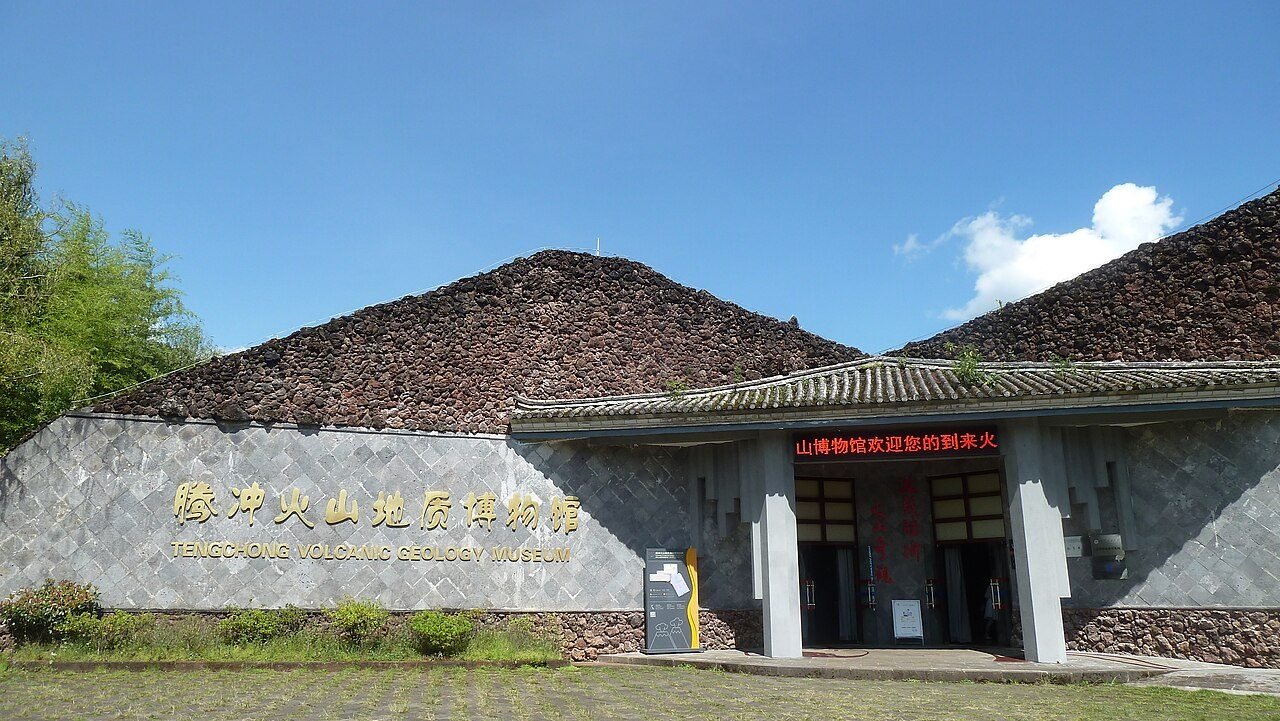
Besides the two climbable cones, the geopark has a museum with basalt columns and volcanic bombs, and a “flying saucer” observation area on a taller cone reached by cable car (about 20 RMB one way). Skip the overpriced combos and just do the two main climbs plus the museum. The whole visit is two to three hours.
Rehai: the boiling field
A few kilometers south of town, Rehai (热海, “hot sea”) is where the underground heat is obvious. Wooden boardwalks loop past steaming vents, one of which, the “Big Boiling Pot” (Dashengguo, 大滚锅), is a spring at roughly 96°C that locals use to steam corn, eggs, and peanuts in bamboo baskets. You can buy a basket of eggs cooked in the steam for about 10 RMB and eat them warm on the path. The sulfur smell is strong and the railings are hot; keep a normal distance and do not touch the water.
Rehai also has paid hot-spring baths if you want to soak, with ticket-and-bath combos from 100 to 200 RMB. I found the public boardwalk more interesting than the baths, but a soak after the cone climb is a reasonable plan. Entry to the Rehai scenic area is about 50 RMB.
Heshun: the village that traveled
Heshun (和顺古镇) is the reason many visitors stay overnight. It is a preserved village of grey-tiled homes, narrow lanes, and a famous library founded in 1928 by overseas Chinese from the area. The Heshun Library is one of the oldest village libraries in China and still has its quiet reading rooms. Entry to the town is about 55 RMB and includes several small museums.
What makes Heshun different from other “ancient towns” is that it feels lived in rather than staged. Old men play cards under the eaves, and the alleys open onto working farms. Go early or late; midday brings bus tours. A coffee on the edge of the rice fields, watching the light move, is one of the calmer experiences in a country not known for calm tourist sites.
The war museum
Tengchong holds a difficult history: it was the site of heavy fighting in the Second World War, when Chinese and Allied forces retook it from Japanese occupation in 1944. The Cemetery of the National Heroes (Guohun, 国殇墓园) and the adjoining museum are sober, well-kept, and free to enter. It is worth an hour if you want the fuller picture of why this border region mattered. Photograph respectfully.
Food in Tengchong
The local table leans into the volcanic soil and the border. Try “da jiu jia” (大救驾), a stir-fry of rice cake, egg, and vegetables said to have saved a fleeing Ming prince’s hunger, served in most local restaurants for 15 to 30 RMB. The area is also known for “tengchong e (饵)”, rice cakes in various forms, and for wild vegetables and mushrooms in season. For the wider picture, our Kunming guide covers the gateway city, and Dali is the usual jumping-off point by road.
| Site | Entry (approx.) | Time needed | Best time to go |
|---|---|---|---|
| Volcanic Geopark (cones) | 35 to 60 RMB | 2 to 3 hours | 8 to 10 a.m. |
| Rehai hot springs | about 50 RMB | 1.5 to 2 hours | Morning or late afternoon |
| Heshun ancient town | about 55 RMB | Half day | Early or after 4 p.m. |
| Heshun Library | Included in town ticket | 30 to 45 minutes | Opening hours, avoid noon |
| War cemetery and museum | Free | 1 hour | Any open period |
Quick facts
- Tengchong sits on a volcanic field of roughly 90 cinder cones in far western Yunnan
- No high-speed rail as of 2024; fly to Tengchong or drive from Dali (about 5 hours)
- The geopark’s two climbable cones are Dakongshan and Xiaokongshan
- Rehai’s “Big Boiling Pot” spring runs near 96°C and steams food in baskets
- Heshun is a preserved village with a library founded in 1928 by overseas Chinese
- Flights Kunming to Tengchong take about 50 minutes and cost 400 to 900 RMB
- A local driver for two days runs around 600 RMB per day
Frequently asked questions
Is Tengchong safe to visit given its border location?
Yes, the town itself is calm and tourist-friendly. The immediate border crossings into Myanmar are restricted, and you should not attempt them. Stay within the scenic and town areas and you are fine. Check current travel advisories before any border-region trip.
Do I need a guide for the volcanic park?
No. The boardwalks and steps are signed in Chinese and English, and the climbs are short. A guide adds geology detail but is not required. Download an offline map, because mobile signal weakens on the cones.
When is the best time to go?
Spring (March to May) and autumn (September to November) are best, with clear skies and mild temperatures. Summer is rainy and the boardwalks get slick; winter is cold but clear. Our best time to visit China guide breaks this down by region.
Can I see Tengchong on a day trip from Dali?
Not comfortably. The drive is about five hours each way. Plan at least one overnight, ideally two, so you can do the cones, Rehai, and Heshun without rushing. The Stone Forest near Kunming is a better day-trip volcano-ish option if your time is short.
Are the hot springs safe to bathe in?
The paid bath facilities are managed and safe. Do not enter the wild steaming pools at Rehai; the water is near boiling and the ground is unstable. The egg-steaming baskets are the safe, fun interaction.
Is the food spicy like the rest of Yunnan and Sichuan?
Less so than Sichuan. Tengchong food is mild, sour, and rice-based, with border influences. If you want heat, ask; if you want mild, you will get it by default more often than in Chengdu or Chongqing.
How do I combine this with a Yunnan trip?
Fly into Kunming, spend a night, then fly to Tengchong, then either fly out or drive to Dali and continue east. Renting a car is possible but the border roads need a confident driver; a hired local car is simpler.
If you want a Yunnan route that includes Tengchong, the cones, and the hot springs without the planning headache, we can build a custom food-and-travel itinerary through the contact page. The western edge of the province is the part most foreigners miss, and it was my favorite corner.
Written by the ChinaTravelFood editorial team.