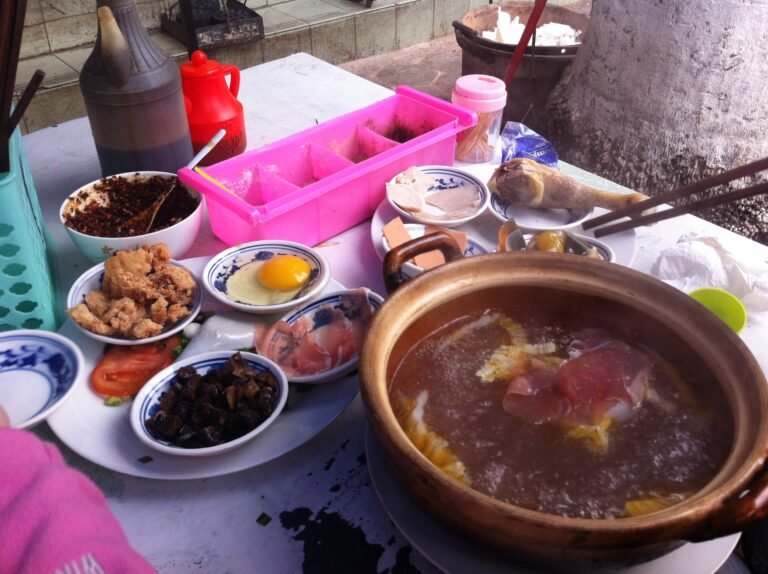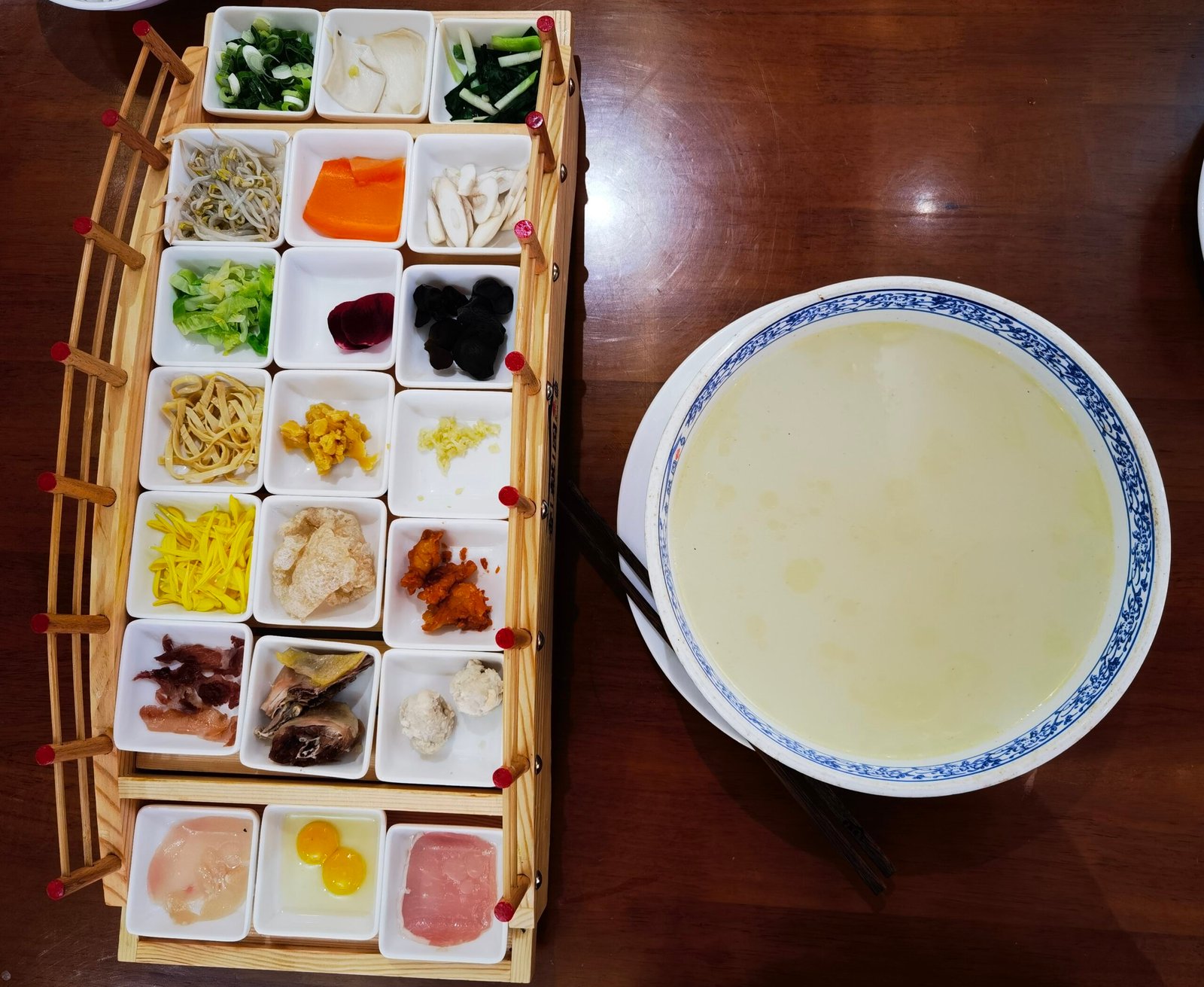
The first bowl of crossing-the-bridge noodles (guo qiao mi xian, 过桥米线) I ate was in a Kunming shop where the waiter brought a bowl of near-boiling oil floating on broth, then told me, through gestures, to slide the raw slices in myself. I nearly cooked my fingers. The dish is a performance as much as a meal: a separate tray of paper-thin meats, quail egg, and vegetables that you poach in a scalding bowl at the table. This is Yunnan’s most famous noodle, and the story behind it is better than the marketing.
The legend, and why it sort of holds
The folk tale says a scholar studied on a small island and his wife crossed a bridge daily to bring him lunch, keeping the noodles hot by floating a layer of oil on top. The oil cap is real and still the trick. Whether a woman invented it in the Qing dynasty is the kind of origin story every regional dish claims. I repeat it because it explains the architecture of the bowl: broth plus oil lid plus a cold tray of toppings.
The dish belongs to the Yunnan cuisine family, which is built on mushrooms, wild herbs, and the minority tables of the southwest. Unlike the wheat noodles of the north, crossing-the-bridge uses rice noodles (mi xian), soft and slippery, a texture that divides first-timers.
How the bowl is built
You get three things: a large bowl of chicken or pork broth capped with a centimeter of oil, a plate of rice noodles, and a tray of toppings. The order of assembly matters.
| Step | Add | Why |
|---|---|---|
| 1 | Raw meat slices, quail egg | Cooks in the hot oil broth |
| 2 | Vegetables, tofu | Blanches, keeps crunch |
| 3 | Rice noodles | Warms without overcooking |
| 4 | Seasonings, herbs | Flavor on top, last |
Get the order wrong and the meat stays raw or the noodles turn to paste. I learned step 4 by watching a local who added a spoon of pickled vegetable and a handful of coriander only after everything else was in. The broth stays hot for a surprising ten minutes because of the oil lid.
Rice noodles versus wheat
To understand why this dish feels different from a Beijing noodle, read the types of Chinese noodles breakdown. Rice noodles are gluten-free, mild, and absorb broth; wheat noodles are chewy and stand up to stir-fry. Crossing-the-bridge only works with rice noodles because they soften in the warm broth without needing a boil.
Where to eat it well
Kunming is the home ground. The city has dedicated mi xian buildings where you pick your tray and broth strength. I paid 18-35 RMB for a solid bowl in 2024, and 80 RMB at a tourist “heritage” house that added goose and a private room. The cheap places near the universities are better than the famous names.
The Kunming travel guide I wrote points to the side streets near Green Lake where the locals queue at 7 am. If you are routing through Yunnan more broadly, the Dali and Erhai Lake area serves its own thinner version with local herbs, worth a stop if you are already there.
Broth, the quiet star
The broth is chicken and pork bone, sometimes with ham, simmered for hours. A good shop smells like a kitchen, not a perfume counter. The Chinese noodle soups guide covers the clear-versus-rich broth split that defines regional soups; crossing-the-bridge is the rich end, capped with fat.
Toppings that matter
The classic tray: pork loin, chicken, fish, quail egg, tofu sheet, greens, and a slice of Yunnan ham. The ham is the umami anchor. Cheap shops skip it; ask if you care. I rank a bowl by the ham and the broth clarity, not the number of plates.
Common mistakes
Tourists dump the noodles first, then wonder why they are mush. Others stir too hard and break the oil seal, losing the heat. And some eat the toppings with chopsticks straight from the tray, missing the cook-in-the-broth point. Watch one local table and you will get it in thirty seconds.
A bowl I ate in a Kunming back lane
The best version I had was not in a famous house but a 12-seat shop near Green Lake where the owner assembled the tray from memory. The broth arrived with a clear oil disc on top, and he watched me add the meat, frowning when I rushed the noodles before the pork set. When I finally ate, the ham hit first, then the sour note of a pickled vegetable I could not name, then the soft rice noodle. That bowl cost 22 RMB in 2024 and beat the 80 RMB tourist set by a mile. I went back the next morning and it was just as good, which told me the place was consistent, not lucky.
The lesson for travelers is to ignore the “heritage” branding. The shops with the longest queues of students and old men are the ones to trust. I now judge a mi xian house by whether it has a stack of worn trays and a busy morning, not by the calligraphy on the sign.
Why the oil cap is the real trick
The genius of crossing-the-bridge is not the flavor but the engineering. A centimeter of rendered fat on the broth traps heat so well that the bowl stays near boiling for ten minutes after it reaches your table. That is what cooks the raw slices safely. I tested this once with a kitchen thermometer at a friend’s house: the broth read 92 Celsius under the oil and 70 at the surface five minutes in. The meat hits the hot layer first and sets before the cooler top touches it.
This is also why you must not stir immediately. Breaking the oil seal dumps the heat and leaves your pork lukewarm. Let it sit, add noodles last, and the system does the work. It is the rare dish where the instructions are physics, not preference, and following them is the difference between a safe bowl and a sick one.
Variations across Yunnan
Not every Yunnan city makes the same bowl. Kunming is the standard bearer with the widest tray; Dali serves a thinner version with local herbs I could not name; Xishuangbanna, down near the border, adds lemongrass and a sour edge from the Dai minority table. The Dali and Erhai Lake area is worth a stop just for the herb version, which tastes greener and lighter than the Kunming original. I rank Kunming first for the broth, Dali first for the aroma.
The rice noodle itself also varies in width. Kunming uses a round, medium noodle; some towns use a flat ribbon. The broth stays the constant, and that is the point of the dish: the soup is the recipe, the noodle is the vehicle. When a shop changes the broth to a clear chicken-only version, locals notice and complain, because the fat cap and the ham are what make it crossing-the-bridge and not just another noodle soup.
Quick facts
- Name in Chinese: guo qiao mi xian (过桥米线), “crossing the bridge rice noodles.”
- Core: rice noodles, oil-capped broth, raw topping tray.
- Price: 18-40 RMB casual, up to 80 RMB at heritage houses (2024).
- Home: Kunming, Yunnan; found across the province.
- Gluten-free: the noodles are rice, but confirm the broth has no wheat thickener.
Frequently asked questions
Is it safe to cook raw meat at the table?
Yes, if the broth is genuinely boiling under the oil, which it is in a proper shop. The oil is the insulator, not the heat source. I have eaten it dozens of times without issue.
What does it taste like?
Rich chicken-pork broth with a clean ham finish and a soft noodle. Not spicy unless you add chili; Yunnan versions are mild compared to Sichuan.
Are rice noodles gluten-free?
The noodles are, but ask about the broth; some shops thicken with a little wheat or use soy with gluten. Strict celiacs should confirm at the counter.
Can I make it at home?
You can, with a strong homemade broth and a separate tray. The hard part is hitting the temperature; use a thermometer and keep the oil layer. It will not match Kunming but it is a fun dinner.
Why is it called “crossing the bridge”?
The legend of the wife crossing a bridge to feed her studying husband. The name stuck even though most modern shops are on solid ground.
Is the tourist-version worth the price?
Not really. The 80 RMB bowl adds ham and a room, not better flavor. Spend 25 RMB at a local spot and you will eat the real thing.
How spicy is it?
Barely. You add chili oil or pickled vegetable at the end. If you want heat, order a side of Yunnan chili paste; it is the right companion.
If you want crossing-the-bridge and other Yunnan eats built into a southwest China route, reach us through the contact page and we will map the stops.
Written by the ChinaTravelFood editorial team.