Xi’an City Wall in a short answer
The Xi’an City Wall is the most complete piece of ancient city fortification left in China: 13.7 kilometers of rammed-earth wall faced in brick, built in 1370 under the Ming dynasty, still standing at full height around the old city. When I first cycled the flat stretch between the South Gate and the East Gate at sunset, with the Bell Tower ahead and the traffic below, the wall felt less like a monument and more like a working piece of the city. The short advice: walk one section and bike the rest, start in the late afternoon, and pay the extra for the bike. The full circuit takes four to five hours on foot, which is more wall than most people need in one day.
The wall that survived
The Hongwu emperor ordered the wall built in 1370, four years after he founded the Ming dynasty, and his engineers raised it on the footprint of the Tang dynasty capital’s inner walls, thirteen hundred years after Chang’an was the largest city on earth. The core is rammed earth, layered and pounded hard, faced with grey brick, and the whole thing was restored in a long campaign that finished in the 1980s after decades of neglect. That is why it looks complete while the walls of Beijing and Nanjing survive only in patches.
The bricks are the part I find most interesting. Ming brickmakers stamped their products with the workshop name, the overseer, and the date, a quality-control system that meant a faulty brick could be traced to the man who made it. Thousands of those stamps survive, and the wall museum inside the South Gate displays the best of them. Walk the ramparts with that in mind and the wall stops being a flat surface; it becomes a signed record of the people who built it.
Walking the ramparts
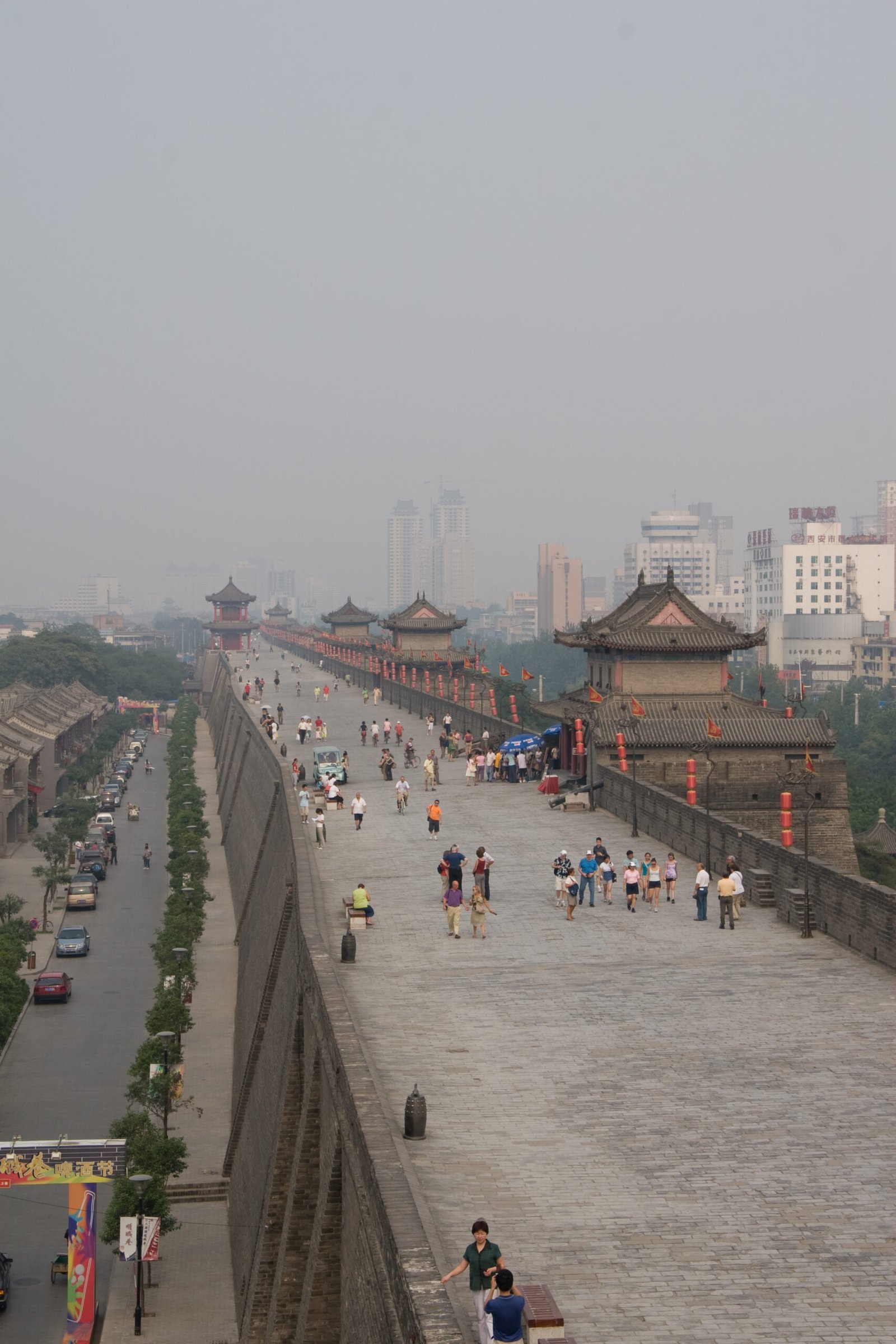
The top of the wall is fifteen meters wide, paved, and flanked by battlements and parapets, so walking feels like strolling a broad avenue rather than a narrow rampart. The flat stretch from the South Gate to the East Gate is the most rewarding direction, because the morning light hits the old city and the evening light turns the brick the color of dark honey. The north side is quieter and looks down on the grid of lanes and markets that never got demolished the way Beijing’s did.
My own pattern is to enter at the South Gate, walk east along the top for two hours, and come down near the Muslim Quarter for dinner. That covers the best light and the best views without committing to the full lap. If you do walk the whole thing, plan on four to five hours with stops, and bring water, because there is no shade on the wall itself and the vendors are clustered near the gates.
Cycling the wall
Bikes are the classic way to see the whole circuit, and the rental is one of the better deals in Chinese tourism. Single bikes, tandems, and the occasional three-wheeler for families are available at the South and East gates, and a rental buys you the right to ride up and down the wall as much as you like within the time window, usually two to three hours. On flat ground that is enough for most people to circle the entire 13.7 kilometers, and the rental operators will swap your bike at the halfway gate if something breaks.
Two warnings from experience. First, the tandem bikes wobble, and the seams between the brick sections are hard on small wheels, so a mountain-bike-style rental with fatter tires makes the ride smoother. Second, the wall closes to riders before dark in some seasons, so ask about the return time when you rent; walking off the wall in the dark is fine but the views are gone.
The gates and the corners
South Gate (Yongningmen)
The main gate and the most complete, with the archery tower, the drawbridge over the moat, and the wall museum in the gate passage. This is where the Tang-style welcome ceremony plays out for visiting officials, a short performance with drums and banners that is worth timing your arrival for if the schedule says it is on. Enter here.
East Gate (Changlemen)
The gate that faces the old imperial approach, and the natural exit if you walked the morning stretch. The towers here have been rebuilt many times, and the view down onto Changle street below is the best angle on the wall’s relationship to the modern city.
North Gate (Anyuanmen)
The quietest of the four main gates, with the fewest visitors and the most residential view. If you want the wall to yourself, start here and walk south; the lanes behind the wall are some of the least photographed in central Xi’an.
The corners
Each corner has a rampart tower, and the northeast corner is the best of them, a two-story structure that guards the junction where the wall changes direction. The corner platforms were the defensive brains of the design, covering two faces with arrow fire, and standing in one explains the geometry better than any diagram.
When the wall comes alive
The wall is a stage for the city’s big dates. During Spring Festival the lantern festival turns the ramparts into a corridor of lit sculptures, and the crowds come in layers. The Xi’an City Wall International Marathon, a half marathon held on the wall itself, fills the top with runners once a year, and the night lighting in the warmer months gives the whole circuit a glow that changes the mood completely. For everyday visiting, the wall is best in the early morning or the last two hours before closing, when the tour groups have gone and the local cyclists come out.
Summer on the wall is hot, with the brick radiating everything the day stored up, and winter is cold with the wind coming straight off the plain. Our best time to visit China page maps the national seasons if you are building the trip around other regions.
Tickets and getting there
The wall charges a single entry, with bike rental separate, and combination tickets that add the bell tower and the drum tower exist but only make sense if you want all three. Prices below are recent-year ranges; the wall has adjusted its rates and its opening hours season by season, so confirm the current numbers on the official site before you go.
| Item | Recent-year range | Note |
|---|---|---|
| Wall entry | about 50 to 60 yuan | one entry, all gates |
| Bike rental | about 40 to 55 yuan for 2 to 3 hours | tandem costs more |
| Wall museum | included with entry | inside the South Gate |
| Opening hours | roughly 8 am to 9 or 10 pm in season | shorter in winter |
Getting there is easy: metro Line 2 stops directly at the South Gate, and the other gates sit within walking distance of other Line 2 stations. Xi’an is on the Beijing to Xi’an high-speed spine, about four and a half hours from Beijing and around three from Chengdu; our China trains guide covers the booking, and the station sits inside the north wall, so you can walk from the platform to the ramparts in twenty minutes. For the first-timers’ route around the city, the wall pairs naturally with the Terracotta Army, an hour east of town, and the two make a full day that leaves the evening free.
Quick facts
- Built: 1370, Ming dynasty, on Tang dynasty foundations.
- Length: 13.7 kilometers around the old city.
- Height: about 12 meters, top width about 15 meters.
- Construction: rammed-earth core, brick facing, stamped with makers’ names.
- Main gates: South (Yongningmen), East (Changlemen), West (Andingmen), North (Anyuanmen).
- Full walk: four to five hours; full bike ride: about two to three hours.
- Best: late afternoon for light, early morning for quiet.
Frequently asked questions
Is the wall worth the entry fee?
If you ride or walk a section, yes. It is the only complete city wall in China and the views it gives of the old city are the best in Xi’an. If your interest is purely historical, the museum inside the South Gate carries the stamp collection and the restoration story, which is the substance behind the photos.
Can I walk the whole wall?
Yes, but give it four to five hours and bring water. Most visitors do one or two sections. The gates all allow exit and re-entry is not always free, so decide your route before you start.
Is biking safe for kids?
Tandems and sidecar trikes are available, the surface is flat and paved, and the traffic is separated from the city below. Younger children do better in a sidecar than on their own bike.
What time does it close?
Closing varies by season, roughly 9 to 10 pm in summer and earlier in winter, with last entry usually an hour before closing. The night views from the South Gate towers are the argument for staying late.
Does the wall connect to the Muslim Quarter?
The quarter sits just northwest of the wall, a ten-minute walk from the West Gate area, and it is the natural place to eat after a wall walk. Our Xi’an food guide to the night markets covers the stalls and the specialties, and the noodles below the wall are as good an argument for visiting as the brick above them.
What should I eat before or after?
Start with a roujiamo, the Xi’an pork burger that the city claims as its own, then work through the biangbiang noodles that the region built its reputation on. The wall walk earns it.
Is the wall accessible?
The rampart surface is paved and the slopes at the gates are gentle ramps rather than stairs, so wheelchairs and strollers can get up and along the top. The inner slopes between some sections are stepped, so check which gate has the ramp when you enter.
Making the wall part of a Xi’an plan
The wall works as the spine of a Xi’an itinerary: morning at the Terracotta Army, an afternoon on the ramparts, and an evening in the Muslim Quarter. If you want the trains, the wall times, and the right dinner reservations sequenced into one plan, send us your dates through the contact page and we will sketch a custom food-and-travel route. The wall at sunset is the best introduction the city offers.
Written by the ChinaTravelFood editorial team.