Why Tengchong is worth the detour
Short answer: because it is the one place in China where you can climb an extinct volcano in the morning, stand beside water boiling at nearly 100 degrees at lunch, soak in a mineral spring in the afternoon, and sleep in a caravan town where the library is bigger than many county ones. Tengchong sits on a volcanic plateau in western Yunnan at about 1,640 metres, roughly 60 kilometres from the Myanmar border, and it runs on geothermal heat and border trade.
The honest caveat first: this is a long way from anywhere. There is no high-speed rail into the town, the nearest big city is several hours by road, and the airport has limited service. Getting here costs you the better part of a day. I think it is worth it, but I would not add it to a two-week first trip to China.
The volcano field, and what you can actually see
Tengchong sits on a volcanic field with dozens of cones, and three of them have been developed into a park about twenty minutes north of the city near Mazhan. They are 大空山, 黑空山, and 小空山, which translate roughly as Big Hollow, Black Hollow, and Small Hollow, and the two you can climb are the big one and the black one. Both have stairways to the rim.
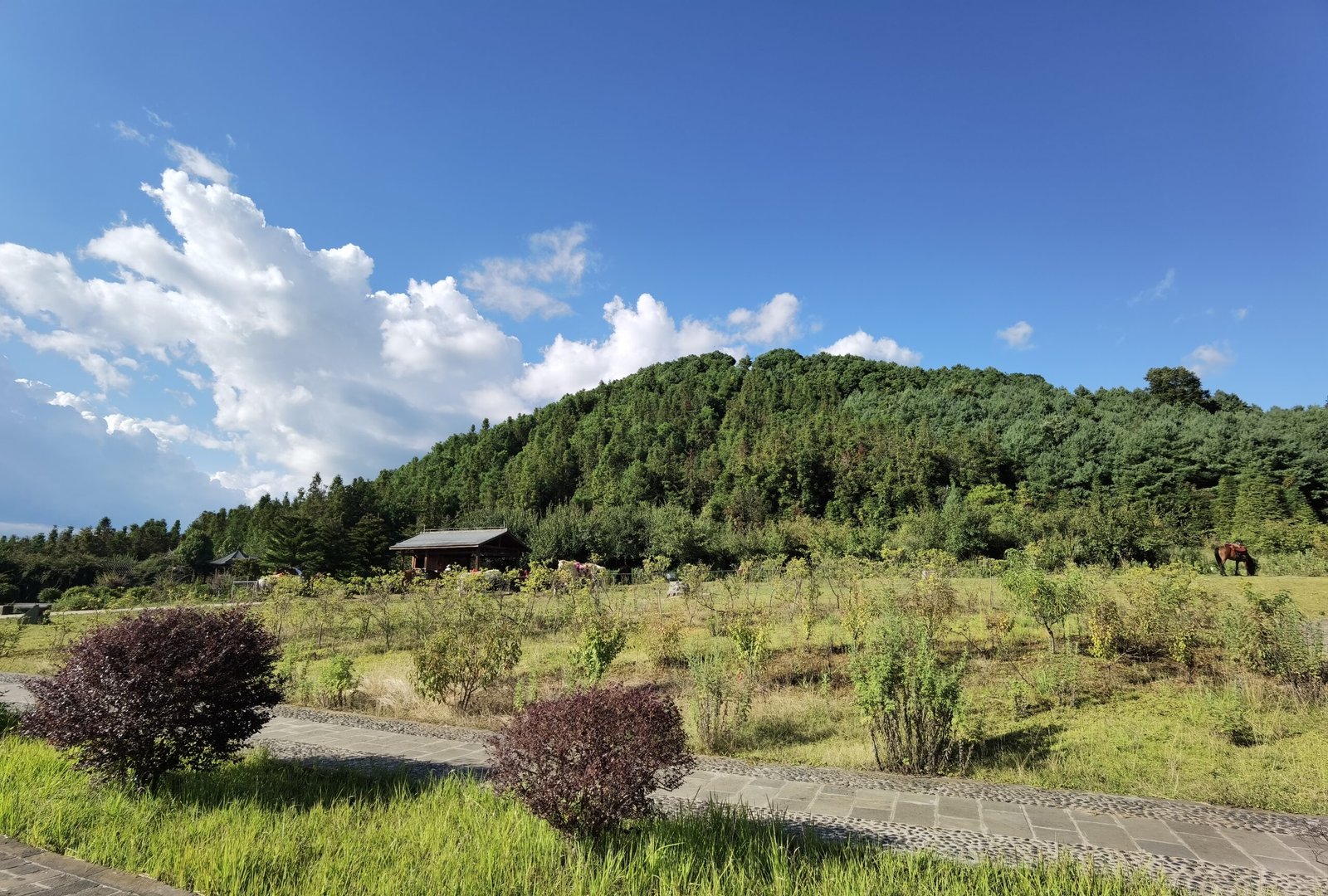
Managing expectations: these are grassy cones with a crater depression, not smoking peaks. The climb is a few hundred steps and takes about fifteen minutes. What makes it worth doing is standing on the rim and looking across at the other cones and the lava plateau, and then walking down into the crater, which gives you a sense of scale you cannot get from the road.
The better geological sight nearby is the columnar jointing at 神柱谷, where cooling basalt fractured into hexagonal columns and then was exposed by erosion, producing a cliff face that looks manufactured. If you have seen the Giant’s Causeway, this is the same process, and it is far less visited.
The field is geologically young and the ground under Tengchong is still hot, which is the connection to everything else in this article.
Rehai: the boiling ground
Rehai means hot sea, and it is the geothermal core of the region, about eleven kilometres southwest of the city. Water surfaces here at or near boiling, and the park is built as a walkway through a valley with several named features.
| Feature | What it is | Note |
|---|---|---|
| Big Boiling Pot (大滚锅) | A roughly circular pool of water at close to 97 degrees, boiling continuously | The centrepiece, and loud |
| Toad Mouth (蛤蟆嘴) | A vent shaped like an open mouth, jetting steam and water | The best photograph in the park |
| Pearl Spring (珍珠泉) | Gas bubbling up through a pool, so the surface looks like boiling pearls | Subtle, easy to walk past |
| Pregnancy Well (怀胎井) | A spring with local folklore attached about fertility | One of several named wells with folk stories |
| Drumming Spring (鼓鸣泉) | A vent that makes a rhythmic noise as steam escapes | Listen before you look |
The thing everyone does is buy a string of eggs. Local vendors sell eggs tied into mesh strings, you lower them into the steam vents or the edge of the boiling pool, and a few minutes later you peel them. It tastes like an egg, which is the joke, but the act of cooking food in a hole in the ground is exactly the point of the visit.
Practical note: the walkway is hot, wet, and steep in places, and the steam is genuinely scalding. Stay on the path. The park is at altitude and the combination of heat and humidity is tiring, so do this in the morning rather than at the end of a day of walking.
Which hot spring to soak in
Rehai is for looking. The soaking happens at developed bath complexes, and there are several, each with a different character. All of them are fed from the same geothermal system, and the water is mineral-heavy with a sulphur smell that you will carry in your hair for a day.
| Spring | Character | Price band | Best for |
|---|---|---|---|
| Rehai hot spring | Inside the geothermal park, so you bathe where you have just been walking | Higher | Convenience and the novelty |
| Lotus hot spring (荷花温泉) | A large complex of outdoor pools in a valley, well run | Mid to high | The best all-round option |
| Yongle hot spring | Local, cheaper, less polished | Low | Budget and a local crowd |
| Resort spas near the city | Hotel-attached, private pools available | High | A quiet soak without a crowd |
On etiquette and safety: swimwear is required in the public complexes, showers before entering are the norm, and you should not stay in water at 40 degrees or above for more than about fifteen minutes at a time, especially at 1,600 metres after a day of walking. This is the most common mistake visitors make here, and it ends with people feeling faint.
Heshun: the caravan town
About four kilometres southwest of the city, Heshun is why a lot of people come to Tengchong, and it is not like the other old towns in Yunnan.
Heshun was a departure point on the southern routes into Burma. For centuries men from these villages went 走夷方, walking to the lands beyond the border to trade cotton, jade, and general goods, and the money came back as houses, ancestral halls, bridges, and public works. The result is a town of grey brick courtyard houses, stone lanes, and a river with covered laundry pavilions built so that women could wash clothes out of the sun, which is a detail I have not seen anywhere else in China.
The library is the thing to see. Heshun Library was founded in 1928 by returning merchants and it became one of the largest rural libraries in the country, with a collection built up over decades and a building that has been expanded several times. In a village of a few thousand households, a library of that scale tells you where the wealth went.
The town charges admission and has been restored, and it does get tour buses. The counter to that is to stay overnight, because the evening, when the day visitors have gone and the residents are out in the lanes, is a different place entirely.
Jade, the Burma Road, and the war
Three parts of the border story, and the least comfortable of them is the one you should spend a few minutes on.
Jade is still a serious industry here. Tengchong has been a centre for Burmese jadeite trading and carving for a very long time, and the markets in town sell rough stone, carved pieces, and a great deal of glass. I would treat buying jade here as a specialist activity that requires a specialist, and browse rather than spend.
The Burma Road ran through this country, and the wartime history is visible in the town. There is a large memorial cemetery and a museum covering the 1944 campaign in western Yunnan, and the fighting in that year destroyed most of Tengchong’s old city, which is part of why Heshun, a few kilometres out, is the historic town that survives. It is a heavy site and I would not call it an attraction, but visitors who skip the town’s history miss the reason it looks the way it does.
On the food: the border shows up in the kitchen as well. The regional picture is in Yunnan cuisine, and the caravan-trade side of the food history is in Silk Road food.
Season, and the ginkgo village
| Season | Months | What it is like | Verdict |
|---|---|---|---|
| Dry autumn | October to November | Clear skies, warm days, and the ginkgo turning gold in mid to late November | The best window, and the busiest for domestic tourism |
| Winter | December to February | Mild days around 15 C, cold nights, and hot springs at their best | My pick. Fewer people, and the springs make sense |
| Spring | March to May | Rhododendrons on Gaoligong, comfortable walking | Good for trekking |
| Monsoon | June to September | Heavy rain, landslides on the mountain roads, low cloud | Avoid if you can |
The ginkgo village at Gudong is a genuine event. Ancient ginkgo trees stand among the houses, and for a few weeks in November the whole village goes gold and is packed with photographers from across China. Go on a weekday, arrive early, and accept that you will be sharing it.
Also worth a half day: Beihai Wetland, a shallow lake north of the city covered in floating mats of vegetation that you can be punted across, and the Gaoligong range to the east for anyone interested in birds and trekking.
Getting there, and what to know on the ground
Tengchong Tuofeng Airport has flights from Kunming of around an hour and a quarter, with some direct services from other Chinese cities depending on the season. Flying is the sane option for most visitors.
By road, the drive from Dali takes around four to five hours via Baoshan, and from Kunming it is a long day. Rail has reached Baoshan on the Dali to Ruili line, and the continuation toward Tengchong has been under construction, so verify the current position before you plan around it rather than assuming there is a train.
Within the county, hire a car and driver for the day. The sights are scattered across twenty or thirty kilometres and public transport between them is slow. Expect to pay several hundred yuan for a full day.
Two notes. The town is at 1,640 metres, which is comfortable for almost everyone, and the sun at this latitude and altitude is strong. And carry cash: small vendors, village admissions, and the egg sellers at Rehai take phone payment, but having notes makes everything faster. For the regional climate picture across the province, see China weather.
If you are routing this into a wider Yunnan trip, Dali travel guide covers the obvious staging point four or five hours east, and Xishuangbanna is the other direction if you want tropical lowland instead of volcanic upland.
Quick facts
- Tengchong sits at about 1,640 metres in western Yunnan, roughly 60 kilometres from the Myanmar border.
- The volcanic field has dozens of cones, three of which are developed with stairways to the rim.
- The Big Boiling Pot at Rehai is a pool at close to 97 degrees. Vendors sell strings of eggs to cook in the steam.
- Heshun Ancient Town, four kilometres out, was a departure point for caravans into Burma and has a library founded in 1928.
- Best months are November for the ginkgo and December to February for the hot springs.
- Flying from Kunming takes about an hour and a quarter; verify rail status before planning around it.
- The 1944 fighting in western Yunnan destroyed much of the old city, which is why Heshun survives as the historic town.
- Limit soaks in the hottest pools to about fifteen minutes at a time.
Frequently asked questions
How many days should I spend in Tengchong?
Three full days. One for the volcanoes and Rehai, one for Heshun and the town, one for the ginkgo village or Beihai Wetland plus a soak. Two days works if you cut the wetland.
Is it safe to visit given the border location?
Yes. Tengchong is a domestic Chinese tourist destination with no restrictions on visitors, and the border area beyond it is not open to casual travel. Check current travel advice for the wider region before you go, since border policy can change.
Can I see an active eruption?
No. The field is dormant to extinct in human terms, and what you get is cones, craters, and hot ground rather than lava. The drama is geothermal, not volcanic.
Is the water safe to drink from the springs?
No. It is mineral water at near boiling with a high mineral content, and some vents contain unpleasant elements. Cook with it if you like, do not drink it.
What should I eat?
The local rice noodle dish er si, the stir-fried rice cake dish known locally as 大救驾, clay pot stews, and pine pollen cake. The border influence shows up in sour and herb-forward dishes that taste closer to Burmese cooking than to central Yunnan.
Do I need a guide?
Not for the main sights, which are well signed. You do want a driver, because the distances matter. A guide helps for Heshun’s history and for any trekking in Gaoligong.
How crowded does it get?
November is busy, Chinese public holidays are very busy, and the rest of the year is comfortable. Heshun in the evening is quiet almost always, which is the best argument for staying in the town rather than the city.
Can I combine it with Dali and Lijiang?
Yes, with a road transfer of four to five hours to Dali, and it makes a good contrast to the more visited northwest of the province. Most people do Kunming, Dali, Tengchong, or Kunming, Tengchong, Ruili.
What is the one thing not to miss?
Heshun Library. Not the volcanoes, not the boiling pool. A village library of that size, funded by caravan traders in 1928, tells you more about this border country than any of the scenery does.
Plan a western Yunnan route
Tengchong pairs well with Dali and with the lowland south, depending on the season, and it needs more transport planning than the usual Yunnan loop. If you want a route that fits it into your dates without wasting a day on a bus, tell us when you are going on our contact page and we will build a custom food-and-travel plan for you.
Written by the ChinaTravelFood editorial team.